After being drafted on 1 April 1943, Donzelli was assigned to the Coastal Guard Corps in Corsica, where he completed military training until the armistice of 8 September. Afterwards, his company was transferred to Santa Teresa Gallura in Sardinia. From there, they began a long march on foot along the coast toward Alghero. The soldiers slept under the open sky and relied on shepherds and farmers they met along the way for food and shelter.
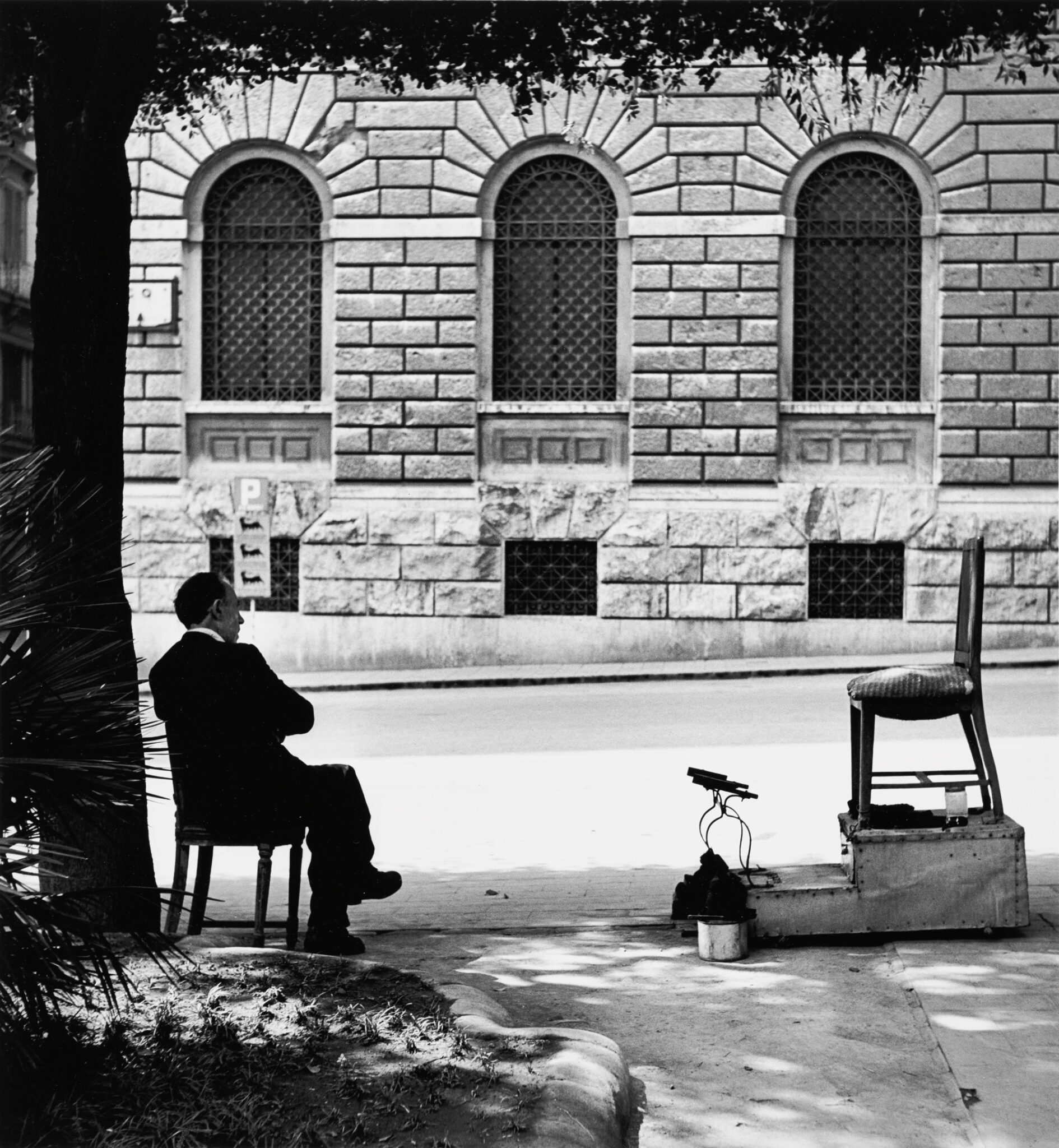
© Renate Siebenhaar, Pietro Donzelli Estate
In February 1944, the company was transferred to an American camp. There, Donzelli and his comrades were tasked with breaking stones for the runways of the “Flying Fortresses.” After completing military training in the American camp, the company boarded the cruiser Garibaldi in Cagliari in April, disembarked in Naples, and, after a short stay, was sent to the front at Monte Cassino.
For Donzelli, this marked the beginning of a different war, one completely unlike the one he had experienced in Corsica. His company was attached to a Polish division and assigned the task of transporting ammunition and supplies to artillery positions at night, while American forces deployed white-phosphorus mortar shells and the guns of the Royal Artillery bombarded the centre of Cassino.
The inferno of fire ended in mid-May. Then began a long march northward in the wake of the Allied troops.
The march continued northward with the Allied troops. After a first stop in the recently liberated city of Rome, the journey proceeded in stages through the devastated towns of Tuscany and Emilia-Romagna to Predappio on the so-called Gothic Line. There, the offensive against the Wehrmacht turned into a patrol war in which thousands of Italian soldiers lost their lives. They were killed in ambushes or blown apart by mines buried along roads and farmyards.
The survivors were responsible for transporting the wounded to the field hospital in Predappio. At night, they sewed the dead into jute sacks and buried them in the cemeteries of the surrounding villages.
In December, Donzelli’s company was reorganized and transferred to Rimini. From there, they continued toward Ferrara. In April 1945, they reached Pontelagoscuro, a village on the Po Plain, where they were confronted with the horrific sight of mutilated bodies drifting in the river.
After the end of the war in May 1945, Donzelli returned home and resumed his work as a technical draftsman at SIRTI, a telecommunications company in Milan, where he had been employed since the age of sixteen. Instinctively, he turned back to photography, seeking to give form to the existential chaos of his wartime odyssey. He later wrote:
“The war left deep scars within me. The almost daily confrontation with death and the compromises necessary to defend the right to survive drove me, in search of images, to communicate my emotional state, my feelings, and my thoughts to others. Guided by instinct, I tried to use the camera for this purpose.”
Convinced that he would find like-minded companions among amateur photographers, he joined the Milanese Photography Circle in September 1946, a place that had been known in the 1930s for passionate experimentation and research into photographic language, closely linked to the European avant-garde.
However, the war and the bombings of Milan had not only taken away the members’ enthusiasm for research; they had also led them to suppress the tragedy they had experienced. As Donzelli later observed:
“Within the Circle, people talked endlessly about technique. Young people discussed the importance of modern photography and all sorts of things related to it. In their photographs there was no trace of the great tragedy that humanity had endured.”
In 1947, the Italian photographer Guido Pellegrini published an article in the Bollettino Quindicinale del Foto Club Italiano. Already a member of the Milanese Photography Circle before the war, he appealed passionately to photography enthusiasts to interpret the drama of the postwar years using the expressive power of photography. He argued that photography was capable of capturing the profound transformations of consciousness and existential experience:
“Have we not fought to recognize photography as a force of expression? To make us aware of incomparable personal experiences and their style? Yet photographers continue to retreat into idyllic bouquets, magical still lifes, peaceful views, and landscapes, continuing to preserve the image of man detached from social reality.”
Donzelli shared this criticism. For him, it was difficult to understand why, after the war and the catastrophic upheavals of the twentieth century, so many photographers still devoted themselves to flowers, still lifes, butterflies, and picturesque landscapes as if nothing had happened. If such forces as war and destruction had truly affected people, he argued, they must also have left traces in photography.
This conviction led him to reject the aestheticism of photographic salons and to search for a photographic language capable of confronting reality directly. Rather than photographing an idealized world, he wanted to use photography as a means of seeing and understanding the human condition in the aftermath of war.
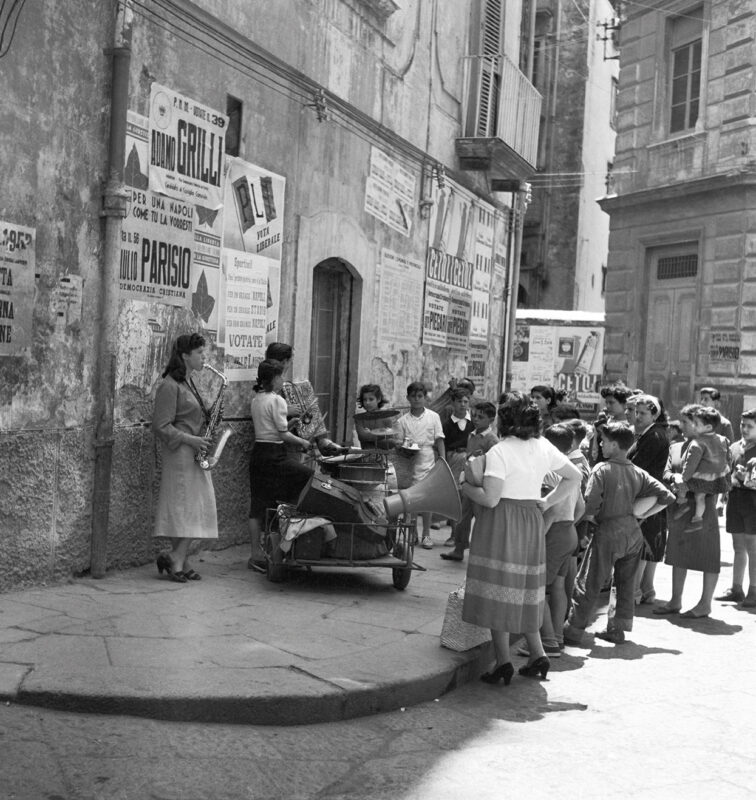
© Renate Siebenhaar, Pietro Donzelli Estate
The amateur photographers, however, had no intention of changing the course of the past. They preferred to devote themselves to photographic aesthetics, to proven genres such as landscapes, portraits, still lifes and to increasingly sophisticated physical-chemical processes. During a visit to Turin in 1947, Donzelli attended an exhibition organized by the Società Fotografica Subalpina, to which he had been invited to participate.
In a letter to Aurelio Bonori, president of the Association of Professional Photographers of Bologna, he expressed his disagreement:
“It is my personal opinion that an exhibition should do more than simply document achievements; it should also include works that strive toward a new kind of expression. Apart from Moncalvo, the only artist with truly modern tendencies, we encounter the same amusing scenes, the same views of the cathedral, and the same still lifes, in which all attention is devoted to precision in shooting and the quality of the print, while the most important thing has been forgotten: the subject. As for my impressions, I can honestly say that I found nothing exceptional. Even some of the most renowned names in photography, such as Cavalli, Vender, Facchini Stappo, stayed away from the exhibition.”
Shortly afterward, he learned the reason why several of the most important Italian photographers of the 1930s had chosen not to participate. Giuseppe Cavalli, Ferruccio Leiss, Mario Finazzi, Federico Vender, and Luigi Veronesi had decided to distance themselves from the amateur photography circles and continue the research they had begun before the war. They founded an independent group called “La Bussola” (The Compass).
In April 1947, they published a manifesto in the magazine Ferrania, outlining their aesthetic beliefs:
“We believe in photography as art. One can create poetry with a camera just as with a brush, chisel, or pen. But with the camera one must transform reality into imagination. This is the indispensable first condition of art. From this premise follows an important consequence: photography must free itself from the dead binary opposition between documentation and art. Photography must document our own time, for example, the ruins of war, but it would commit the same surprising error as a writer who wished to portray a historical event while forgetting that art is concerned not only with the event itself, but also with the subject who experiences it, and even more with the sky above the subject.”
Influenced by the aesthetic philosophy of Benedetto Croce, according to which the aesthetic fact lies in form rather than content, and unwilling to confront the realities of the postwar world directly, the members of La Bussola chose to place their photographic aesthetics under the protection of “artistic beauty.”
Donzelli, by contrast, pursued a different goal. He wanted to bring photography down from the heavens to the earth, immersing it in the flow of life and material reality. Inspired by the documentary style of Italian Neorealist filmmakers, he sought to place the “ordinary person”—the “man without adjectives,” as writer Elio Vittorini had described him, at the centre of attention.
This is precisely what he emphasized in his letter to Bonori: “The most important thing in photography is the subject.”
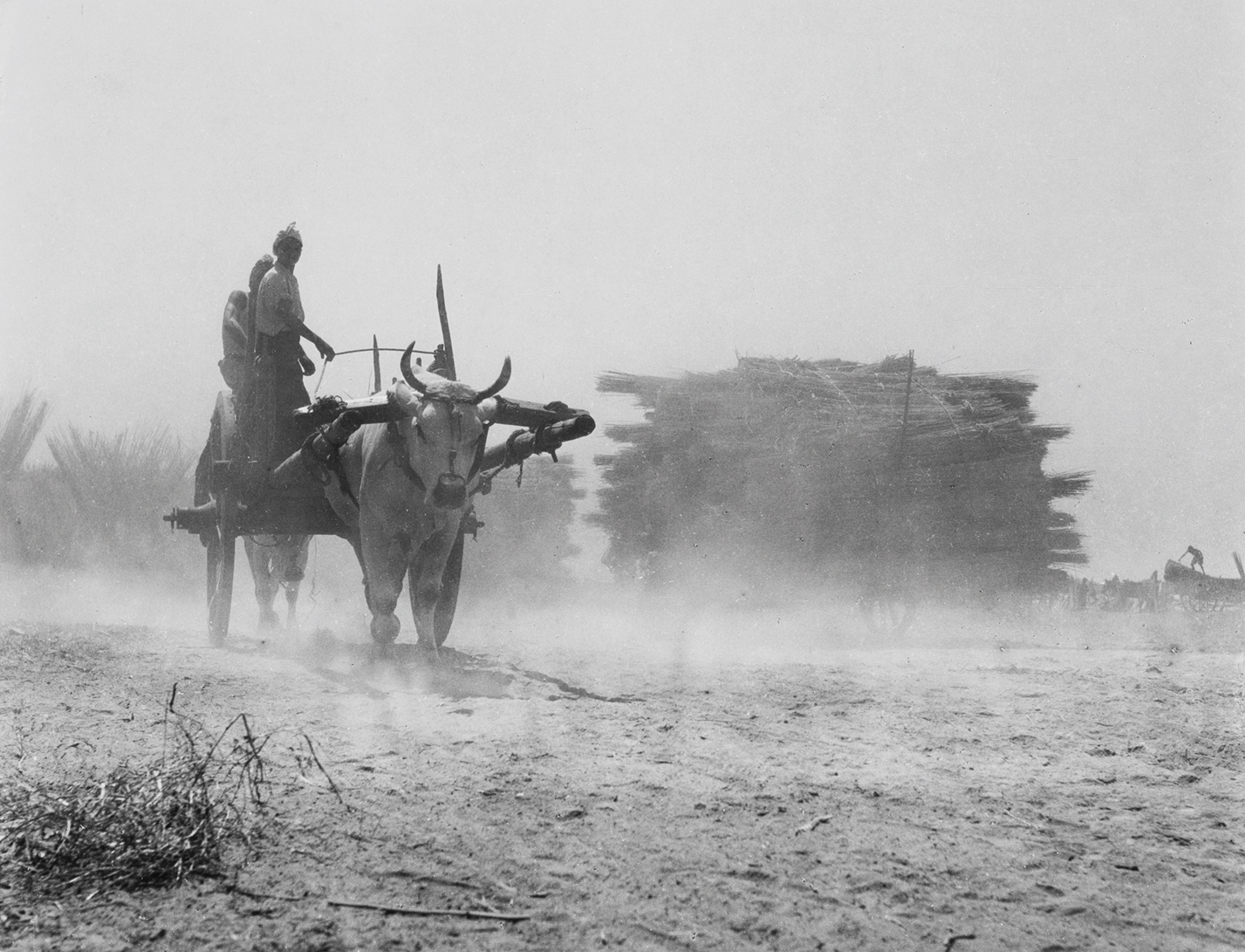
© Renate Siebenhaar, Pietro Donzelli Estate