Ferrari, the pioneer and still today the titan among exclusive sports car brands, has its headquarters in Maranello, seventeen kilometers south of Modena. A few kilometers farther away, in Fiorano, lies the test track, many simply call it Ferrari’s private racing circuit. Maserati, originally founded in Bologna, has been building its cars in Modena for generations and today, as part of the Fiat group, operates from a large modern factory. Lamborghini, once a tractor manufacturer and now a Volkswagen subsidiary, is based in Sant’Agata Bolognese. Pagani, the youngest marque, is located a few kilometers farther south in San Cesario sul Panaro.
Today we intend to explore this holy grail of the automotive elite, a kind of cultural summit of automobilism. Our first destination is the newly built museum at the original workplace of Enzo Ferrari, the epoch-making racing driver, industrialist, automobile magnate, and style icon for everything that wishes to move on four wheels both beautifully and quickly.
Before heading toward the industrial district north of Modena, our route leads through the villages of Acetaia Villa San Donnino, which had been warmly recommended to us, south of the old archbishop’s residence. It is one of those rural production sites where “traditional” balsamic vinegar is made, meaning grape juice is transformed directly into vinegar over months and years, slowly and without adding wine vinegar.
True original balsamic vinegar develops without alcoholic fermentation. The sugar molecules of the cooked and thickened must from white Trebbiano and red Lambrusco grapes oxidize directly into acetic acid. The barrels, made from different woods such as oak, chestnut, juniper, mulberry, and others, in which this process takes place over at least twelve years, always remain open at the top, protected only by a cloth against dust and falling dirt.
In the meantime, a large part of the originally prepared liquid evaporates, which makes the remaining product all the more expensive. A tenth of a liter, Balsamico Tradizionale is sold only in a few little bottles designed by the famous automobile designer Giugiaro, usually costs well over 100 euros.
Francesca, the 22-year-old niece of the owner, explains the production process to us. Her tour begins in the attic. There the barrels are stored, the largest holding barely fifty liters, because the strongly fluctuating temperatures regulate and optimize the fermentation process. In the summer heat everything evaporates that has no place in balsamic vinegar. In winter, at temperatures just above freezing, all chemical reactions come to a standstill. Salts, sediments, and other solids precipitate out, and the vinegar has time to settle.
The years-long process depends entirely on the microclimate in the low-ceilinged rooms, which must be meticulously regulated by the vinegar maker, through fresh air or humidity, but never through air conditioning. At the end of the tour we are allowed to taste the precious, almost black concentrates and are astonished that traditional balsamic vinegars taste milder and more aromatic than all the vinegars we know from our gourmet shops back home. Less sharp, although they possess a higher acid content. But they contain no wine vinegar.
The Ferrari Museum in Modena is grand spectacle on a grand scale. Its owner, famous less for modesty than for being a 16-time world champion marque and the most successful racing stable in the highest class of motorsport, calls the 5,000-square-meter building designed by the British architect Jan Kaplický “a temple of automotive culture,” in which homage is reverently paid to the legendary Commendatore, the Italian equivalent of a commercial privy councillor, Enzo Ferrari himself.
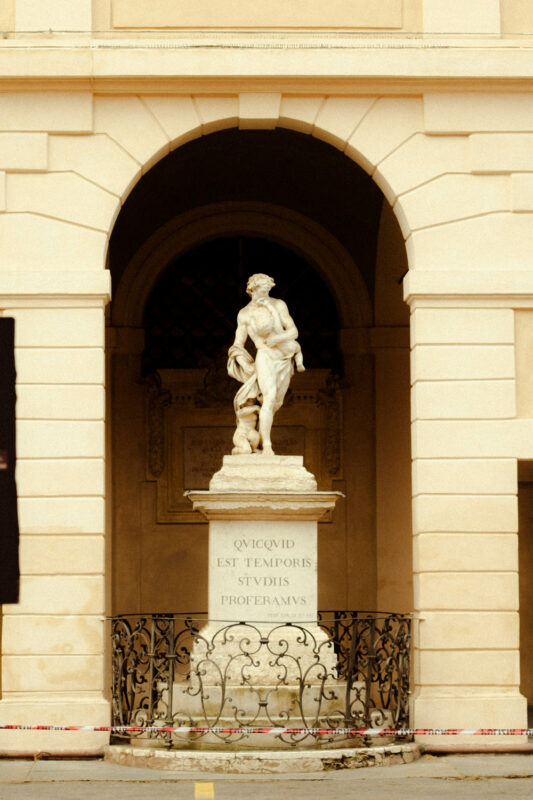
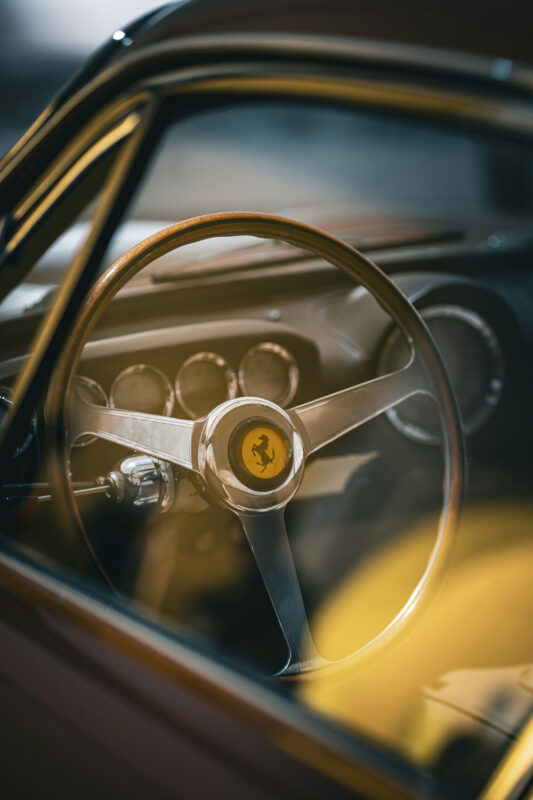
His conference room and offices were recreated in the neighboring building, originally the forge and locksmith workshop of Enzo’s father, faithfully according to the original.
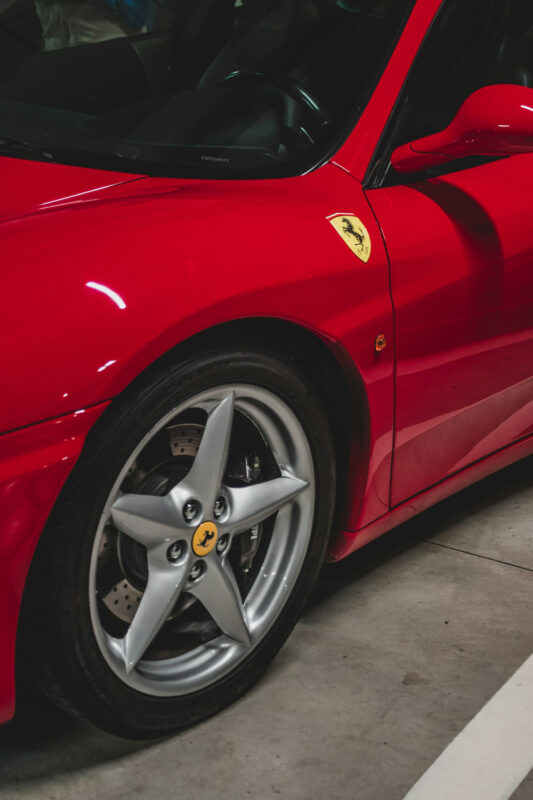
We admire the temporary exhibition in the great hall, tracing the development of the super sports car from the Model F40 of 1987 through the F50 and Enzo to the LaFerrari, the brand’s current flagship. But also on display is the elegant “500 Superfast,” of which only 36 examples were built from 1964 onward. Its 12-cylinder engine delivered the then unheard-of performance of 400 horsepower and justified the model designation with a top speed of 280 kilometers per hour. Even during its production years the coupé cost twice as much as the then-current Rolls-Royce Silver Cloud limousine.
In the neighboring building, where besides memorabilia of Enzo Ferrari mainly technology is exhibited, suspensions, engines, and complete drivetrains from racing and road vehicles, the crowds of visitors are noticeably smaller.
Next we look at the Stanguellini collection, the exhibition of an almost forgotten family business which between the late 1930s and the 1960s primarily built featherlight racing cars with small four-cylinder engines. Sixty years ago these machines were already capable of producing 100 horsepower from 750 cubic centimeters and competing successfully in Formula 2.
In 1960, the year Fellini’s greatest film success, “La Dolce Vita,” was released, the team was able to field its star, Marcello Mastroianni, as a driver for the Monza race. They accelerated their cars, weighing only 400 kilograms, to over 220 kilometers per hour, thus participating in the 24 Hours of La Mans, dominating the racing class at the Nürburgring, and even achieving a one-two-three finish at the Monaco Grand Prix. Yet the company had to give up in 1965. The era of the small, light racing cars, designed and assembled independently, was definitively over. From then on, only those who had the nine-figure fortune of a sponsor or the budget of a multi-car manufacturer behind them could survive in international competition.
The Stanguellini collection is housed in the former Fiat dealership that supported 3 generations of the family. Right at the entrance stands the Fiat Tipo Zero, which great-grandfather Francesco, then a manufacturer of heating stoves, bought at the World Fair in 1908 and with which he founded his family’s passion for automobiles. The license plate simply reads “1 MO,” the first automobile in Modena licensed for road traffic. According to our museum guide, the car still runs today and is occasionally driven in vintage-car events.
The real attraction of the exhibition, however, is the racing cars: the Delfino model from 1962 with an aluminum body identical to the Ferrari racing cars of that season; the Formula Junior from 1958 with internally ventilated drum brakes; the aerodynamically optimized Colibri from 1963; and the Barchetta d’Oro with its three front headlights, which in 1947 competed in the Mille Miglia. All the cars are so tiny that passengers taller than 1.70 meters can barely fit inside. Everything is openly exposed, intake pipes, exhaust manifolds, fuel and brake lines, cables, all in the striking signal red once seen only on Italian racing cars. Nowadays even lipsticks shine in comparable shades.
The Stanguellini collection can only be visited by appointment. Today we are the only visitors. Our guide, a wiry retiree, formerly worked as a mechanic at Stanguellini and speaks enthusiastically about the company’s history, about how it repeatedly achieved success in international competition. He is proud of every screw he can show us, every tool, every machine, and takes time for each of our many questions.
We leave Modena heading southwest. Even today the sun burns mercilessly over the Po plain, bathing the enormous fields of corn, wheat, and rice in a diffuse flickering light. The eye finds occasional rest only in a row of hedges or a poplar avenue. In the east, near the delta, this northern Italian river landscape reminds us of the Mississippi. Today we feel almost as though we were in Texas, especially as large herds of cows graze between the fields again and again on dusty pastures. From their milk come the world-famous cheeses of the region, Parmigiano Reggiano, Reggio nell’Emilia is one of the larger cities nearby, and Grana Padano, “the king of the Po region.”
For almost an hour we wander about in the utterly flat and featureless landscape between widely scattered farms. The approach to his estate, our next host had instructed us over the telephone, branches left from the country road at a large elderberry bush. But the entire route seems lined with large elderberry bushes. And where exactly is “left”? Does the description apply when approaching from the west or from the east? We have already driven up and down in both directions on nearly all the little roads that cross the irregular checkerboard of fields and meadows at right angles.
At last we discover a tiny signpost and arrive at the farmstead “Hombre.” Around 500 cows live here and provide the milk for the production of organic Parmesan, which according to the strict legal regulations governing the cheese specialty must mature on site for at least twelve months, and depending on quality grade up to thirty-six months, before delivery to wholesalers.
We park Papa Leone in the shade of a tree at the rear end of a dusty square. The scenery looks like the opening sequence of an Italian western. It smells of sour milk and manure. Flies buzz everywhere, somewhere behind a corner someone shuffles past in rubber boots. Occasionally an animal lows.
The farm takes its name from the founder’s nickname. Before entering motorcycle production at Maserati in 1953 as a management employee, he had worked in Venezuela. When he later established a cattle ranch in the countryside around Modena modeled after South American examples, his neighbors called him by the Spanish word they considered fitting for a rancher.
Besides Panini, whose correct name was “Hombre,” he was also an automobile enthusiast. In 1969 he acquired a private collection consisting of nineteen models. Today around fifty bodies, just as many historic motorcycles, and around a dozen vintage tractors belong to his son Giovanni, who now leads us through the exhibition in one of the large utility buildings of the estate.
Noodles Make You Happy
If, despite all the sophistication and refinement of culinary culture in the Italian regions, there is perhaps something like a “national dish” among the people between the Brenner Pass and the island of Lampedusa, then it can only be the many varieties of pasta dishes. In the traditional sequence of courses of cucina italiana, they appear as primo piatto, the first substantial course.
Usually the boiled and drained pasta (pasta asciutta) is served in small portions with a sauce, often additionally seasoned with herbs and cheese. As early as the twelfth century, long before the Venetian Marco Polo could encounter Chinese noodle culture on his journeys to the Far East, the Arab geographer al-Idrisi described boiled dough products that were eaten in Sicily alike by Christians and Muslims, the oldest known source concerning the enjoyment of pasta.
Literally translated, pasta first simply means dough. In Italy noodles are traditionally made only from durum wheat flour or semolina, a southern European grain variety. Its kernels contain more protein than northern European varieties. Durum wheat therefore binds better when mixed with a little water. Soft wheat, on the other hand, is more suitable for baked goods; its dough rises more easily with yeast or other leavening agents.
In addition, in Italy pasta varieties made from egg dough are also produced, for example broad tagliatelle or fettuccine, which without the additional binding effect of egg components would fall apart during cooking like German ribbon noodles made without eggs. The wrappers for tortellini, ravioli, and other filled pasta varieties are likewise made with eggs for reasons of tear resistance and firmness.
Finally, there are also pasta varieties made from potatoes: gnocchi. And for all varieties there applies the advertising slogan of a German pasta manufacturer from the 1960s: “Noodles make you happy!”
While French haute cuisine can draw upon more than three hundred registered cheese varieties, Italy possesses a similarly rich abundance of pasta forms at the high level of its culinary culture. Beginning with the simple spaghetti, in their thinnest form known as capelli d’angeli, angel hair, through the hollow tubes of macaroni (maccheroni), penne, rigatoni, and tortiglioni, to the twisted fusilli or gemelli, the folded farfalle, or the concave orecchiette and conchiglie, which as conchiglione are gladly served with fillings.
Pasta production in Italy became almost completely industrialized over the course of the twentieth century. The largest producer is the family company Barilla, which in 2014 employed around 8,100 people and generated more than 3.25 billion euros in revenue, half of it from noodles and matching sauces. Barilla’s largest pasta factory stands near Parma directly on the Via Emilia. In a production street 120 meters long, thousands of tons of pasta are produced there daily, 8 to 10 million portions.
As a Maserati manager, Signor Panini primarily bought cars of his own brand. Today his collection is famous for such rare pieces as the one-off concept study later developed into the Boomerang model. Or for the AC model that participated in the Mille Miglia in 1953. Of its especially elegant bodywork, designer Pininfarina produced only two examples. Hombre’s exhibited Quattroporte Royale served in the 1980s as the last official state vehicle of Italian president Sandro Pertini.
The highlight of our extensive tour is the driving demonstration of a Maserati Ghibli. The large eight-cylinder engine starts effortlessly, “con un pochino di choke,” Giovanni comments, but at first the machine sputters and smokes heavily. It takes a few minutes before the cold engine responds properly to the accelerator and pushes the large vehicle blusteringly out into the open air. The exhaust cloud left behind in the exhibition hall smells strongly of leaded gasoline.
From the collection Giovanni next takes us into the cheese dairy, where additional visitors to the “Hombre” ranch are waiting to tour the milk-processing operation. Five thousand Parmesan wheels, each weighing at least fifty kilograms, are stored here in high shelves, turned and washed by robots, though still regularly cleaned by hand with salt brine. During the first year of its aging process each wheel loses around twenty percent of its mass: water evaporates, the cheese flavor becomes concentrated.
We are allowed to taste the different quality grades, aged one, two, or three years. Around eighty percent of Parmesan production goes to the United States.
After this automobile-saturated day in the Po Valley, fortunately it is not far to Parma. The dome above the crossing of the cathedral here displays a spatially sophisticated fresco by the Renaissance painter Correggio, “The Assumption of Mary,” while the façade of the octagonal baptistery beside it is entirely decorated with rose-colored Verona marble.
The wealthy industrial city has a generous pedestrian zone, and its inhabitants, much like those in Bologna, are often quite young. Around one seventh of Parma’s good 180,000 inhabitants study at the venerable university, founded in 1412. Several faculty, lecture hall, and institute buildings belong to the old town.
Thus we once again experience a lively evening. At dinner on an inn terrace overgrown with ivy and wild grapevine, where we order parmigiana di melanzane, slices of eggplant baked with Parmesan, we become acquainted with a group of young people. The pasta company Barilla has invited two dozen trainees from across Europe to a basic course at the company headquarters. Newly hired university graduates are supposed to become familiar with their future employer firsthand.
Later we end up on Parma’s main boulevard, the Via Farini. In the bar “Dolce Vita” we raise a toast to the name of the establishment.