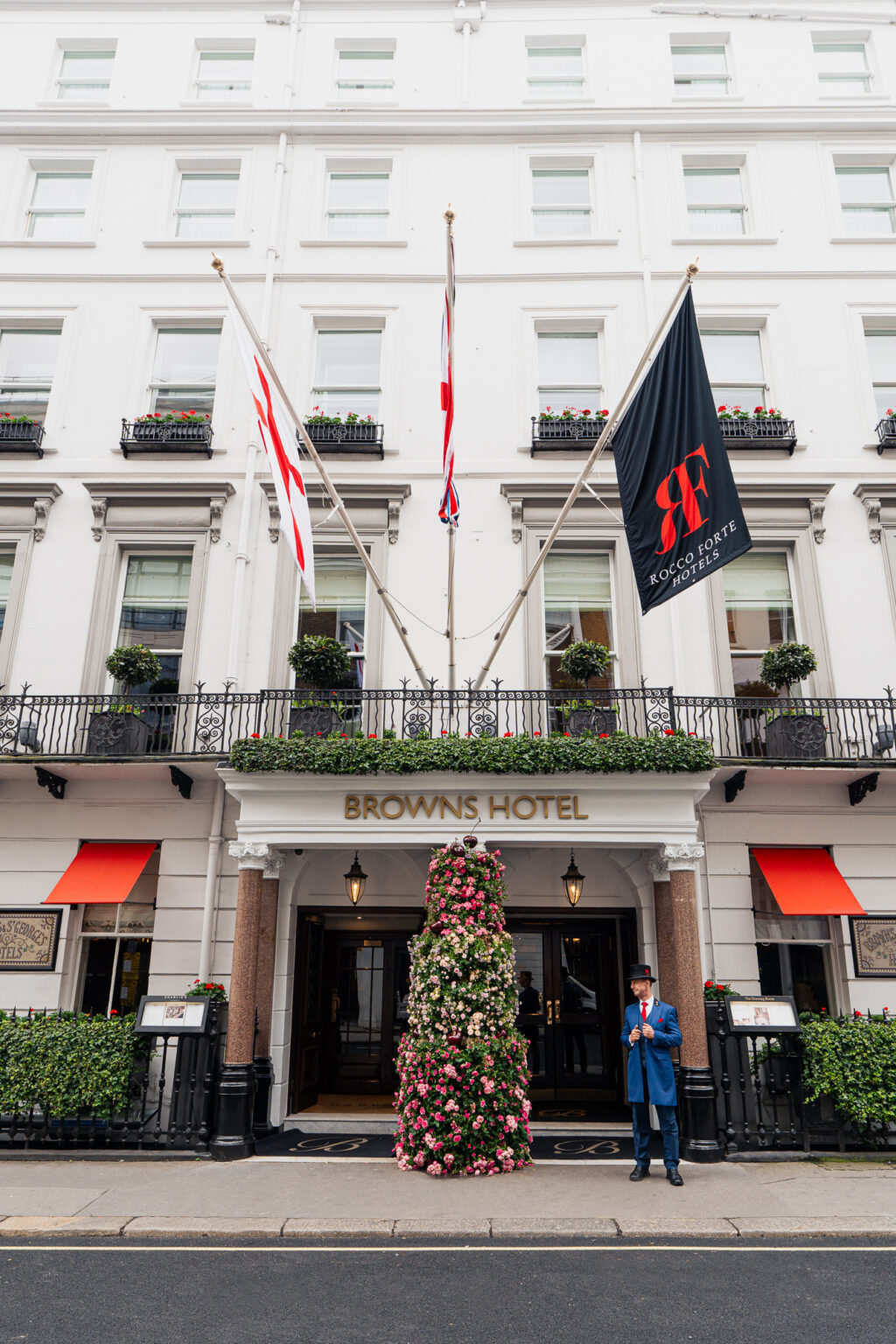

Step out of the car and a doorman in a top hat greets you—a small piece of theatre that promises nothing and implies everything. Albemarle Street stays quiet, almost discreet. Inside, the register shifts: low light, somewhere the touch of a piano. Spines of books line the walls, as though you had wandered by accident into a good club that had been expecting you.

The location
Mayfair is the quietest form of centre that London has to offer. Between Bond Street and Regent Street, a walk from Green Park and Piccadilly, lies Albemarle Street—once home to Byron’s publisher John Murray, and still home to the Royal Institution, which keeps Faraday’s legacy. Brown’s occupies eleven Georgian townhouses, merged into one without straightening the façade. From outside it is reticent: pale stone, narrow windows, a door with a man in a top hat before it. Anyone who doesn’t know what lies behind it walks straight past.

Backstory
Brown’s opened in 1837, founded by James Brown, a former valet, and his wife Sarah, said to have been in the service of Lady Byron—a hotel, then, dreamt up by people who knew the staff better than the masters. From here Alexander Graham Bell made the country’s first telephone call in 1876; Kipling worked on The Jungle Book here, and Agatha Christie took the house as her model. Since 2003 Brown’s has belonged to Rocco Forte Hotels. The tone is still set by Olga Polizzi, sister of the owner Sir Rocco Forte and the group’s Director of Design. She decorates every room individually and insists that, in these spaces, you sense you are in London. The effect is that of a family house that happens also to be a hotel.


Interior & architecture
Brown’s is really eleven Georgian terraced houses drawn together into one in the nineteenth century—which explains the wonderfully illogical geography of its corridors, the small changes of level, the doors that lead almost nowhere.

The rooms are tall and bright, with plaster cornices and genuine daylight. Olga Polizzi rebuilt the interiors from the ground up and has not stopped: in 2025, with Paolo Moschino, she designed three new suites borrowing from the architect Sir John Soane, complete with a concealed door and a Farrow & Ball wall colour.


The Kipling Suite wears wallpaper by Lewis & Wood, silk by Manuel Canovas, furniture by Julian Chichester. British art everywhere, British novels on the shelves, and in the Donovan Bar the photographs of Terence Donovan. Antiques beside the present day, with neither overpowering the other.

A look inside
Behind the lobby the house arranges itself almost casually: The Drawing Room for tea, Charlie’s for dinner, the Donovan Bar for afterwards, the spa for the morning, and six rooms for private dining, each named after a former guest. 115 rooms and suites, no two alike.

The beds are meant seriously—a mattress and pillow menu, sheets of Egyptian cotton or Irish linen. In the suites a screen sits at the foot of the bath, which sounds briefly absurd and proves surprisingly welcome.


The Kipling Suite is the largest; the more recent one, fitted out by Paul Smith, collects vintage art and small impertinences. Comfort here means: you notice it only once it is gone.

Culinary
Brown’s had one of London’s first hotel restaurants—before that, guests dined in their rooms. Today it is called Charlie’s, after Lord Charles Forte, and is run by Adam Byatt, who earned his Michelin star south of the river. The twist: Byatt’s grandfather was a bellboy here in the sixties.

Next door, in The Drawing Room, the famous Afternoon Tea is served, a favourite of Queen Victoria’s: seventeen teas from the Rare Tea Company, scones, a pianist in the background. And in the Donovan Bar, beneath the photographs of Terence Donovan, the evening begins or ends over a cocktail. The cooking is British and seasonal, the ingredients sourced by hand—roast beef carved tableside from a silver trolley, venison en croûte, crab from Cornwall. The wood-panelled room, with its pictures by Kristjana S. Williams, is Olga Polizzi’s work.


Wellness & Relaxation
There is no pool, and the house makes no secret of it. The spa lies in the basement: three treatment rooms, one for two, low light and a silence that in Mayfair almost counts as luxury. The treatments use, among others, Irene Forte Skincare — the line by Rocco Forte’s daughter, its active ingredients grown on the family’s own estate in Sicily, which gives the whole thing a pleasantly concrete provenance.

Those who would rather sweat than rest will find a round-the-clock gym with Technogym equipment and, on request, a trainer. Relaxation here means above all retreat: a few steps below the noise of the city.


Surrounding area
Outside the door runs Albemarle Street, and at its end the Royal Institution with the Faraday Museum—the basement where electricity was half-tamed is open to visitors and usually empty. A few steps further begins the densest stretch of art in Europe. Cork Street is lined with galleries of contemporary work; at Gagosian on Grosvenor Hill hangs whatever is in the next catalogue; and at the Royal Academy it is the Summer Exhibition above all that rewards a visit, that cheerfully overcrowded wall of a thousand pictures. For something quieter, walk to the Handel Hendrix House on Brook Street, where two centuries and two geniuses once shared a party wall; in the evenings there are concerts in the original room.

At Sotheby’s on Bond Street the viewings are free—the most discreet way to inspect millions without bidding. For craft: the tailors of Savile Row, the barber Trumper’s on Curzon Street, the perfumer Floris and the cheesemonger Paxton & Whitfield on Jermyn Street. And for a stroll, the crooked little Shepherd Market, Mayfair’s last scrap of village.
Activities
For art lovers: Cork Street, Gagosian on Grosvenor Hill and Hauser & Wirth are all within walking distance, the Royal Academy in any case. At Sotheby’s and Christie’s the viewings are free—the most discreet way to look at millions.
For eaters: Charlie’s stays in-house. Venture out and you’ll find Gymkhana (Indian, starred) and Scott’s (fish) on Mount Street, plus the eccentric Sketch on Conduit Street, whose pink room is worth seeing once.
For walkers: Green Park begins at the end of the street, Hyde Park just beyond. On the way back, the glazed Royal Arcade right beside the hotel and the older Burlington Arcade, with its own liveried beadles, are both worth the detour.
For families: The Faraday Museum with real experiments, the Handel Hendrix House, the Royal Academy’s family days—and, because London is what it is, a ride on a red double-decker.

© Igor Sporynin on Unsplash

© Benjamin Davies on Unsplash
For shoppers and craft: the tailors of Savile Row, the perfumer Floris, the barber Trumper’s, the cheese of Paxton & Whitfield. Paul Smith keeps shop around the corner too, fitting for the suite that bears his name.
For night owls: first the Donovan Bar in-house, then the Connaught Bar a few streets away—and for anyone still going, Soho is within walking distance.
Details
- Rooms & suites: 115, each individually decorated. Largest suites: the Kipling Suite, the Sir Paul Smith Suite, and the new Forte Suites—Clementi, Clara Dow and Nightingale.
- Dining: Charlie’s (modern British, Adam Byatt); the Donovan Bar; Afternoon Tea in The Drawing Room (Rare Tea Company).
- Spa: three treatment rooms, one for two; treatments by Irene Forte, among others. Round-the-clock gym (Technogym), personal training.
- Meetings: six private rooms, each named after a former guest.
- Services: concierge, valet parking, airport transfer, 24-hour in-room dining, shoe-shine, laundry. Dogs welcome.
- Represented by: The Leading Hotels of the World.