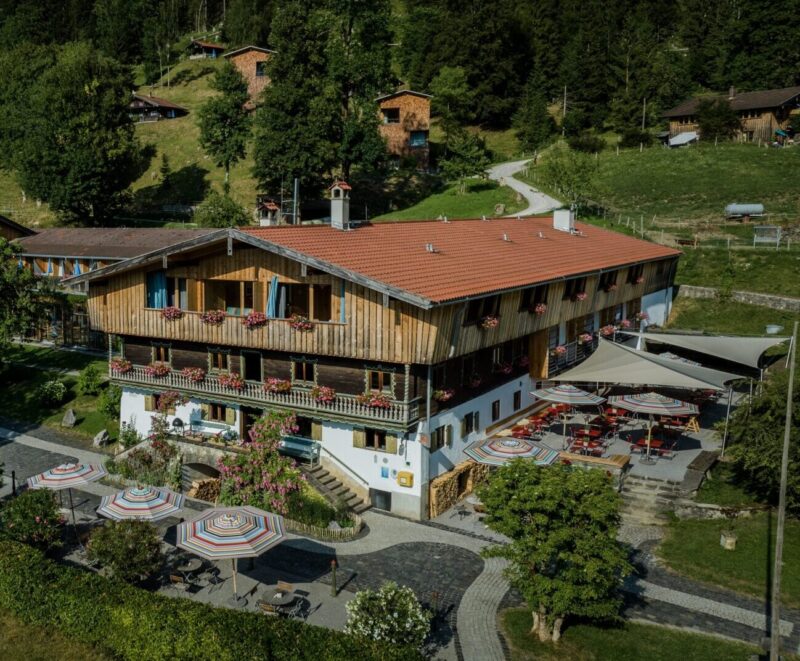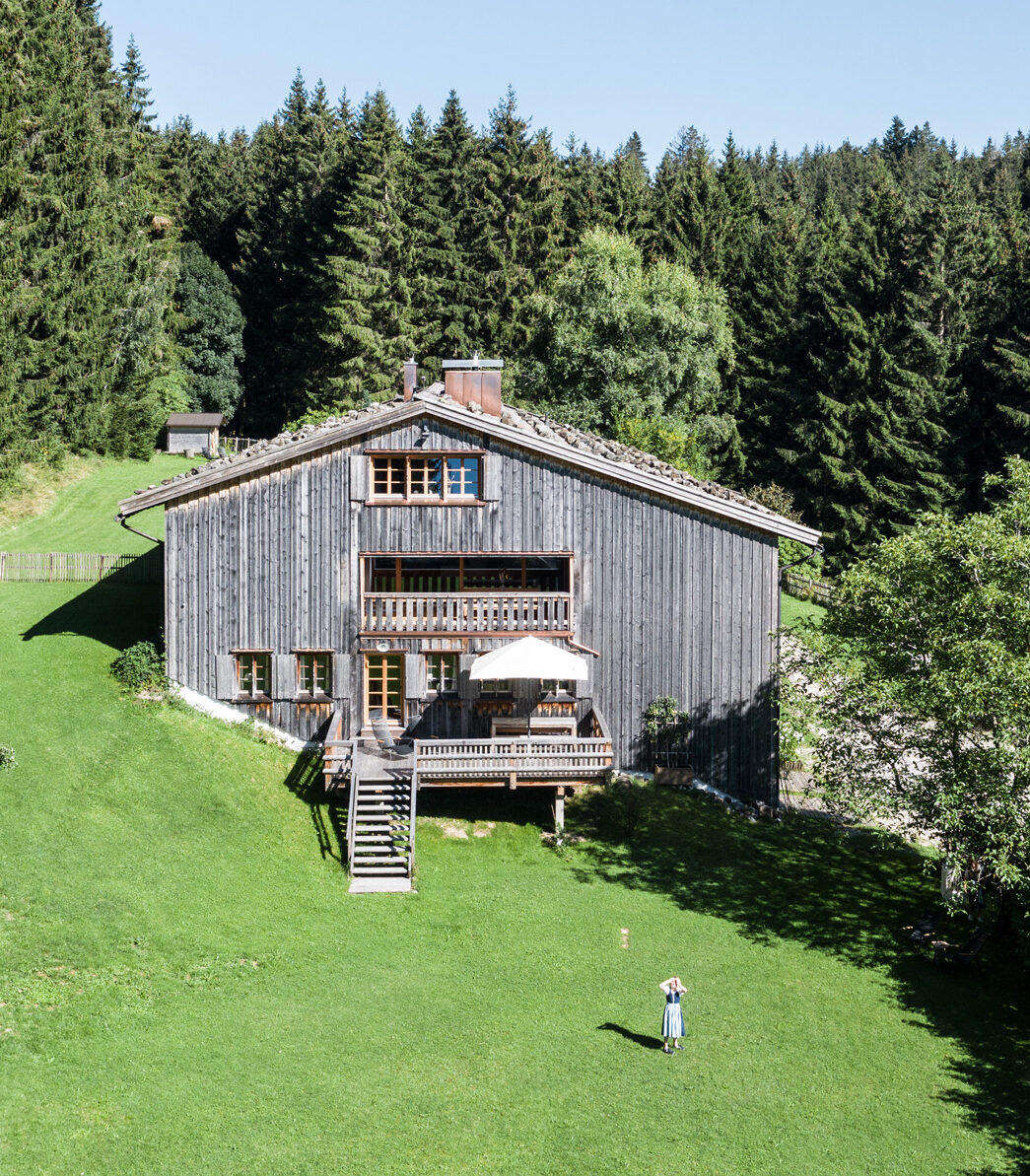

The forest smells cool and dark with spruce, and you walk for a while before anything happens. Then, without warning, the light breaks through the trees, and a clearing opens like the end of a sentence. The house has stood there for almost three hundred years, in the sun, as though it had been waiting for you—which, strictly speaking, is of course nonsense.

The Location
Grünenbach itself takes moments to cross – a few farms, a church, then the forest track begins. In summer you can drive almost all the way up to the clearing; in winter the car stays down in Riedholz, by the old drag lift with its self-pull T-bar and a tear-off ticket from the days before chip cards, while the luggage travels ahead by tracked vehicle and you yourself trudge through the snow on foot.

© Robert Kittl
Then, at the top, after the last bend between the trunks: a farmhouse with a weathered grey-brown, silvery-gleaming shingle façade, a coach house beside it, both ringed by spruce like a bodyguard that lets no one through who has not been invited.

© GT

© Ansitz Hohenegg
Backstory
Anna-Dina and Sebastian Priller lived in the centre of Augsburg, with the vague wish for a counterpoint to city life, and found Hohenegg in 2017 through a sale listing they had really only meant to view, so as to turn it down afterwards with a clear conscience. The clearing settled that plan within seconds.

The property belonged, curiously enough, to the state of Baden-Württemberg, despite standing in Bavaria, and was four days from the end of a public tender in which three proposals had made it to the final round: a yoga association, the Catholic Church, and the Prillers. Concept, proof of financing and drawings came together in two days, hand-drawn, delivered by courier shortly before the deadline. The family comes from Augsburg’s brewing and catering world; the long table and the hospitality have stayed with them, even though the brewery’s name appears nowhere on the house.

© GT

© GT
Interior & Architecture
The oldest part of the building, a farmhouse from the early eighteenth century, had a second roof drawn over the first in the 1980s, under the administration of the district authority—the silhouette stayed historic, the technology beneath it turned modern. A stroke of luck that the Prillers took over in 2018 and left as it was.


The carpenter Flori Heinle brought along around eight master craftsmen, each with an assistant; the agreement was that no decision would sit unmade for longer than twenty-four hours, and the beer was free—roughly 350 crates, by their own count. At times the Prillers slept on the building site, to sense which routes the rooms needed. New Brunner fireplaces were set into the old fabric so that they seem never to have left the house. Scattered among it all: the grandmother’s skis, hunting trophies, things with a provenance rather than off-the-shelf furnishing.
A Look Inside
Four apartments in total, no two alike. The Schindelhaus, almost three hundred years old, forms the core—hand-split shingles, low door frames, a floor plan that still remembers cattle once stood here. In the neighbouring coach house, once the stable and hay-loft wing, sit the three rooms Wipfelglück, Waldblick and Heuboden: loft-like, high ceilings, plenty of regional timber, with loden and leather in muted colours.

Names like Wipfelglück already give away which way you’ll be looking when you wake up. Each unit has its own kitchen, its own bathroom, its own retreat—meant for families who want to see each other, but not constantly. Beds, mattresses and pillows were chosen for whatever the hosts themselves had missed in other people’s holiday homes. The sauna area in the vaulted cellar is shared by all.


Culinary
There is no restaurant, but there is a Naschkastl—a self-service shop run on trust, stocked in arrangement with Susi from the village shop in Ebratshofen. The cheese comes from the Sennerei Rutzhofen, whose fondue blend, according to the hosts, settles any doubts about artisanal cheesemaking in the Allgäu, a region with industrial dairies alongside small producers, dairies happy to stage themselves as alpine huts.

Anyone wanting more drives to Kempten, to Jamei Laibspeis’ right on the market square, or to the Metzgerei Giray, which has a branch in Isny. For eating out, the Gasthof zum Bären in Eglofstal is worth recommending, a building around 700 years old with painted shutters: the chef came from starred kitchens and now cooks in a down-to-earth style, with noticeable precision. For catering, the Hirschen in Isny steps in, and anyone staying in the house can order a private chef the family knows, who promptly turns the sitting room into a restaurant, breakfast included.


Wellness & Relaxation
The vaulted sauna cellar is low, built of stone, and smells of wood and stone at once. There is no pool—and, surprisingly quickly, you don’t miss it either. After the steam session you step out into the cold of the forest, on some evenings straight into the snow, and in the garden a spring waits too, its water cold enough year-round that any mention of thermal baths starts to sound faintly absurd.

Relaxation here means silence, a fire, your own body heat measured against the forest’s, and a towel you hand yourself. Wellness in the original sense of the word, long before the word was invented and marketed.


Surrounding Area
Isny is the nearest place for anything practical, Ebratshofen with Susi and Wolfi’s village shop the nearest for anything neighbourly—both reachable on foot, if you’re so inclined. Anyone after a cool head finds one at the Eistobel, a gorge whose water ends any debate about cooling off, even at the height of summer; anyone wanting a longer swim turns to the quieter part of the Alpsee, to the Hengelesweiher, a clean moor lake, to the Burgwanger Weiher or the Waldbad Isny, and anyone who likes things historic finds, at Seltmans, a club-run outdoor pool that still looks like an outdoor pool and not a water park with a slide tower.

At the mountain huts of Königsalpe and Bergwiese there’s homemade cake and a hospitality that pointedly doesn’t concern itself with urban expectations, ice cubes for instance—anyone expecting sparkling water with a lemon slice will be disappointed here and, with a bit of luck, taught something better.


Lake Constance lies barely half an hour’s drive away; the house’s own boat can be steered towards Konstanz, Meersburg or a vineyard—the roads along the shore, meanwhile, stay exactly where they are: jammed. Ravensburg, Wangen, Kempten, Lindau and Bregenz are all within day-trip range, each town with its own tone, from Swabian thoroughness to Austrian nonchalance.
Activities
For multi-generational families: The Schindelhaus for the grandparents, separate apartments for children and grandchildren, the long outdoor table as a shared meeting point in the evening, the large garden for every age in between.
For the active: Cycling and hiking trails right outside the door, the new boat for trips on Lake Constance, circular routes to the small alpine huts nearby.
For guests seeking retreat: The solitary position on the clearing, anonymity without uniformed staff, the view over the forest from the loggia, discretion for managers and conductors just as much as for families.
For families with children: Water rockets made from PET bottles, the old fire hoses, the Polaris tracked vehicle in the snow, cheese and sausage from the Naschkastl for a snack on the go.
For winter: The historic drag lift with its T-bar and tear-off ticket, the car-free, silent snow outside the window, a fire instead of fireworks on New Year’s Eve.


For those who like to indulge: The cheese from the Sennerei Rutzhofen, the Gasthof zum Bären in Eglofstal, the private chef the family knows on request, the honesty-based Naschkastl.
For water lovers: The Eistobel for a quick cool-down, the quieter part of the Alpsee, the Hengelesweiher, the Burgwanger Weiher and the Waldbad Isny as further alternatives.
For culture travellers: Ravensburg, Wangen, Kempten, Lindau and Bregenz within day-trip range, the Königsalpe and the Bergwiese with homemade cake, away from the Allgäu cliché.
For those seeking quiet: The mist in the clearing, the natural spring in the garden, the vaulted sauna cellar, the towel you hand yourself there, a silence that cities can at best simulate.
Details
- Four holiday apartments: Schindelhaus (historic core, circa 1730), plus Wipfelglück, Waldblick and Heuboden in the coach house.
- Sauna in the vaulted cellar, no pool; a natural, year-round cold spring in the garden.
- No restaurant; a Naschkastl with regional produce, plus a private chef the family knows on request for a menu, cookery course or barbecue.
- A boat for trips on Lake Constance; a large outdoor table for evenings together.
- Solitary position in a forest clearing near Grünenbach; winter access only by tracked vehicle or on foot, car stays down in Riedholz.
- Around 50 minutes from Bregenz and Kempten, just under 30 minutes from Lake Constance.