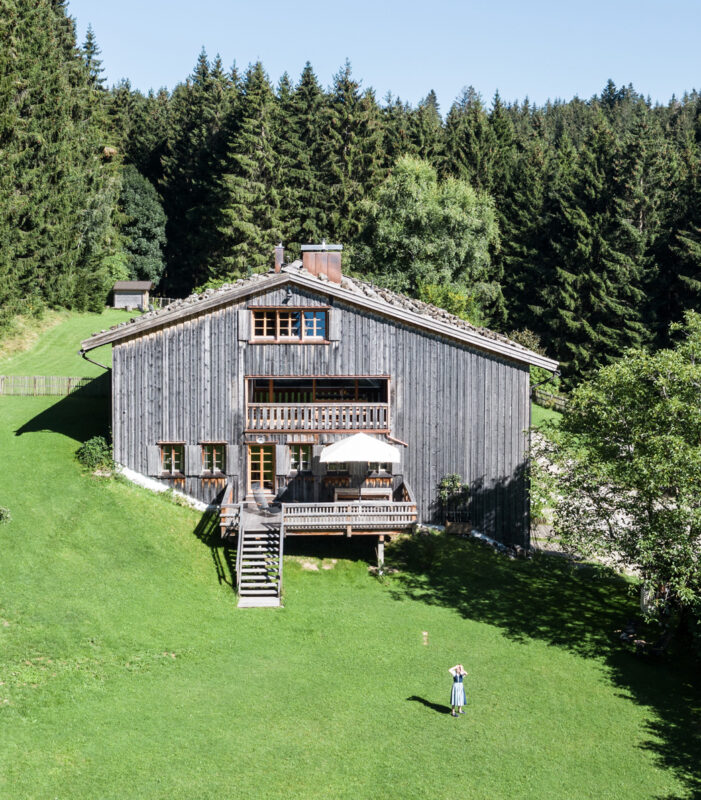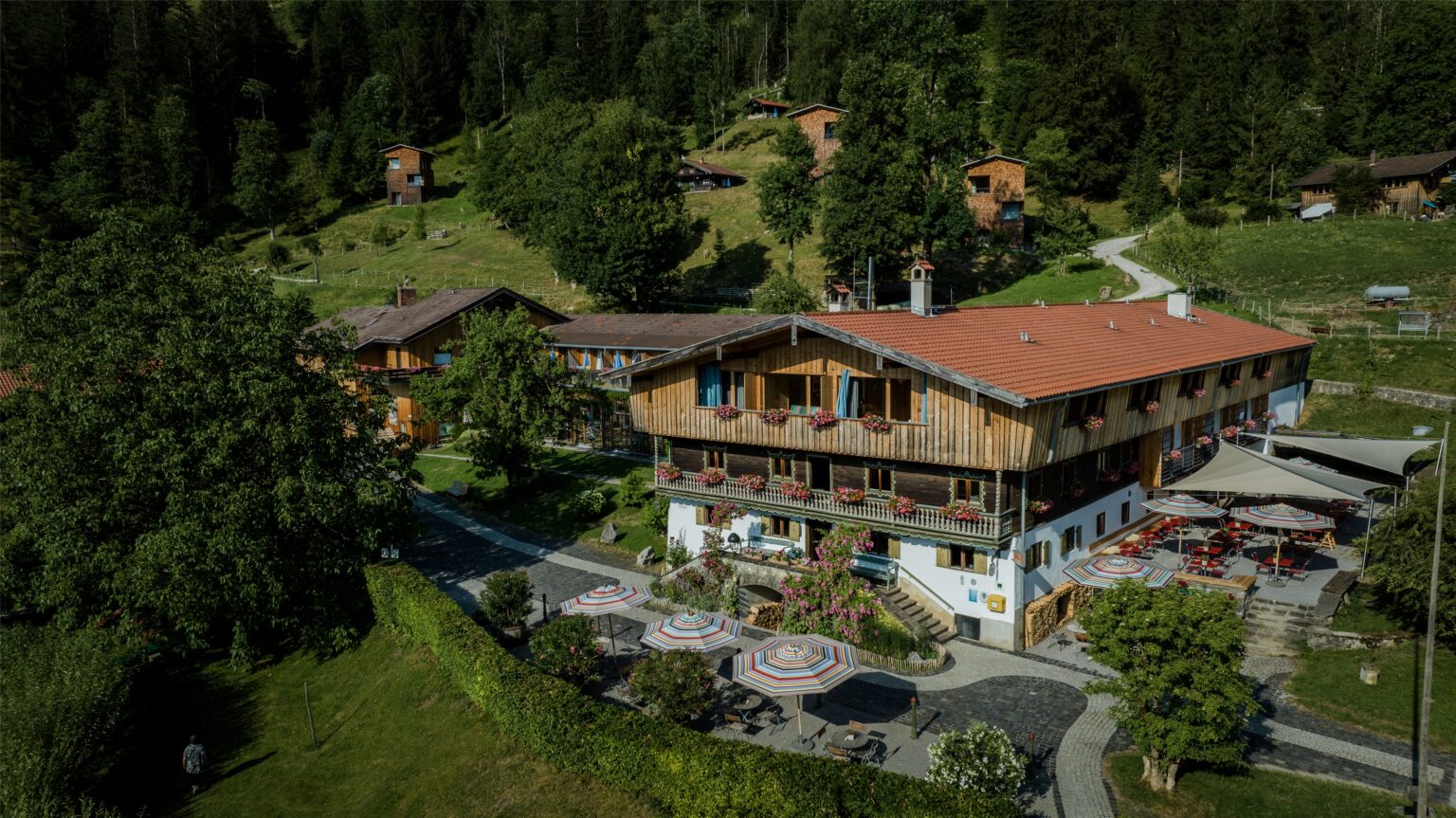

The road ends in a meadow, and there it stands: a village of timber and larch shingles, scattered across the hillside as if dropped there. Ducks waddle across the stone path, two Zebu cattle graze beside the pool, the smell of soup drifts across the yard. Arriving here, it takes a moment to grasp that all of it is a single hotel.

The Location
Bayrischzell lies an hour south-east of Munich, where the foothills tip into the mountains — between the Wendelstein, the Rotwand and the Schliersee. The Tannerhof itself hangs a further 850 metres above the village, five minutes from the valley station of the Sudelfeld ski area, reachable by train direct from Munich.

© Hansi Heckmair
Walking the last stretch, the first thing you see is the Alte Tann: a single-ridge farmhouse from the seventeenth century, surrounded by four larch-shingled towers scattered over the slope. A stream runs straight through the grounds. Alpine meadows and forest surround it, a footpath leads straight up from the yard.


Backstory
In 1905 the pulmonologist Christian von Mengershausen bought a derelict farmhouse above Bayrischzell and founded the Kurheim Tannerhof, carried by the Lebensreform movement and Pfarrer Kneipp’s healing methods. The first Lufthütten went up that same year — sleeping as close to nature as possible. His son Johannes introduced Buchinger fasting.

The third generation, Malte and Andrea, both doctors, preserved the buildings — regulars included Richard von Weizsäcker, Germany’s president from 1984 to 1994. In 2007 the fourth, Jonas’s parents Burgi and Roger, decided to turn the health-cure business into a hotel.


Today the fifth generation, Jonas von Mengershausen, takes over — no physician, but a trained chef who ran a restaurant with friends in Berlin. His mark shows quietly: two fitness rooms he negotiated into the new Bade-Harpfe’s plans. His mother stays on as employed managing director.

© David Zehentner
Interior & Architecture
In 2007 came the decision to reshape the Tannerhof architecturally, without erasing four generations of building work. The Munich architect Florian Nagler was tasked with holding old and new buildings together under one bracket. The Alte Tann, a single-ridge farmhouse, became the venerable core again; around it rose the hut-towers, larch-shingled timber buildings that added rooms without sealing more ground.

© Rainer Hofmann
2025 brought the Bade-Harpfe, built on the model of alpine hay-drying barns: open timber construction, few closed walls. Solid wood furniture, natural stone, linen instead of synthetics, plus wood-chip heating and green electricity from Polarstern. Old tiles from demolished buildings were bought up and relaid, a former general store became the Tannerhof bar. Upcycling is a design principle here. The architecture earned the BDA Bavaria prize, the German Timber Construction Award, and an entry in the 2013 German Architecture Yearbook.


A look inside
Reception, restaurant and bar sit in the Alte Tann, the heart of the estate. Around it spread 59 rooms across six room types. Those who want height book one of the four hut-towers in the forest, 26 to 28 sqm with a king-size bed and views over the Leitzach valley.

© Hansi Heckmair
Smaller, more solitary: the mountain cabins — Auerhahn, Reh and Taube huts — each with its own stove, no more than two beds. In the Baumallee lie retro-furnished rooms with Missoni curtains, in the farmhouse the bright, rustic Alm rooms, up to 33 sqm.


Rooms in the Neue Tann carry names such as Sonnwendjoch, Seeberg or Wendelstein. Smallest are the Kammerl, at eleven sqm — compact, but fully equipped. No television, good beds everywhere.


Culinary
The fish comes from the Fischerei Schliersee, the beef from Miesbach pasture cattle, both organic and ABCert-certified, guided by the EAT-Lancet Commission’s Planetary Health Diet. Slow Food here is daily sourcing practice. Overnight guests experience the “Dreivierteltakt” — breakfast buffet, light lunch buffet, a served three-course dinner, vegetarian three nights a week — or the low-carb line Schlanke Tanne.

Those wanting more book Restaurant Pool, named after the neighbouring indoor pool in the Orangerie: twelve seats, a five-course tasting menu, Wednesday to Saturday, open to non-guests too.


The kitchen is run by Nico Sator: previously at Munich’s Sparkling Bistro, a Michelin star, and once before a young chef at the Tannerhof. The crockery is thrown by Helene Andres of nearby Gmund, the bar furniture by designer Michael von Mücke. Herbs and some vegetables grow in the hotel’s own greenhouse, five hens pecking for worms in between.


Wellness & Relaxation
The old sauna hut from 1936 still smells of another era: a Finnish sauna at 85 degrees, beside it a milder Kelo-pine bio-sauna. In the indoor pool you swim beneath a mural by Nele von Mengershausen, great-aunt of today’s operating family, who layered desert and water here. Since 2025 the Bade-Harpfe has joined it, a former hay-drying barn reimagined as a panorama sauna, quiet room and 25-metre natural pool set into the meadow.

© Sebastian Schels
The Harpfe also holds two small fitness rooms, for strength and endurance, both facing the Seeberg. Those who prefer lying to swimming find an unprogrammed spot on the forest sun deck. Massages, wraps, cosmetics and Kneipp treatments round out the offer, tailored to guest and day alike.


Surrounding Area
Bayrischzell itself begins just below the slope: the small pilgrimage chapel of Birkenstein, a Baroque gem in the forest, lies a short quarter-hour’s drive away and is overlooked by most guidebooks. Directly below the Tannerhof stands the small parish church of St Margareth, barely six hundred metres off — a good walk before breakfast. Those heading for water drive ten kilometres to the Schliersee, which is living a second life: since a friend of the family opened the Fischerei Schliersee in 2019 — char and trout from its own spring-fed ponds in the Leitzach valley — a young food-and-drink scene has grown up around the lake.

© Sandra Grünewald, Unsplash
The Fischerei now runs the bar at the old Strandbad; next door is Walters am See, a small beach club from the Seehotel Schliersee family. The Tegernsee, too, is barely thirty minutes away by car, with its own, glossier scene — to grasp the difference between the two valleys, visit both in a day. Towards the city it is the same hour: Munich, with a dining scene of enormous depth, a starting point for extending a Tannerhof stay with dinner out. The Wendelstein itself remains the house landmark: visible from almost every room.
Activities
Active: walking old alpine paths and open forest, mountain biking on trails straight from the door, plus road cycling through some of the best terrain south of Munich, e-bike optional. Guided walks set off several times a week from the Alte Tann, pace and route depending on weather and group. Those wanting to go higher try Hike & Fly: climb on foot, paraglide down into the valley.
On and in the water: swimming and stand-up paddling on the Spitzingsee, Thiersee, Tegernsee or Schliersee, plus hidden rock pools in surrounding mountain streams — or the hotel’s own natural pool.

© Romy von Mengershausen

Winter programme: ski touring, cross-country skiing through quiet valleys and snowshoeing, alpine skiing at the Sudelfeld, plus the Wendelstein cable railway with its summit cave.
Body and mind: the weekly programme of yoga, pilates, Feldenkrais, aqua gymnastics, autogenic training and guided herb walks, complemented by camps such as the annual Qigong Camp or the coaching retreat Heldinnenzeit, for everyday clarity.
Culture: Hofkultur in the hall of the Badehaus, with concerts such as the “Night of Jazz Guitars” by Paul Brändle and Andreas Dombert, readings by contemporary authors — most recently Yuko Kuhn with her debut novel Onigiri — and photography exhibitions, among them one on a two-thousand-kilometre walk across Japan.
Health in detail: medically supervised Buchinger fasting, at least five days, ten recommended, the dietary programme Schlanke Tanne as a gentler entry point, or programmes for the immune system, mental resilience and healthy ageing.


Details
59 rooms across six categories, the largest the Alm rooms in the farmhouse (up to 33 sqm) and the hut-towers (26–28 sqm). Restaurant Pool: five-course tasting menu, Wednesday to Saturday, twelve seats, reservation required. House guests dine on the Dreivierteltakt or Schlanke Tanne low-carb. Spa: historic 1936 sauna hut, indoor pool, new Bade-Harpfe with panorama sauna and natural pool, two fitness rooms. In-house doctors’ practice for Buchinger fasting. No television, WiFi only in the main houses. Pets welcome on request. Check-in from 3pm, check-out by 11am.

© Hansi Heckmair