

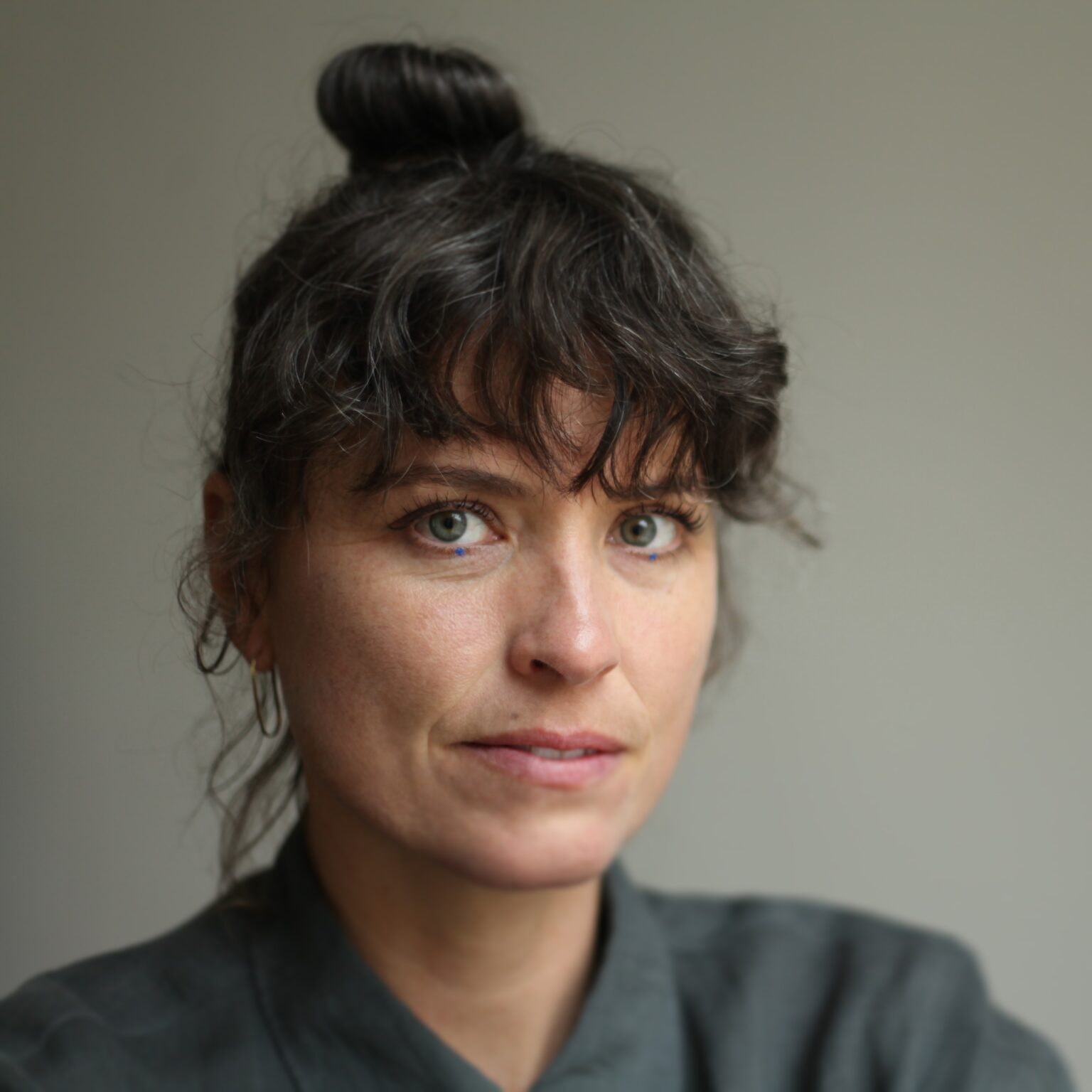
Sarah Schrof is working across process-based art, spatial installation, and abstract sculpture. Her practice conceives of material as a living system, shaped through the interplay of observation, time, and transformation—organic, self-evolving movements in which repetition, layering, and physical transformation operate with equal agency. Through repetitive gestures and subtle motions, an unstable boundary emerges between object and living form.
She works with pigments derived from plants—time becomes subjectively perceptible, and materials unfold their own dynamics through processes of flux. Drawing on conceptual, scientific, and experimental approaches, she meticulously deconstructs the traces of her working process and translates them into material constellations—works that evoke states of temporality and presence, revealing a symbolic reality.

© Courtesy of the artist
Which place do you currently call home and where do you work on your projects?
Together with my family, I live in the centre of Stuttgart, in a 100-year-old listed building. My atelier is only a five-minute bike ride away—close enough to keep everyday life and work naturally connected. The city’s bowl-shaped topography, known as the “Kessel”, defines its structure and gives Stuttgart its distinctive character, with many stairways—the so-called “Stäffele”—connecting the different boroughs of the city. One of the things I appreciate about Stuttgart is its proximity to nature. Within minutes you can leave the urban density behind, reach the hills, walk through vineyards or fir forests and enjoy wide views.
Where is your studio located & how does it look?
My studio is located in Stuttgart West, near Bismarckplatz. I share it with another artist and a floral set designer. It’s a space for both focused work and experimentation. The walls display research materials and models, while shelves hold glass jars filled with pigments, plants and botanical specimens. The atmosphere balances artistic practice with a sense of research and observation.

© Courtesy of the artist
Are there any projects that are important to you personally, that you have recently completed or that you are still working on?
My current work is shaped by a close connection to the earth as a complex ecosystem and the interdependence of all living forms.
My process combines intuitive experimentation with alchemical principles—preparing pigments, extracting colours, and working with organic materials that carry their own adaptability and sensitivity, serving as both medium and metaphor for transformation. This allows me to work with the boundaries between inside and outside, visible and invisible, human and more-than-human.

© Courtesy of the artist

© Courtesy of the artist

© Courtest of the artist
Do you have a favorite place in your area where you like to relax and linger?
I often spend time in the forests around Stuttgart, especially at Bärensee, where you can find quiet paths and, with a bit of luck, even spot a kingfisher by the water. Karlshöhe is another place I return to often—a hillside park with a view across the city that feels both central and calm. I also like walking along Blauer Weg, which connects residential areas with green spaces on the city’s edge. The Lapidarium, with its historic fragments and garden atmosphere, is one of those places that offer a slower rhythm within the city.
And the old Heslach indoor swimming hall, built in 1929 in the architectural style of New Objectivity, has retained a certain charm that makes it a pleasant place to unwind.
The Österreichischer Platz, converted from a former parking lot, now hosts a variety of cultural and public events. It transforms urban space into a flexible platform for interaction, allowing residents and visitors to experience the city in new ways. My son loves to borrow sports equipment such as a BMX for free and race around the pump track.

© Julian Herzog, Schlossplatzspringbrunnen Schlossplatz Stuttgart 2015 03, CC BY 4.0
Are there any urgent political issues or problems in your region?
Stuttgart faces real challenges around traffic, air quality, and housing—its bowl-shaped topography and strong ties to the automotive industry amplify congestion, while rising rents make the city increasingly difficult for students, families, and lower-income residents.
Even in a city long shaped by car traffic, a growing number of local initiatives are reclaiming space for greenery and community—proof that civic engagement can change how a city feels.
In your opinion, what has developed well in the last 5 years—and what has not?
Several off-spaces and cultural initiatives have developed positively in Stuttgart over the last years. St Maria als has developed into an important space for Stuttgart’s cultural scene, hosting a range of artistic projects and community events. It provides an alternative venue where artists and audiences can engage in experimental formats and local exchange and has become a social meeting point for initiatives such as Harrys Bude, a non-profit project founded in 2020 by Harry Pfau, who was previously homeless for thirteen years. Rescued food is distributed free of charge in front of St. Maria Church, accessible to everyone without proof of need. Beyond food distribution, there’s also Harry’s Lab, an educational program in schools addressing food waste and sustainable practices.

© Schlaier, Stuttgart Staatstheater 9, adjusted colours & cropped, CC BY-SA 3.0

© Quartl, Wilhelma Maurisches Landhaus qtl1, adjusted colours, CC BY-SA 3.0
Do you know a hidden gem when it comes to local manufacturers—whether it’s arts and crafts, sustainable products or food?
The Eselsmühle in the Siebenmühlental is a historic site where traditional milling and organic production are still practiced. Bread is baked in wood-fired ovens, and the small shop offers regional and Demeter-certified products such as bread, cheese, wine, and seasonal produce. The setting, with its courtyard and resident donkeys, is worth a visit.
The Theater am Faden is a small cultural venue offering performances, workshops, and events for all ages. It provides a space for artistic programming and community engagement, bringing together local audiences in a welcoming and intimate environment.
At Eiscafé Fragola, the atmosphere is lively and informal. It’s an authentic Italian ice cream parlour and a neighbourhood meeting point. I particularly enjoy their Panini and my son likes the Stracciatella ice cream, which I can also recommend.

© Eselsmühle

© Eselsmühle
Is there anything particularly innovative in your region? Also in comparison to other places you have already visited?
The Stuttgart region has a long tradition of innovation shaped by the Swabian Tüftlergeist—that quiet, persistent urge to understand how things work and to make them just a little bit better. From the first automobile to advances in robotics and sustainable materials, this inventive spirit continues to evolve with the times. It’s an approach rooted in patience, curiosity, and a love of detail, often unfolding far from the spotlight. You can sense it in technology, art, design, and everyday life, where creativity is guided by a characteristic sense of precision and care.
Do you have a secret restaurant tip that you would like to share with us?
Noir Cuisine is a small, understated restaurant known for its precise, seasonal vietnamese cuisine. It offers a calm atmosphere where attention to detail and the quality of ingredients are central to the dining experience.
Piloni is one of my favorite Italian restaurants that focuses on authentic flavors and simple, well-prepared dishes. Its intimate setting and thoughtfully curated menu make it a reliable spot for both casual meals and longer visits.
Eiscafé Pinguin is a local ice cream café with a long-standing presence in the city. It combines traditional Italian-style ice cream with a welcoming, informal atmosphere – situated at “Eugensplatz”, it has a really nice view over the city.
Is there a local shop whose products are only available in your region?
Café Schurr is a traditional confectionery in Stuttgart known for its handmade cakes, pralines and seasonal chocolate specialities. All products are made daily on site by a small team of confectioners, following long-established recipes and methods of German pastry craftsmanship. The focus on fresh ingredients, short transport routes and work by hand gives the place a distinctly local character that connects skill and tradition.
What are your 3 favourite apps that you use every day and couldn’t live without?
BirdNET helps me identify and learn about local bird species. It allows me to record sounds and instantly recognize different birds, keeping me connected to nature and the environment that often inspires my work.
Miro Board is an essential tool for my creative process. It enables me to visually map ideas, concepts, and materials, which helps me to experiment with arrangements and relationships before bringing them into the studio.
Are.na is a platform for collecting and organizing research, inspiration, and references. Its flexible, collaborative structure allows me to explore connections between ideas, materials, and projects, supporting both personal and interdisciplinary projects.
Do you have any favourite newspapers or online magazines? And how do you keep up to date with politics or social and cultural issues?
I keep up to date with the Theater RAMPE. It continues to offer socially engaged and innovative performances, often combining multiple disciplines. It has strengthened its role as a space for reflection and critical engagement, reaching audiences with unconventional and thought-provoking theatre formats.
I also enjoy listening to the radio—such as FIP Radio Paris or Deutschlandfunk Kultur.

© Julian Herzog, Neues Schloss Schlossplatzspringbrunnen Jubiläumssäule Schlossplatz Stuttgart 2015 02, adjusted colours, CC BY 4.0
Imagine you could be mayor for a year—what would you change?
I would focus on making Stuttgarts urban environment more accessible and liveable by prioritising green spaces over paved surfaces and transforming grey areas into parks and gardens wherever possible. Reducing car traffic in the city would be an important step to improve air quality, noise levels, and the overall urban experience. I would also like to make the river more accessible to residents and ensure that the water of the Neckar is clean enough for swimming, bringing the city and the river closer together. The Neckarinsel is already a good example of how nature can be reclaimed or reintegrated in urban spaces. In addition, I would address the housing shortage and rising rents to make living in Stuttgart more affordable.
One last question: If you could choose another place to live—regardless of financial or time constrains—which one would you choose?
I’m drawn to the landscapes of southern France – the forests around Sainte-Baume, Esterel or Massif des Maures. I particularly like the evening light and the atmosphere there. They have such a calm and grounded quality. So I’d say I’d really love to spend more time in these ancient landscapes.


