
Since 2016, around a dozen new galleries have opened, and a number of international art dealers have established branches. Also since 2016, the art fair ARCOlisboa has taken place every May, and in 2018 JustLX was added as a competing event at the same time. For several years there has also been a small but steady stream of artists who let themselves be enchanted by London, Milan, or Madrid and set up their tents by the Tagus: rents for apartments and studios are still comparatively low by European standards. The art press has since occasionally described Lisbon as Europe’s “new Berlin”, a label that is not particularly popular within the scene itself.
The most important and popular places to view art are certainly the Museu de Arte Antiga for old art and the Museu Nacional de Arte Contemporânea, founded in 1901, for contemporary art. Both are state museums that foreground the works of Portuguese artists. The Museu Calouste Gulbenkian* houses the eclectic collection of its namesake and founder alongside a high-calibre collection of modern art. The Museu Coleção Berardo in the Centro Cultural de Belém (CCB) also traces back to the foundation of a private collector, it is among the most visited museums in the world and focuses on modern art, with foreign artists strongly represented, as in the Gulbenkian.
The Museu de Arte, Arquitetura e Tecnologia (MAAT) in Belém, which opened in 2016, received at its launch the collection of the painter Pedro Cabrita Reis, which had been purchased by the foundation of the energy provider EDP. It comprises 338 pieces by 74 Portuguese artists, all created after 1990.
*Calouste Gulbenkian was an oil trader of Armenian descent who fled from France to Lisbon in 1942. There he lived in seclusion at the luxurious Hotel Avis, where he also died in 1955. During his lifetime he was considered one of the richest people in the world; his art collection, which he placed in the foundation, was regarded as one of the largest in the world. To this day, the foundation derives the lion’s share of its income from a Panamanian holding company that Gulbenkian had already set up in 1938.
Private & public with Catarina Botelho
Lisbon, a city of art? Catarina Botelho is rather sceptical about that: “The art scene is very small, almost like a family. Few people go to museums and galleries. Footballers, musicians, or actors are prominent — painters or photographers are not. Of course there are exceptions like Vhils or Joana Vasconcelos, but they actually only confirm the rule.” Catarina has been a photographer since 2007, and her work has been exhibited and awarded prizes both at home and abroad. As a true Lisboeta, she grew up in the harbour district of Cais do Sodré, she has always drawn inspiration from the city: “Even as a child I collected impressions here that brought me to art,” she says. As a schoolgirl she would wander through the city with a video camera and a camera to capture scenes, people, and moods.
After school it was clear how she wanted to go on: she wanted to do “something with art.” Her great passion was always film — for her it is a “complete” art form, similar to opera in music theatre. The problem: the Lisbon art academy offers no photography or film classes to this day. So she studied painting, even though brush and canvas are not really her medium. Nevertheless, when you look closely at her pictures, you can still see traces of her training, for example in her handling of light and colour and the composition of her images, which often feature classical arrangements, such as still lifes.
Many of her photos contain no people at all. When there are any, they are often solitary figures, almost always in their personal space, clearly not people she knew; the photographer Botelho is more interested in the city itself, which she has been photographing and documenting for years in a series she calls a “Work in Progress” — closed shops. It is a frequently encountered sight as she walks through her city, through Baixa, Mouraria, Alfama, Saldanha, Intendente, from one neighbourhood to the next, and along the way she has been photographing the windows of closed businesses. “I see them every day, and they look to me like paintings.” Spaces that were once populated by people appear emptied, as if the air stubbornly refuses to move on. The photos by Catarina often seem melancholic, but she intends them to be politically charged: as a historical document of displacement, as an invitation to reflect on the function of commercial spaces beyond their commercial exploitability. The photos bear witness to the “silent violence” of gentrification — the closures of businesses mean the loss of the people who worked and shopped there. “A space is lost,” she says: “When a shop closes.” She wants her photos to be understood not as a lament for “melancholic beauty” but as a political statement. As for the shops she photographs, new tenants are being sought for them.
How she feels about the direction Lisbon is developing, I ask. She says critically that they had finally… then came the massive wave of tourism. Previously the city had “taken its time,” unlike other European capitals. “It’s true that we still treat each other more considerately than is the case in other cities. We simply don’t push. But it’s about the city itself, and the city is losing its peace. In public spaces there is now music everywhere and constantly. And the Sunday closing of shops was good for the city, because it allowed it to rest.”
But tourism has enormously boosted the economy and brought many jobs, I point out. “Yes, that’s true. But because of that, tourism has also become a kind of blackmail—it brings income, but it changes the quality of life and forces changes that don’t correspond to what the people who live here need and want.” The idea that everyone must always be constantly available is the opposite of a liveable life. “In Portugal too, people work a lot, but differently. But the phone-addicted—of course we have them too,” she says with a laugh.
Nevertheless, she too says that in recent years a particular dynamism has become noticeable among artists as well. “There are a lot of young people doing exciting things, even though state funding is lacking. But in photography there is neither a tradition nor a recognisable direction that would be typical of Lisbon.” What she plans for the future, I want to know. “I’d like to make films someday.” Indeed, a few months after our meeting she fulfilled her wish and made the documentary film Notas de Campo (Notes from the Field), which has since been shown at many festivals.
A surprise comes at the end of our conversation. When I ask if I may photograph her, Catarina agrees, but pulls a face: “I can’t stand being photographed.”
Miguel Marques & the language of the universe
When it comes to art, one thing is clear: without money it is difficult for serious artists, and money was in short supply in Lisbon for decades. But thanks to the boost in popularity that Lisbon has experienced in recent years, a great deal of money has come into the city. Not only through tourism, but also through a large number of foreigners who have settled here. Many of them are wealthy and have triggered a real estate boom in the city, which has pushed many locals out of the housing market. But it is not only the property market that is benefiting from the fresh money — the art market is also getting a healthy boost. Does Lisbon want to become an art city thanks to foreign investment?
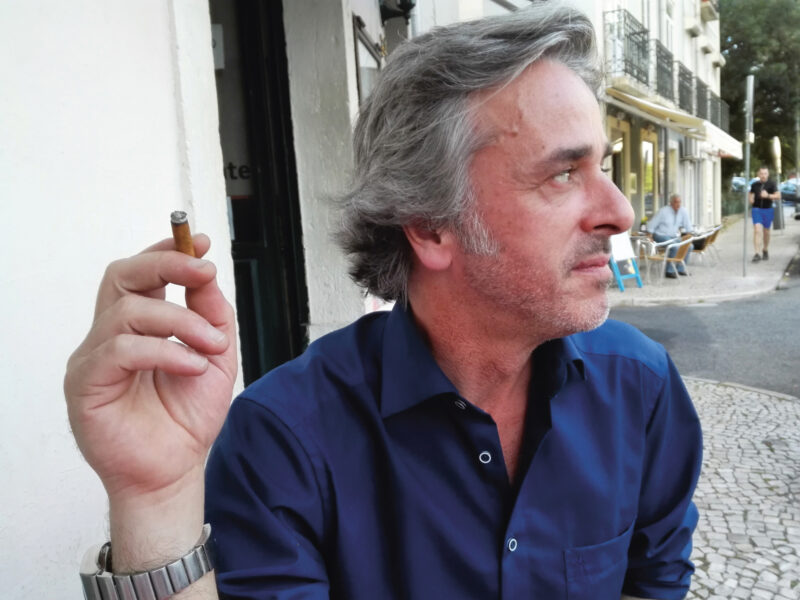
“I wouldn’t put it that way,” Miguel Marques demurs. Miguel is a gallery owner by trade and therefore stands right in the middle of the daily struggle for survival of today’s working artists. “Yes, a lot is happening. But poetry and music have always been much more at the centre of interest here in Portugal. A genuine and above all broad art scene, such as one knows from other European cities, doesn’t really exist here. The number of people interested in modern art is also small—genuine competition between collectors, galleries, foundations, and artists is lacking. Equally scarce in Lisbon is an artists’ quarter, and support for young creatives is extremely modest. When something does happen, it is mostly on the initiative of the artists themselves.”
© Corso Verlag
© Corso Verlag
Miguel is a lawyer by training, but it was always clear to him that art is the content of his life. “In my family there was actually no interest in it at all, but for me it was the most exciting thing from an early age.” He very much enjoys drawing and painting himself, and as a child he even won a prize for a poster submitted to a school competition. “With painting and drawing, it’s less about the hand than the mind. It’s about how one perceives reality—the technique is then something else.” He also plays piano and has learned Portuguese guitar; music moves him to feel in a special way, he says.
As a student he began collecting pictures; at some point this developed into a small art trade and later a gallery.
“For a long time I represented mainly foreign artists—I didn’t find the local scene that interesting.”
Financing had previously been no problem; in the course of the speculative bubble the banks also readily gave loans for art investments. “Then came the financial crisis—that was the end of that story.” At the same time, several auction houses opened in Lisbon, disrupting the market with aggressive pricing policies. Sometimes less than half the actual value would be paid at auctions. “There were and are very few collectors here anyway, and they started concentrating their spending on established artists. For young artists, we gallerists have to compete with the low prices of the auction houses—that is very difficult for us and for the artists.” There are very few investors in the art market, and many galleries also don’t believe in young artists.
What does his business strategy look like, I want to know. “I don’t really have one,” he says with a smile: “I have to be personally convinced by an artist and their work; otherwise, it makes no sense for me.” And when is he convinced? What interests him about art is the “incomprehensible,” he says—the element of being drawn in without being able to really explain it. “Art, whether music or visual art, speaks to you. It may sound a little stilted, but: something from the universe communicates with you. That is decisive for me. Often the most efficient communication is the kind that manages without words—that uses images and symbols or sounds.”
But tastes differ enormously, I interject. He won’t accept that: “About taste one can very well argue. But there is natural beauty—the principle of the golden ratio, for example, is a truth.” Beauty and ugliness are universal; one must train the eye to recognise them. “It takes training and experience—then the gallery’s success follows too.”
Let’s talk about money — a gallery exists to sell artists’ works and thereby secure their livelihoods. And there is art that sells better, and art that sells less well. “That’s true. But for me, those artists who work primarily with the market in mind, or whom profit-oriented investors approach, are not interesting.” What he finds compelling are young people who want to get to know the world and are in contact with it. He tries to support them by organising eight to ten exhibitions per year. However, he remains critical even there, having cancelled exhibitions at short notice when he had seen the works and was of the opinion that things simply weren’t ready yet. “That causes trouble, but it is my gallery and my decision.” On a few occasions the artists later thanked him for his veto.
He also differentiates regarding his clientele: “I most enjoy the customers who buy an artwork because they have fallen in love with it. Of course there are also people who buy art as an investment. But that is risky and seldom successful.” His most important clients are experienced collectors, but Miguel also says that at least 70 percent of his clientele had never bought a picture before. “It makes me proud to bring people to engage with art, even when they can’t give a great deal of money.”
A fundamental problem of the art market in Lisbon he has also identified: “We are an open society for all manner of things, but not for art. People simply haven’t been trained for it. To this day, art is only taught as a sideline in schools, no orientation is given — art in general public perception has remained something for the elite, a broad segment of the population that is interested in it simply does not exist. People have threshold anxiety about galleries, thinking it’s only for wealthy people.” Pricing is therefore a constant challenge for him: he must offer something for “walk-in customers” in order to interest them at all, as well as something for experienced collectors. His gallery therefore offers limited prints for 300 euros, but also pictures for significantly more than 10,000 euros.
How will things develop for him and the art market? The new galleries and art dealers that have come to Lisbon in recent years cause him little concern: “That brings more attention for everyone, and that is a good thing.” He too notes that Portuguese artists are appearing more dynamically and self-confidently, and in doing so often take the detour via presentations abroad. “Portugal is, despite all its development, still a country on the edge of Europe, and the gaze of the great collections still doesn’t fall here very frequently. There is also no state support in this regard that would draw that interest here.” And he shrugs: “It is and remains a peculiar market in a peculiar society.”