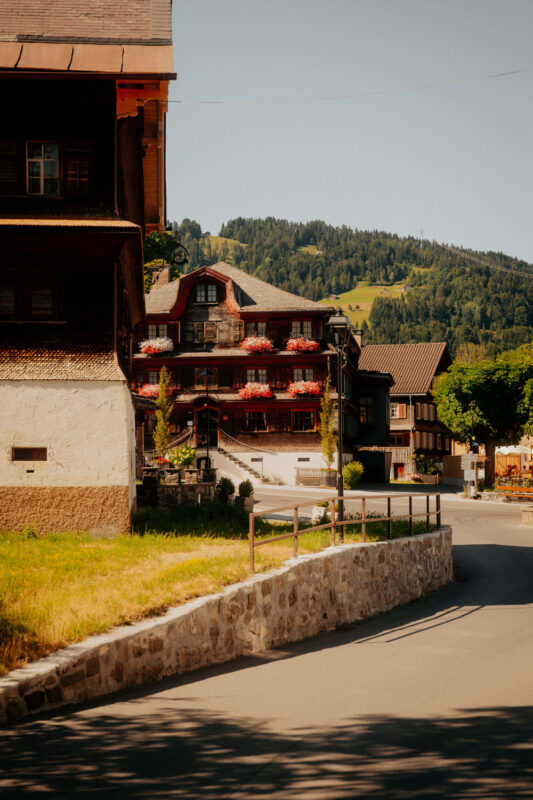

The drive to Lech winds upward through hairpin bends, past villages that seem to sit exactly where the valleys can still just decide to open. At the centre of the village stands a house in a strong shade of pink, arguing with the mountains and winning. The first glance keeps what the façade promises: substance, not a stage set.

© Joann Pai
The Location
Lech am Arlberg sits at around 1,450 metres, where valley, river and mountain roads cross—a position recognised as early as the 1930s, long before the village became a fashionable address. The „Post“ has stood on the same spot ever since, at the geographical centre as much as the social one: from the terrace you can see the Lech river, the church, the coming and going of the village. The façade, painted a strong pink since a 1972 renovation, now looks less like a hotel than a public building—the village, it seems, has long since made the house its own.

© Joann Pai
Backstory
The story begins with a woman others considered mad. In the 1930s, the grandmother of today’s owning family took over a run-down inn with a post station, a farm and a general store—at the point where paths and water meet. She was right.

© Michael Adair
In 1937, Erich and Irma Moosbrugger bought the house officially; later Kristl Moosbrugger ran it and in 1990 became the first woman voted Austrian Hotelier of the Year. Her son Florian took over at twenty-four, after his father’s early death—a burden at first, not a gift. Only after the 2010 renovation, triggered by a 2005 flood, did he walk through the house and think for the first time: mine. Since 1999 he has run it together with his wife, Sandra.


Interior & Architecture
How much modernity can the Post Lech take? The question has shadowed every renovation for decades, and the family’s answer has stayed consistent: no fake period rooms, no artificially aged parlours. What is old is allowed to look old—low ceilings, real stoves, beds and hunting trophies spanning several generations.

© Joann Pai

© Joann Pai
New sections, on the other hand, are free to read as new, as long as they grew from the same understanding of material and space. Televisions and minibars vanish behind historic cabinet fronts, less coyness than respect for the room’s look.


For the new spa, the family parted ways with a well-known designer whose vision ran too gilded, and handed the task to their long-standing architect, Christian Prasser, who had never built one before. The result: ceilings over three metres high, light, space—a deliberate contrast to the intimate historic parlours.

© Herbert Lehmann

© Herbert Lehmann
A Look Inside
46 individually furnished rooms and suites, four restaurant parlours, the Bemelmans Bar, and a spa with a heated outdoor pool in the 6,000-square-metre Ebra-Park are split between the historic core and the new wing opened in 2010—no two alike, and many can be joined through connecting doors, useful in winter when whole families arrive. In the historic rooms, old timber and patina dominate; in the new wing, quieter, brighter surfaces—two languages in the same house that don’t clash.

© Herbert Lehmann
The Postmeisterzimmer, with its enclosed four-poster bed and open fireplace, gets booked again year after year by the same returning guests.

© Michael Adair

© Joann Pai
The Kaiser Suite, around 114 square metres, joins living and dining areas under its own fireplace, the interior held in bold colours.

© Herbert Lehmann
The public side of the house includes the Hubertushalle, with its library and fireplace, four restaurant parlours, the Bemelmans Bar, and a spa with direct garden access. Just in time for the 2026 summer season, Post Lech has unveiled the curated library, developed in collaboration with Sans Soucis Studio to celebrate the hotel’s century-old heritage and the cultural history of Lech and Vorarlberg through a carefully selected collection of books and objects.

© Cecile Christmann

© Cecile Christmann
At its heart is a tribute to Austro-American author and illustrator Ludwig Bemelmans, whose enduring connection to the village is reflected in rare editions, personal memorabilia, and literary works that anchor the library’s narrative of place, hospitality, and storytelling.
Culinary
Four parlours, one kitchen: the Jägerstube, the Kutscherstube, the Emostube and the Postblick panoramic restaurant, refitted in 2017 with a large glass front, share a hand but work in different registers.

© Herbert Lehmann
In the wood-panelled Jägerstube, among trophies owned by family and guests alike, a set gourmet menu runs by advance booking; the Kutscherstube stays the more informal local table with Austrian cooking; the ‘Emostube’, named after the artist Emo Henrich, offers a cosy Austrian atmosphere and serves fondue chinoise during the winter season; Postblick opens the house to the landscape.

© Joann Pai

© Herbert Lehmann
Head chef Michael Volcanjsek rose from sous chef and blends Vorarlberg produce with international references, including meat from the house’s own herd of Tyrolean stone sheep. The cellar holds around 14,000 bottles and several Wine Spectator awards; a brother of the family now runs Schloss Gobelsburg in the Kamptal.

© Joann Pai

© Joann Pai
Evenings gather at the Bemelmans Bar, named after Ludwig Bemelmans, author of the ‘Madeline’ books and a family friend. Guests are welcomed with good fruit juice rather than the reflexive glass of champagne—a small sign of a house that treats restraint as style.

© Joann Pai

© Joann Pai
Wellness & Relaxation
The Ebra-Park, around 6,000 square metres, is more landscape than hotel garden: flower beds, old trees, the Omeshorn behind them. Here tea is served in the garden each afternoon, a small, unhurried ritual. At ist centre lies the heated, 15-metre outdoor pool—among the beds in summer, under snow in winter, the water still steaming.

© Herbert Lehmann
Separate areas for adults and children, a new yoga room, a sauna, treatment rooms, and several relaxation areas complete the wellness offering. They provide peaceful spaces to unwind after a day on the slopes before the weekly guest cocktail starts the next conversation.

© Joann Pai

© Herbert Lehmann
Surrounding Area
Lech itself argues against the idea that smart alpine resorts inevitably become stage sets: the village is still shaped by hosting families, not chains or anonymous investors—take off your coat in the centre of the village, and it often already gives away which house you’re staying at. Culturally, the Philosophicum Lech stands out, meeting for the 29th time in the Lechwelten in September 2026; under the title ‘Betreutes Denken’ (‘Supervised Thinking’), international philosophers spend a week discussing the present—a symposium with little to do with the alpine wellness cliché.

In August, the Lech Classic Festival brings classical music to unusual halls, while the Impact Lech symposium takes on the social effects of new technologies. Anyone seeking the mountains themselves can join the Walserweg Vorarlberg, tracing the Walser settlement history across several valleys. For crafts and regional produce, it’s a short walk to the FeinPostLaden inside the house, or to smaller businesses in nearby Zug, one of the region’s oldest surviving Walser villages. At the foot of the Rüfikopf begins one of the oldest cable-car links in the Arlberg; those on foot find mountain cheese in the surrounding Alpine dairies, still stirred in copper kettles.


Activities
For winter sports enthusiasts: The Lech-Zürs ski area right outside the door, groomed pistes, off-piste powder slopes, heated ski rooms in the house, ski instructors on request.
For families: Connecting rooms, a children’s area in the Ebra-Park, sledging nearby, quiet parlours away from the bustle, personal attention from the house.
For gourmets: The weekly guest cocktail, a gourmet menu in the Jägerstube, wine tastings in the 14,000-bottle cellar, evenings at the Bemelmans Bar.
For the culturally curious: The Philosophicum Lech in September, the Lech Classic Festival in August, the Impact Lech symposium, Walser architecture in the historic village centre.


For summer activity: Guided walks of varying difficulty, mountain-bike trails, golf nearby, yoga in the new studio.
For those seeking quiet: The spa with a sauna and treatment rooms, the heated outdoor pool, afternoon tea in the Ebra-Park.
For food lovers: Produce from the house’s own stone-sheep herd, the FeinPostLaden with house wines and jams, a wine list carrying Wine Spectator awards.
For regulars: Rooms guests come to think of as their own, like the Postmeisterzimmer, close personal contact with the hosting family, fixed dates at Christmas and New Year.
Details
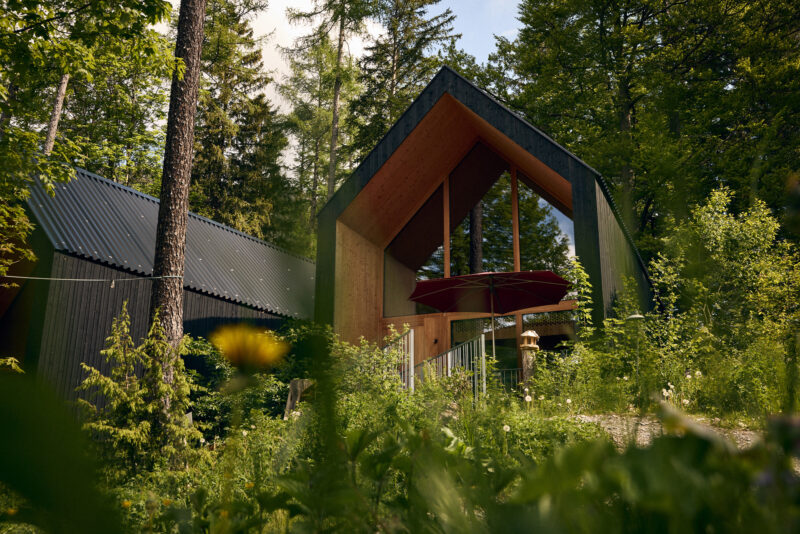
- 46 individually furnished rooms and suites, including the Chalet Säge, located opposite the main house.
- Four restaurant parlours—Jägerstube, Emostube, Kutscherstube, Postblick—plus a breakfast area and the Bemelmans Bar
- Spa with a heated 15-metre outdoor pool, a sauna and treatment rooms in the 6,000 m² Ebra-Park
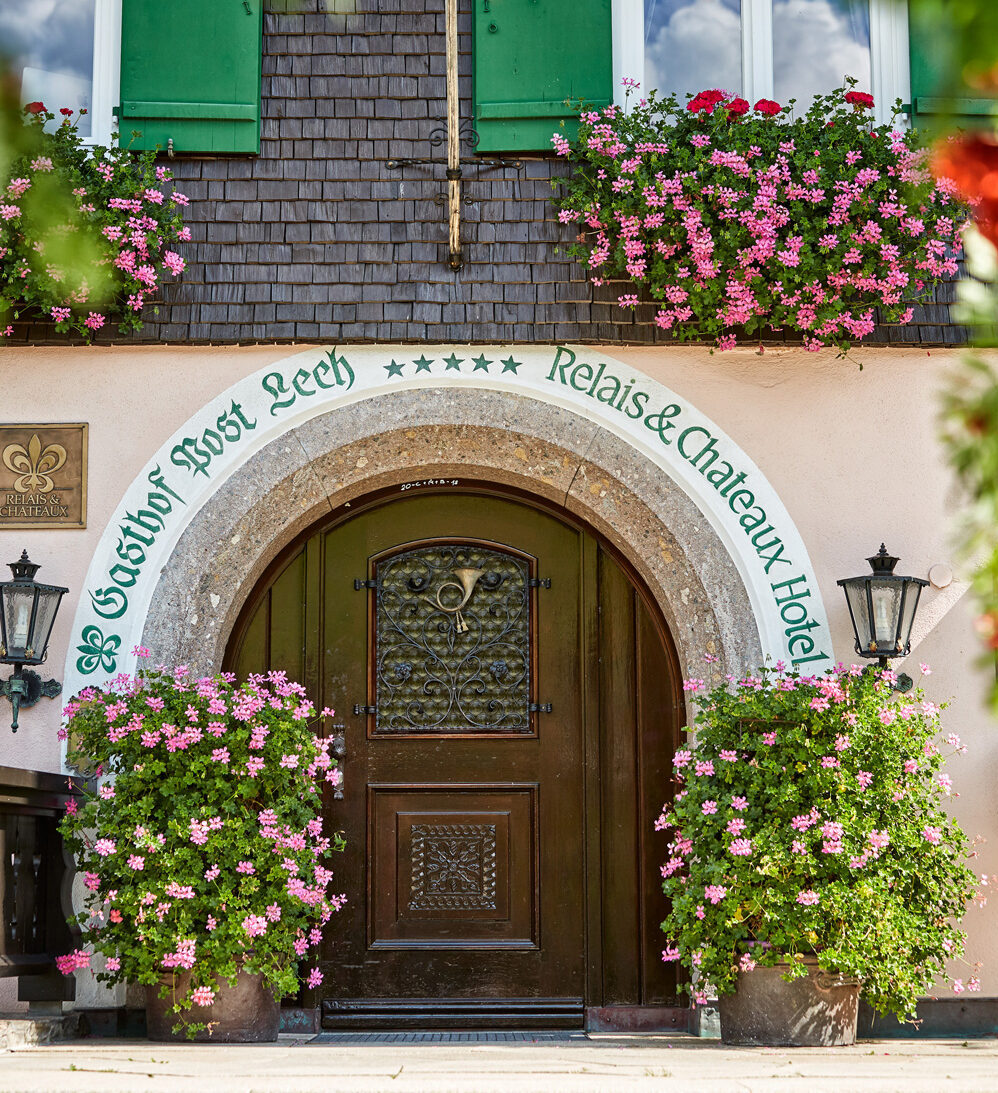
- Relais & Châteaux member since 1976, awarded a MICHELIN Key and 3 Gault&Millau Hauben Restaurant

© Michael Adair