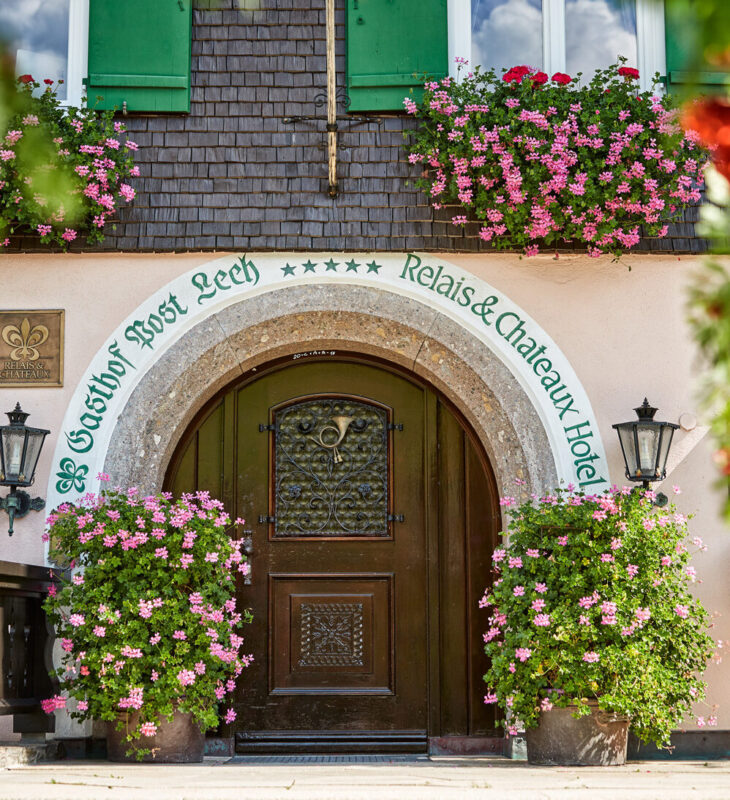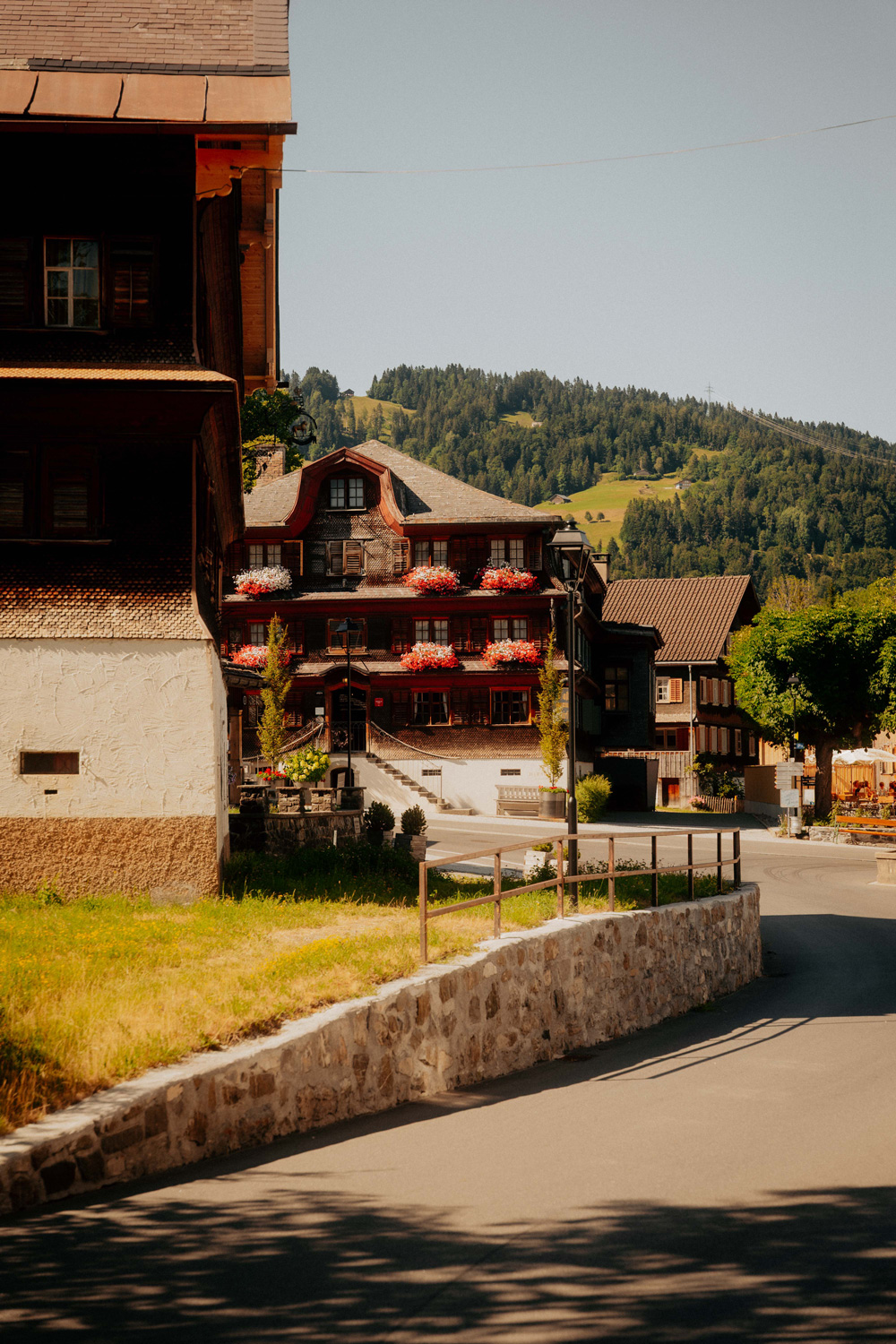

Anyone driving to Schwarzenberg arrives with a picture already in mind: shingle-clad houses, a few cows, plenty of quiet. The picture is largely accurate. Schwarzenberg is a singular place—villages with this much architectural coherence are rare. On the village square, though, the impression is briefly shaken. There stands the Hirschen, on the same spot since 1755, but something about the bar, the voices, the light says: there’s more going on here than the village lets on.

© Jessica Machon
On the Village Square
Schwarzenberg sits at around nine hundred metres, between Lake Constance and the Arlberg, where the Bregenz Forest starts to mean what it promises: timber houses still lived in, not just backdrop.

© Mirco Taliercio
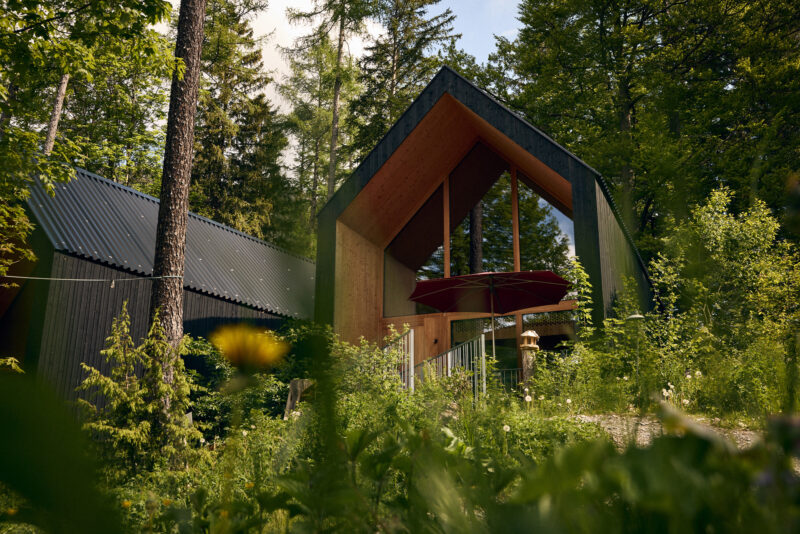
The historic centre is small, walkable in a quarter of an hour, with the church and the Angelika Kauffmann Heimathaus both in view. The Hirschen occupies the site opposite the church, an ensemble of three buildings: the 1755 inn in dark shingle cladding, the lighter Wälderhaus behind it, and, half hidden in the garden, the new Badehaus—a handsome, modern timber structure that was only completed in 2024 and looks more set down than built.

© Angela Lamprecht

© Angela Lamprecht
Tenth Generation
The house has history. First documented in 1601, as a tavern on the village square. Rebuilt after the great village fire of 1755, the Hirschen stayed in the same family for over two centuries: King Max II of Bavaria stopped here around 1856, Eduard Mörike a year later, on his honeymoon. Franz Fetz took over in 1975, laying the groundwork for today’s hotel.

© Vorarlberger Landesbibliothek
Over the next 50 years, Franz Fetz transformed the establishment from a simple village inn into a renowned 4-star hotel with award-winning cuisine. The ‘Wälderness’ series of events, ‘Hirschens feiner Musiksalon’, was launched 18 years ago to revitalise the winter season. In 2017 came Peter and Pia Fetz, the tenth generation. Almost nothing stayed as it was—the hotel’s self-understanding was questioned on many fronts, much of it renewed. Some regulars stayed away; that’s something you live with. When a chimney fire hit the house one winter, half of Schwarzenberg was at the door by morning. By evening, the Hirschen had reopened.

© Julius Hirtzberger

© Lydia Lydekat
Bauernbarock & Badehaus
The historic inn follows the Alemannic farmhouse timber style known here as Bauernbarock: dark wood, small windows, a roof that reaches low. In 2024 the Badehaus was added, designed by NONA Architektinnen—a restrained timber volume that was awarded Austria’s State Prize for Architecture in Tourism and Leisure shortly afterwards.

© Maximilian Pohler
Around it, a garden inspired by the Dutch garden designer Piet Oudolf, with grasses and perennials that still hold their own in November. Inside hangs art from a family collection built up over more than fifty years, on wood-panelled walls. The König Max Suite preserves a ceiling painting from 1812. Much in the house comes from Bregenz Forest workshops—craftsmanship that wouldn’t need mentioning here, if it weren’t so good.

© Hannes Kläger, TMRW Tours

© Julius Hirtzberger
26 Rooms, Two Buildings
The 26 rooms and suites span three buildings: the historic inn, the Wälderhaus and the new Badehaus by NONA Architektinnen. The main building, the Hirschen, houses 14 rooms and suites, with a further 12 suites in the Wälderhaus. The third building, the Badehaus, is home solely to the relaxation rooms and spa.In the historic inn of 1755, guests stay between old walls and baroque charm—the König Max Suite with its ceiling painting is the most striking, the Balcony Suite probably the most photographed.

© Julius Hirtzberger
In the Wälderhaus behind it wait lighter, more contemporary suites, each with its own kitchenette and underfloor cooling, connected directly to the spa and Badehaus—from the compact Suite S up to the Rooftop Loft under the eaves, which sleeps four, if you already know each other well. Outside is the counterweight to the room: the Kaminzimmer for a nightcap, a bench for a Kellerbier, the Bademantelbar for everything after.

© Julius Hirtzberger

© Julius Hirtzberger
Three Toques, One Fernweh
At the stove are Jonathan and Raphaela Burger, a couple who brought the kitchen three toques from Gault Millau and the Green Star in the Michelin Guide. In the fermentation cellar, whatever the season yields gets fermented—a technique that’s simply become part of daily life here. The evening menu changes almost daily, meaning more work for the kitchen and more reasons for guests to return.

© Angela Lamprecht
At lunchtime, the hotel offers an ‘Easy Lunch’ that offers a culinary glimpse beyond the region’s borders.


Even so, nobody here takes themselves too seriously—Kässpätzle sit alongside more elaborate plates, side by side, unbothered.


Raphaela Burger, named Patissière of the Year in 2024, ranks among the fifty best pastry chefs in the German-speaking world; her pastries are served in the afternoon snack hour, somewhere between hiking boots and neckties.

© Julius Hirtzberger

© Ole Becker
Inside the Badehaus
The Badehaus stands on the site of the former Hirschenau, its own structure built for two saunas and two relaxation rooms. Inside the Wälderhaus, the spacious, light-filled exercise room offers space for yoga and other activities.

© Angela Lamprecht
Outside waits the garden after Piet Oudolf, bare and grey-brown in winter, full of grasses moving however they please in summer. Anyone not staying at the hotel can book a day spa, subject to availability.


After the sauna, the way usually leads to the Bademantelbar, where you’re welcome to stay in your bathrobe, pour a glass of wine from the open wine cabinet, and pick up yesterday’s conversation as if nothing had come between.

© Maximilian Pohler
Around the Village Square
The Angelika Kauffmann Museum holds what remains of the painter celebrated in London and rooted here, she was celebrated internationally and was the first female member of the Royal Gallery of Arts. The church, opposite the Hirschen, was rebuilt in 1757 following a village fire. In June and late August, the village reshapes itself around the Schubertiade, one of Europe’s leading chamber music festivals, drawing an international audience without much fuss.

© Peter Bender, Franziska Stegemann
Anyone interested in craft drives the short distance to Andelsbuch, to the Werkraumhaus, designed by Peter Zumthor for the Werkraum Bregenzerwald—a showroom and network of craft workshops from across the region, one of the densest concentrations of craftsmanship in the German-speaking world. Summer makes Schwarzenberg a base for hiking and e-mountain-biking through the surrounding Alps; winter, for skiing and snow walks near Bödele. Lake Constance lies a good half hour away, for anyone wanting water instead of mountains. The village square itself, though, remains what it always was: the real meeting point, ahead of any museum.
Sorted by Interest
Anyone exploring the region beyond the Hirschen will find a first, incomplete sorting here.
Culture & History
- Angelika Kauffmann Museum, a few minutes’ walk away
- Schubertiade in June and late summer, chamber music of international standing
- Werkraumhaus in Andelsbuch, designed by Peter Zumthor, a showcase for regional craft
- Wälderness, the music salon Franz Fetz founded within the house, with a changing programme
Active & Outdoors
- Hiking and trail-running routes straight from the village square, with personal tips from Peter Fetz
- E-mountain-bike tours through the surrounding valleys
- A jump into the Bregenzerache for anyone brave enough—watching works too


Winter
- Bödele ski area, a short drive away
- Winter walks through snow-covered alpine meadows, when the village goes truly quiet
Food & Craft
- Tour of the house’s own fermentation cellar, on request
- Werkraumhaus Andelsbuch as a starting point for further studio visits in the region
- Lake Constance, a good half hour away, for wine, water and a change of scene


The Hirschen at a Glance
- 26 rooms and suites, split between the historic inn of 1755 and the Wälderhaus
- Most striking rooms: König Max Suite with its 1812 ceiling painting, Rooftop Loft, Suite L
- Restaurant: three toques from Gault Millau, Green Star in the Michelin Guide
- Breakfast à la carte, changing daily, served at the table
- Badehaus: 2 relaxation rooms on two floors, 2 saunas. A pool in the outdoor area.
- Garden inspired by Piet Oudolf
- Day spa with Bademantelbar and and massage rooms for outside guests, subject to availability
- Awarded Austria’s State Prize for Architecture in Tourism and Leisure
- www.hotel-hirschen-bregenzerwald.at