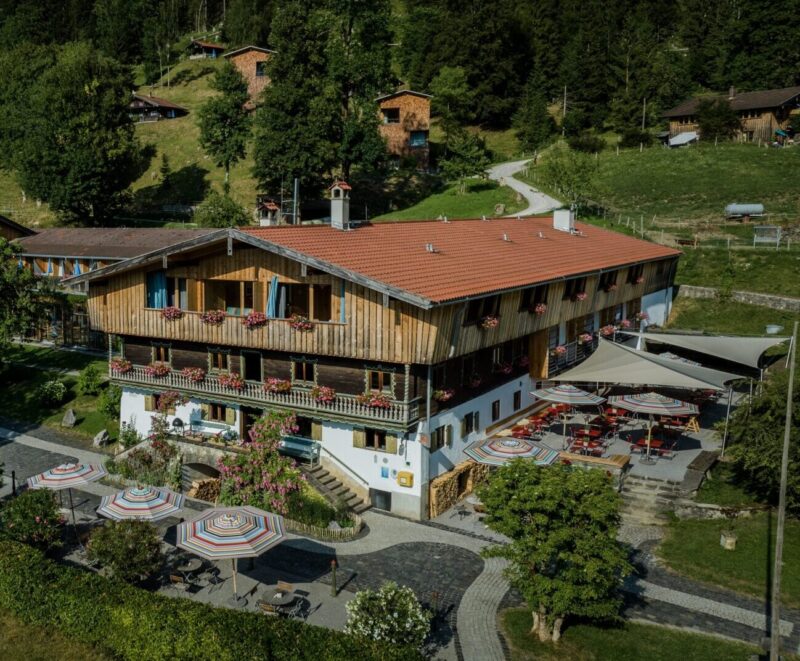
The drive leads along country roads, past fields and avenues of trees, deeper and deeper into stillness. Then a village square, a yellow manor house, a fire pond, old trees all around. Whoever arrives here has left the sea behind and chosen its hinterland instead—and comes upon something improbable: a manor house on whose upper floor international artists engage with the crane, while below and under the roof above, the guests sleep.

The Location
Hessenburg lies on the southern Bodden coast, two kilometres from the Saaler Bodden, on the edge of the Vorpommersche Boddenlandschaft National Park; the open Baltic begins a good half hour further on. Rostock and Stralsund are each forty minutes away.

The estate, which shares its name with the village, covers eight hectares: an ochre-yellow manor house from 1840 at its centre, a wide courtyard in front with a fire pond, an old smithy and a wheelwright’s workshop, and behind it a park of four and a half hectares with trees spanning several generations. From outside, a quiet, almost austere manor house. Inside, the building’s layers of time have been left standing, and the new set carefully among them. Out in the fields, depending on the season, stand the cranes.
Backstory
People had already settled where the manor house now stands as far back as the 13th century; on the hilltop to the northeast sat the knight Antonius von dem Bughe. In 1840 the von Hesse family built the present house and gave the place its name. After decades of GDR-era farming and years of decline came art historian Dr. Bettina Klein—drawn, as she tells it, by the cranes.

© Phillip Obkircher
She bought the estate, restored it with care, and opened the museum in 2011, the hotel in 2015. Klein often shows guests through the house herself, explaining the works, the history, the birds. Without her, Hessenburg would be a beautiful, empty farmstead. Together with the American artist, curator and architect Alex Schweder, and the architect Clemens Klein, Bettina Klein created an overarching artistic concept.


Interior & Architecture
After an extensive restoration, Schweder designed the manor house’s interiors in the spirit of his “Performance Architecture”: historic masonry left raw beside clean, modern fittings. Museum and hotel merge into a single work of art that keeps the building’s layers of time legible; the new interventions stay in the background. The museum occupies the entire upper floor, some 400 square metres across twelve rooms, with a library and reading room.

The house is animated by the artists themselves. An outside curatorial board selects them; under an artist-in-residence programme, international guests spend several weeks on the eight-hectare estate, work with the place and its history, and leave the resulting paintings, videos or installations to the house collection. Their traces reach into the apartments, so that the passage from museum to hotel stays seamless. The four-and-a-half-hectare park, with its orchards and avenues, was regenerated between 2015 and 2020 by landscape architect Ludivine Gragy, both for heritage preservation and ecology. Whatever did not need restoring was left as it was.
A Look Inside
Spread across the whole estate are thirteen units: six rooms on the ground floor of the manor house, two apartments beneath its roof, three in the garden house—the former ice house—and two in the apartment above the old smithy. Each is furnished individually: bright, modern interiors set behind old brickwork, a kitchen or kitchenette, room for self-catering.

Prices run from around 89 to 245 euros; the garden house is the largest, almost a small house of its own. Breakfast comes flexibly on a tray, and you choose where to have it — in your room, in the seminar room, somewhere in the park.


The museum on the upper floor stays open to guests around the clock, which gives the nights a mood of their own: alone with video works and installations, the calls of the cranes outside. Sleep comes easily, in quiet rooms where no television competes for your attention.


Culinary
Cooking happens at the Kranich Café, housed in the old estate smithy. There’s homemade cake and tart, good coffee and tea; small dishes can also be combined into a three-course meal with a glass of wine. You sit by the forge fire or outside on the terraces under old fruit trees. The catch: the café opens only seasonally, from April to October, on weekends and holidays between noon and five.

Anyone hungry in the evening or out of season cooks in their apartment—self-catering is part of the concept here—or drives to the coast. Worth the trip are the inns in Ahrenshoop and Dierhagen, from a fish roll at the harbour to upscale dining with Bodden fish and game from the region.


For your own kitchen, it’s worth the detour to the farm shops nearby: mustard and oil producers, pottery, smoked goods from the Bodden.

Wellness & Relaxation
The house spa is small and sits where you wouldn’t expect it: in the vaulted cellars of the manor house, where a sauna has recently been installed, along with a few treatments. But the real rest comes from outside. Four and a half hectares of parkland, with old trees, orchards and a pond, invite you to do nothing; two kilometres away lies the Saaler Bodden with its shallow bathing spots.

Those wanting more can book one of the fasting-hike programmes, or a yoga retreat in the light-filled seminar rooms. In the evening it turns completely silent, but for the cranes, sending their trumpeting calls across the fields in the distance. A holiday rarely gets quieter than this.


Surrounding Area
The Saaler Bodden lies two kilometres away, and beyond it begins the Vorpommersche Boddenlandschaft National Park. In March, and again in October, thousands of cranes turn the surrounding fields into a stage; their dance, and their evening descent onto the roosts, rank among the most striking sights this coast has to offer. Culturally, the first stop is Ahrenshoop, the old artists’ colony, whose thatched art museum shows contemporary and classical modern work. The late-Gothic village churches in Saal, Lüdershagen and Kenz hold renowned organs, on which concerts are given in summer. Anyone after craft will find small potteries in Saal, Schlemmin and Wustrow, along with mustard and oil producers for the kitchen at home.


Worth a visit for nature is the NABU crane information centre in Altenpleen/Günz, the most honest window onto bird migration for miles around. A little further on wait the wild Weststrand beach with driftwood and amber, the Klockenhagen open-air museum, and the amber museum in Ribnitz-Damgarten. The Hanseatic towns of Rostock and Stralsund are each forty minutes away; Stralsund draws visitors with the Oceaneum and a brick old town under Unesco protection. On the Bodden, the brown-sailed Zeesboote still sail; a trip on one shows living craft at work. In Ahrenshoop, the Bunte Stube, one of the coast’s oldest bookshops, has kept literature and prints on its shelves for over a hundred years.
Activities
For crane watchers: March and October in the fields around Hessenburg, viewing tips from the NABU centre in Altenpleen/Günz, the evening descent onto the roosts.
For art lovers: the house’s own museum, open around the clock, the Ahrenshoop art museum, following the artist-in-residence programme.
For beachgoers: Fischland-Darß-Zingst, the wild Weststrand for amber hunting, the Hohes Ufer cliffs near Wustrow.
For water-sports enthusiasts: kitesurfing and stand-up paddleboarding on the Bodden, sailing on a Zeesboot, boat trips into the reserve.
For cyclists: signposted Bodden loop routes, e-bikes on site, tours into the national park.
For riders: beach rides with the Bernsteinreiter in Barth.
For those seeking quiet: fasting hikes, a yoga retreat, the vaulted-cellar sauna, doing nothing in the four-and-a-half-hectare park.


For families: the Marlow bird park, the Klockenhagen open-air museum, the shallow bathing spots on the Bodden.
For culture travellers: organ concerts in the late-Gothic village churches, the potteries nearby, the Bunte Stube in Ahrenshoop.
For gourmets: mustard and oil producers, smoked goods from the Bodden, the inns of Ahrenshoop and Dierhagen.
For city travellers: the Hanseatic town of Stralsund with the Ozeaneum and its Unesco old town, Rostock, each forty minutes away.
For birdwatchers beyond the crane: sea eagles and ospreys, geese and ducks in the national park, best at dusk with binoculars.
For architecture and garden enthusiasts: the estate park regenerated by Ludivine Gragy, with its medieval hilltop mound and the KRANICH trail.
For rainy days: the amber museum in Ribnitz-Damgarten, then cake by the forge fire at the Kranich Café.
For romantics: a horse-drawn carriage ride through the avenues to the crane fields, best at sunset.

© Phillip Obkircher

© Phillip Obkircher
Details
- Rooms & Apartments: thirteen units (6 rooms on the ground floor of the manor house, 2 apartments in the attic, 3 in the garden house, 2 above the Old Smithy); largest and most expensive: the garden house (from €245)
- Museum: contemporary art across 400 m², upper floor of the manor house, open to guests around the clock
- Café: Kranich Café in the old smithy (Apr–Oct, Sat/Sun and public holidays, noon–5pm)
- Wellness: sauna in the vaulted cellar, treatments; fasting hikes, yoga retreats
- Conferences / Weddings: light-filled seminar rooms, registry-office branch on site
- Breakfast: flexible, served on a tray
- Location: Gutshof Hessenburg, Dorfplatz 2–5, 18317 Hessenburg/Saal; estate eight hectares, park four and a half hectares
- Website: kranichhotel.de

© Phillip Obkircher