

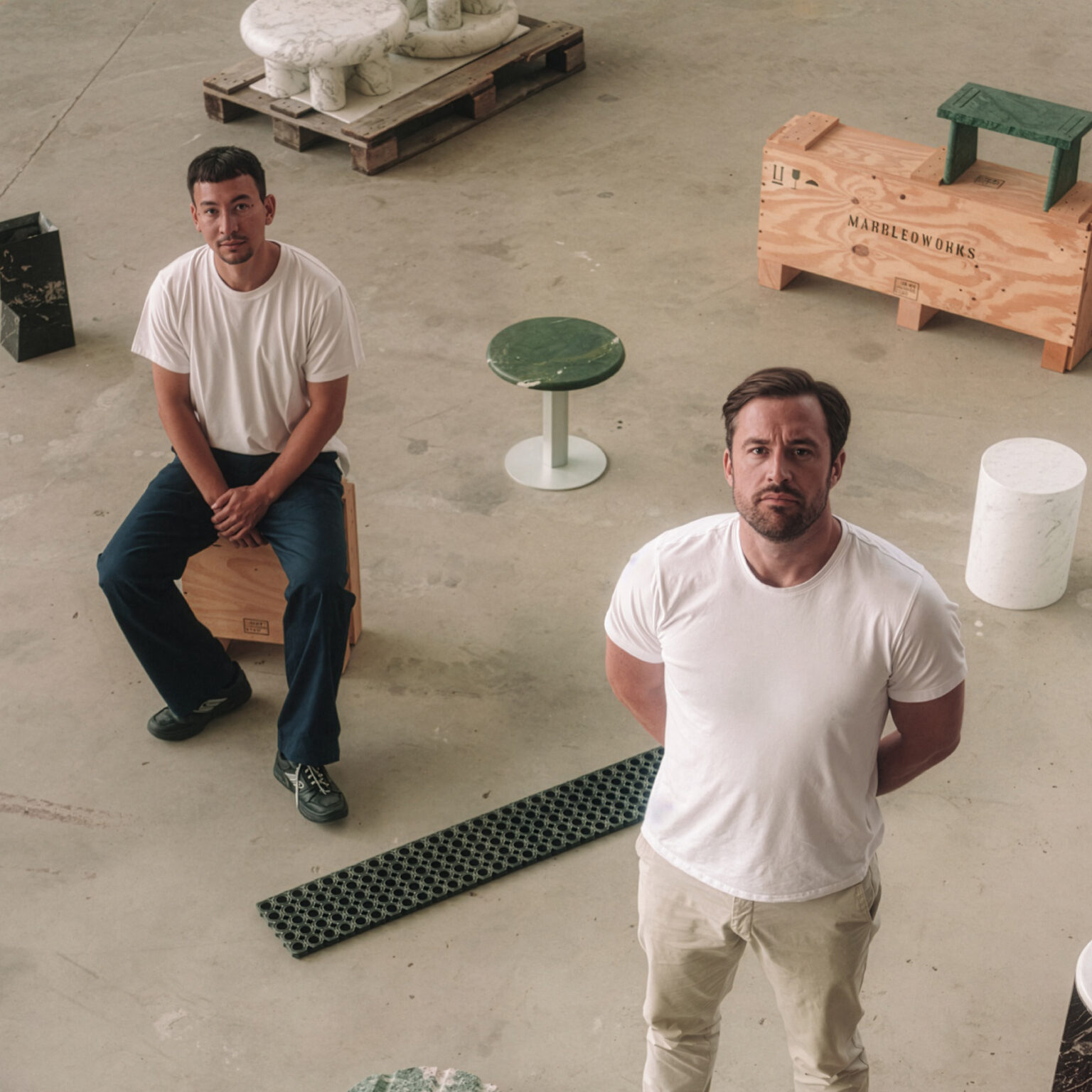
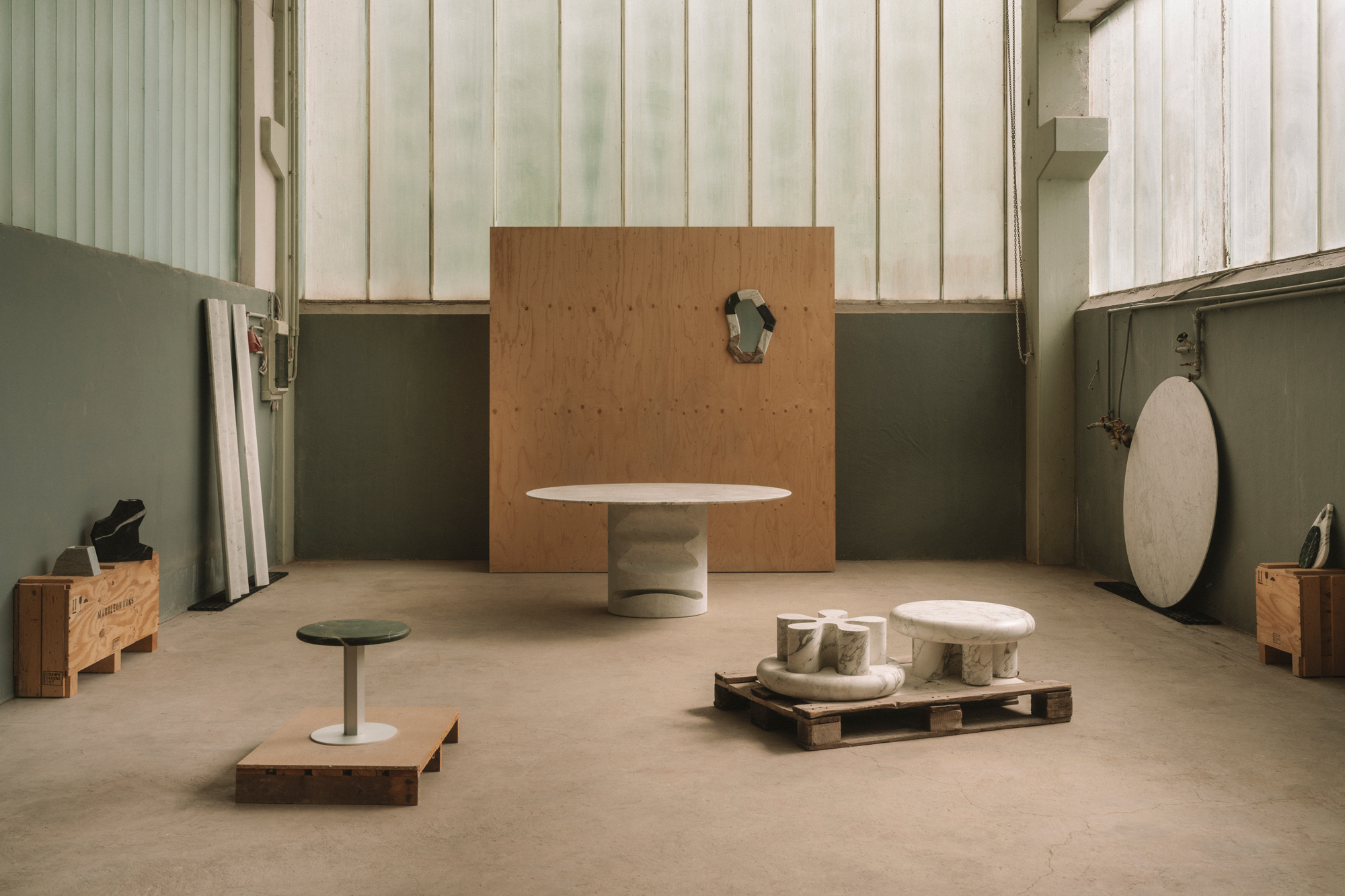
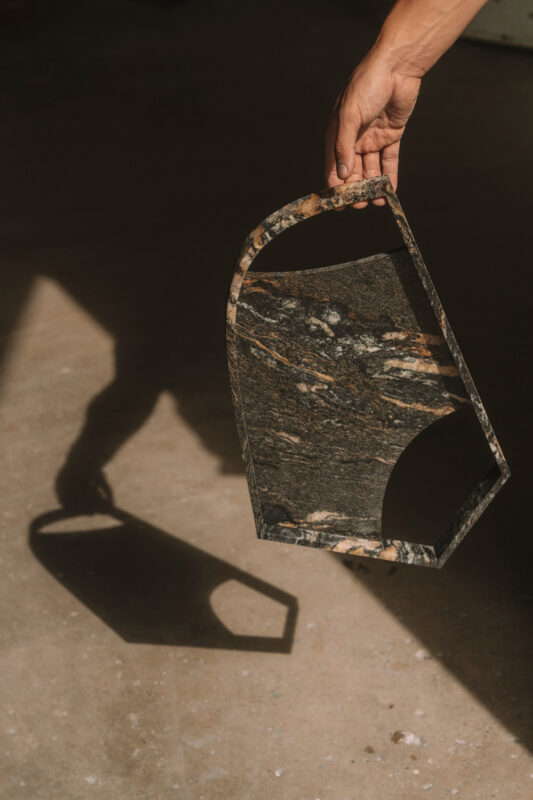
Marbledworks, founded by Maximilian Huber and Dominic Kim, approaches stone as something alive rather than fixed. Their work shifts stonemasonry away from tradition alone, turning it into a field for testing forms, textures, and unexpected typologies. Each piece begins with a close, almost tactile understanding of the material—its weight, its fractures, its journey from quarry to object.
© Photo by Clemens Poloczek
Which place do you currently call home and where do you work on your projects?
We’re based northeast of Munich, where our studio and workshop share the same roof. It was a deliberate choice—we wanted creative and production thinking to be in constant dialogue. Munich offers the right balance: a serious design culture, proximity to Italy’s stone quarries, and access to skilled craftspeople within a small radius. The city has a quiet confidence about craft and quality that aligns with how we think about work.
Where is your studio located & how does it look?
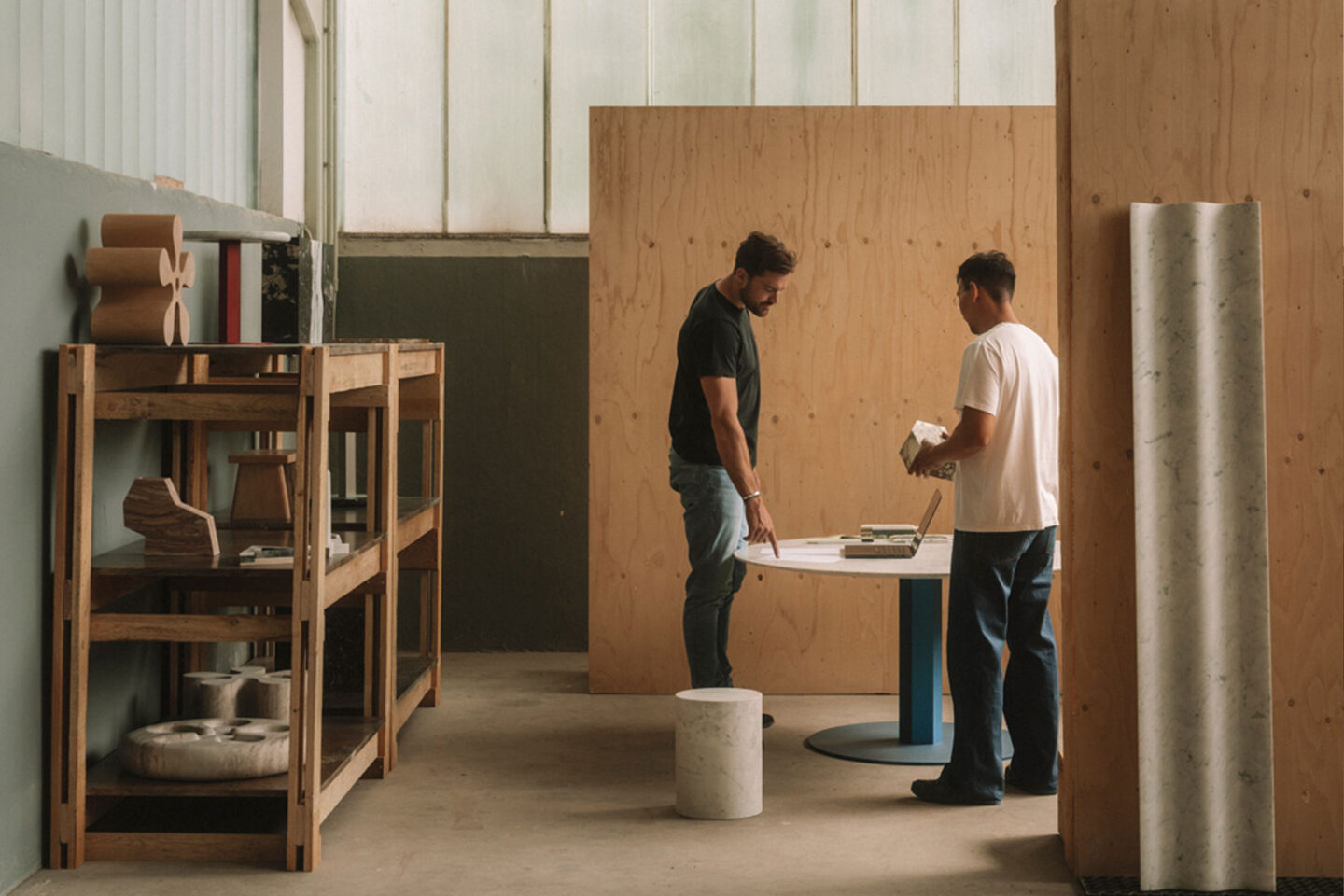
Our studio sits directly above the production hall. You can hear the saws, the polishing machines, the cranes—it’s not background noise, it’s part of the process. The space is minimal: long worktables, material samples scattered across surfaces, 3D models next to stone fragments. Large windows overlook the workshop floor, so we can walk downstairs at any moment to test an idea at real scale. It’s less “studio” in the romantic sense and more a place where thinking and making happen simultaneously.
The workshop itself holds machinery from Max’s family—four generations of stone-working equipment, some industrial, some handed down. There’s something grounding about working in a space where the tools have their own history. That continuity isn’t nostalgia; it’s infrastructure.
© Photo by Clemens Poloczek
Are there any projects that are personally important to you—whether recently completed or currently in progress?
The collaboration with Gonzalez Haase AAS during Berlin Art Week 2025 was significant—it pushed us beyond furniture into spatial thinking and scenography. That partnership has continued since, with new ideas and projects still developing.
On a broader level, we’re rethinking our approach. We’re moving away from manufacturing everything in-house in Germany toward becoming a design studio that curates and directs craft—building partnerships with specialised fabricators internationally. We think of Marbledworks first as a brand, and everything we develop from here will grow from that foundation.
© Photo by Clemens Poloczek
© Photo by Clemens Poloczek
Do you have a favourite place in your area where you like to relax and linger?
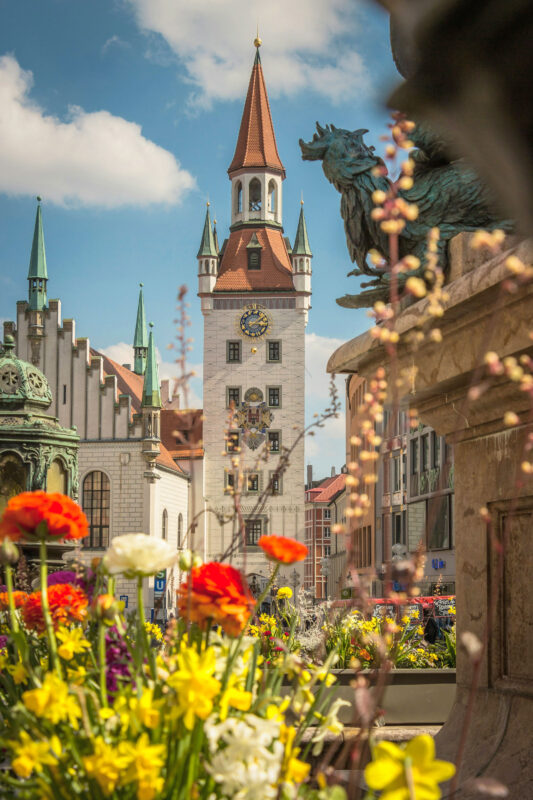
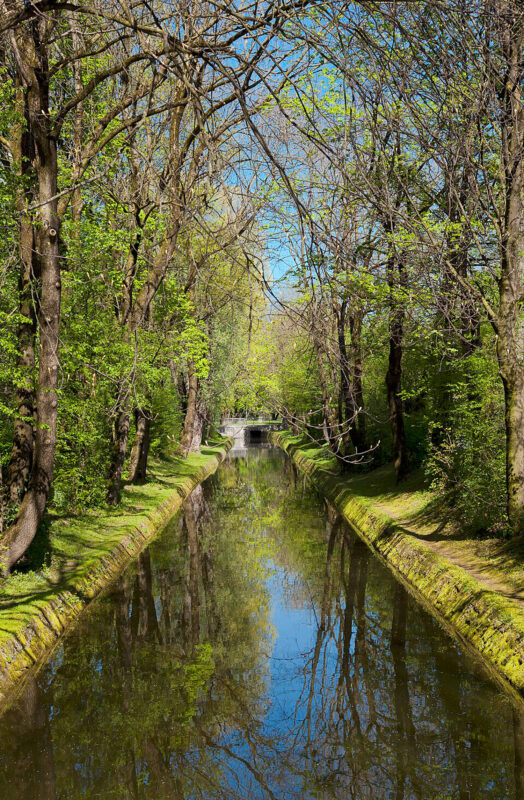
We both feel a strong connection to Maxvorstadt, which reminds us of our time studying there. The district was developed in the early nineteenth century as a planned extension of Munich and is laid out on a clear grid that contrasts with the historic centre. Its large cultural and academic buildings—the Pinakotheken, the university—sit alongside green spaces and lively streets in a way that creates genuine openness. There’s always something worth looking at, particularly in summer. The Alte Pinakothek is probably where we end up most often—the permanent collection has a quietness to it that consistently refreshes how we’re thinking.

© Photo: Anastasiya Dalenka on Unsplash
Are there any urgent political issues or problems in your region?
Housing. Munich has become almost unaffordable for young creatives and craftspeople—for anyone not in finance or tech. The irony is that the city prides itself on quality and craft, but the people who create that quality can’t afford to live here. Studios are disappearing; workshops are being converted into luxury apartments. We’re fortunate to have our space, but we watch talented people leave every year.
The other issue is the slow erosion of manufacturing in Germany. Everyone invokes “Made in Germany,” but fewer people want to invest in the infrastructure that makes it possible—the training programmes, the workshops, the machinery. People see a marble bowl for fifteen euros at a chain store and assume stone is cheap. That price reflects neither the labour, nor the origin, nor the time required to handle a finite material. If that understanding is lost, we’ll become a country that designs but can no longer make.
In your opinion, what has developed well in the last 5 years—and what has not?
What has developed well: genuine appreciation for craft and material authenticity has grown. People are questioning fast consumption, asking where things come from and how they’re made. Design literacy has improved—customers understand modular systems, repairability, the value of joinery over glue. The design community in Munich has also become more collaborative and less competitive.
What hasn’t kept pace is the infrastructure to support that appreciation. Skilled labour is scarce. Young people aren’t entering the trades—stone-working, carpentry, metalwork—because the pay and perception don’t match the skill required. And despite all the talk about sustainability, the economic system still rewards cheap and fast over durable and considered. Appreciation without infrastructure is just sentiment.
© Matthias Schröder auf Unsplash
© Diego Delso, Parque Olímpico, Múnich, Alemania 2012-04-28, DD 18, modified, CC BY-SA 3.0
Do you know a hidden gem when it comes to local manufacturers—whether it’s arts and crafts, sustainable products or food?
A place we find genuinely compelling is the stained glass workshop Die Münchner Werkstätten Gustav van Treeck. We came across it while spending time in the city, and what struck us was how present this craft is, yet how easily it goes unnoticed. Their work sits between art and architecture in a way that feels close to what we try to do. Each piece is painted, fired, and assembled by hand, and only fully comes to life through light. There’s something in that condition that speaks a truth about making: so much of the atmosphere of a space depends on what is most subtle and most overlooked.
What also moves us is the continuity. In a time when most production is industrialised, it feels rare to encounter a place where knowledge is still passed from person to person, rooted in the city itself. It represents a slower, more considered way of working—one that values durability, detail, and cultural memory. These are things we think about every day.
Is there anything particularly innovative in your region? Also in comparison to other places you have already visited?
What we find most innovative about the region isn’t concentrated in a single place or product—it emerges from the network. The area has an extraordinarily dense ecosystem of specialised producers: manufacturers, suppliers, engineers, and research institutions, each contributing deep expertise in a specific field. What stands out is the culture of precision. Many companies focus on a very specific component or process, yet together they form something far more advanced than the sum of its parts.
Compared to other places we’ve visited, this depth of industrial knowledge feels rare. In some regions, innovation is driven by startups or digital platforms; here it is rooted in engineering, material understanding, and long-standing production experience. For us as designers, that environment is invaluable. It lets us engage with materials, processes, and manufacturing constraints directly — not only designing concepts, but thinking through how things are actually made. The gap between design and production is where most of the interesting work lives.
Do you have a secret restaurant tip that you would like to share with us?
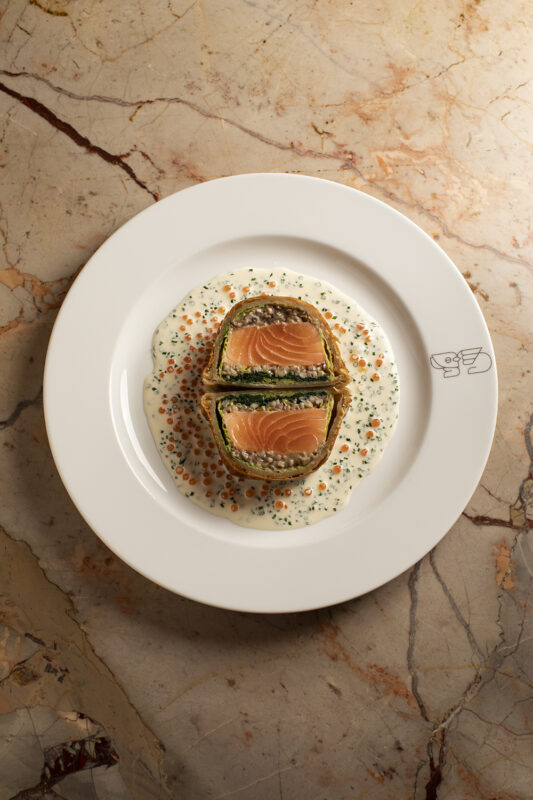
Tantris DNA. It’s not exactly a secret—it holds Michelin stars but the approach is worth noting: they source obsessively, treat ingredients with genuine respect, and the space itself is an unapologetic piece of 1970s brutalist design that has never been “updated.” There’s a conviction there that good design doesn’t need to chase trends. That feels directly related to how we think about objects.
© Tantris DNA, Photo by Joerg Lehmann
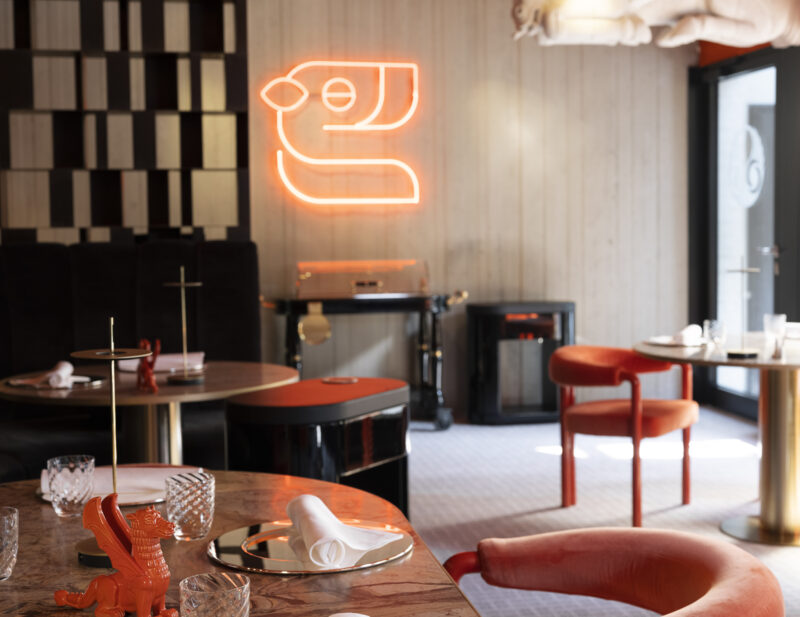
© Tantris DNA, Photo by Joerg Lehmann
Is there a local shop whose products are only available in your region?
Manufactum started in Munich, and the original store here still has the best curation, there’s an accumulated logic to it that the newer locations haven’t fully replicated. It’s grown into something different now: more widespread, more known. At some point that’s inevitable, but something does get diluted. The original idea was almost philosophical—things that last, things that work properly, things designed with intent. The selection doesn’t chase trends, because trends don’t change what constitutes a well-made object. What’s harder to hold onto as a shop expands is precisely that specificity: the sense that this place belongs to this city, that you couldn’t find it the same way anywhere else. That’s what globalisation does to shops, and by extension to cities. They become less themselves. Munich has lost several places like that in the last decade, and you feel it.
What are your 3 favourite apps that you use every day and couldn’t live without?
ChatGPT and Claude have become essential parts of our daily workflow — from logistical questions and contract matters to researching producers and thinking through material combinations. Between them, they cover a breadth of tasks that used to take considerably longer.
Are.na keeps us connected to other designers and the broader creative community. It’s where we collect references, follow ongoing conversations in design, and let ideas accumulate slowly rather than scroll past. The pace of it matters.
YouTube functions almost like a library—tutorials, lectures, documentary material. Whether we’re learning a new process or going deeper on a specific topic, it plays a steady role in how we develop.
Do you have any favourite newspapers or online magazines? And how do you keep up to date with politics or social and cultural issues?
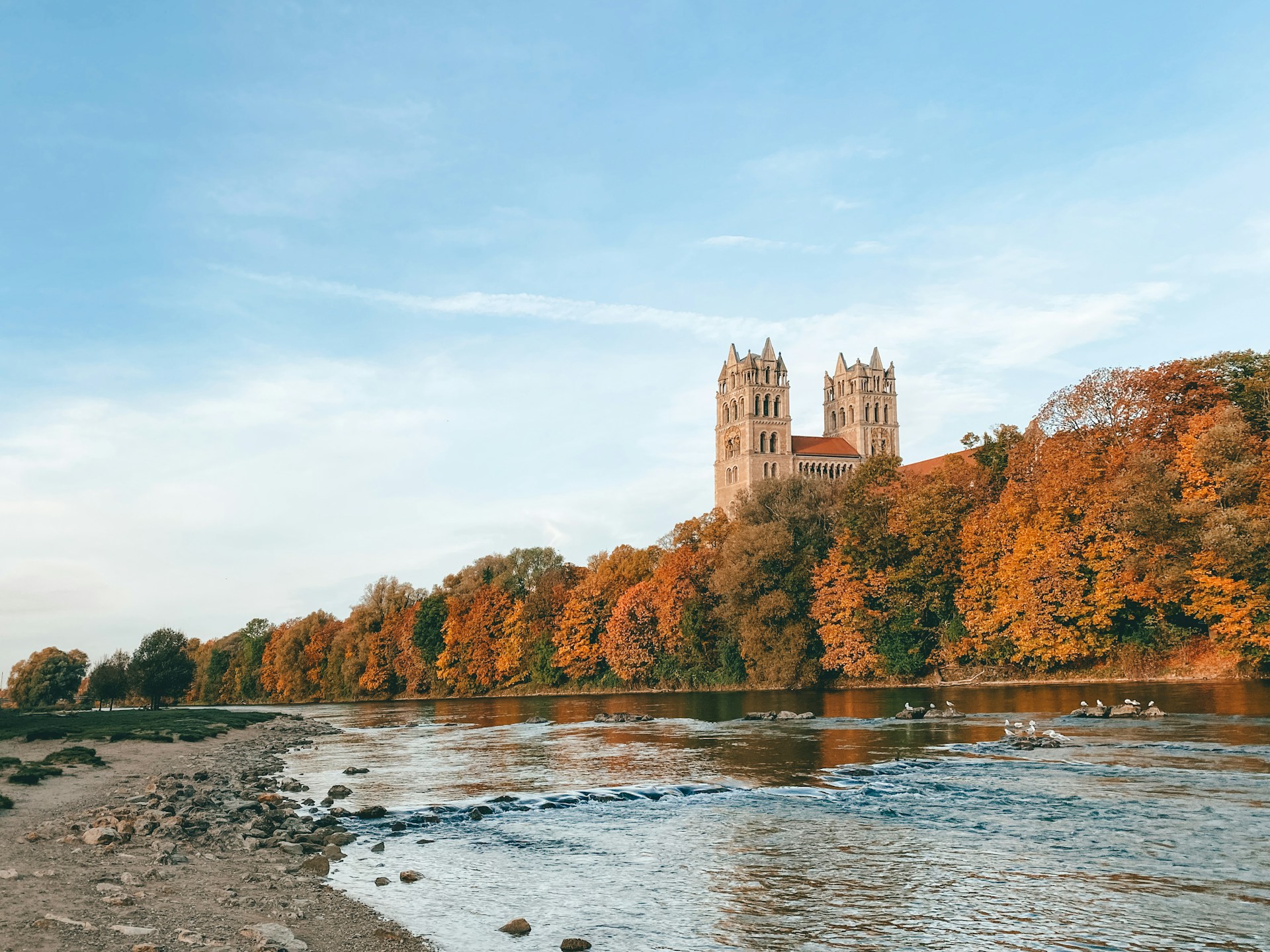
In print, we read The Economist regularly, it’s one of the few places that still takes the time to explain context rather than just report events. We also hold onto old issues of AD and McGuffin. AD works almost like a time capsule—you pick up an issue from ten years ago and it’s a precise screenshot of what a certain period believed good living looked like. McGuffin is the opposite: it slows everything down and commits fully to one object, one material, one typology per issue. That kind of mono-typological depth is close to how we think about our own work. You can’t say everything—you have to commit to the thing in front of you.
© Jan Antonin Kolar on Unsplash
Imagine you could be mayor for a year—what would you change?
We’d focus on protecting the conditions for careful, considered work. In practical terms: securing affordable workshop spaces for small manufacturers, funding apprenticeships in traditional trades, and creating a public material library for designers and architects—a shared resource where people can work with stone, wood, metal, and glass without needing to own the infrastructure themselves. The most important things a city can do are often the least visible: keep the conditions right, and the work follows.
One last question: If you could choose another place to live—regardless of financial or time constrains—which one would you choose?
Somewhere still in the process of becoming. A city where the frameworks aren’t fully set, where there’s still room to help shape what a place turns into—its cultural institutions, its manufacturing scene, its relationship to craft and making. Somewhere like Tbilisi, or perhaps a mid-sized city in Southeast Asia that’s finding its design identity. The most interesting work happens in places that are genuinely open to change, not merely tolerant of it.
We’ve both spent time in cities that have already arrived—Munich, Frankfurt, Zurich and they’re extraordinary, each for different reasons. But there’s something particular about being present at the beginning of something. That’s where our instincts tend to go.


