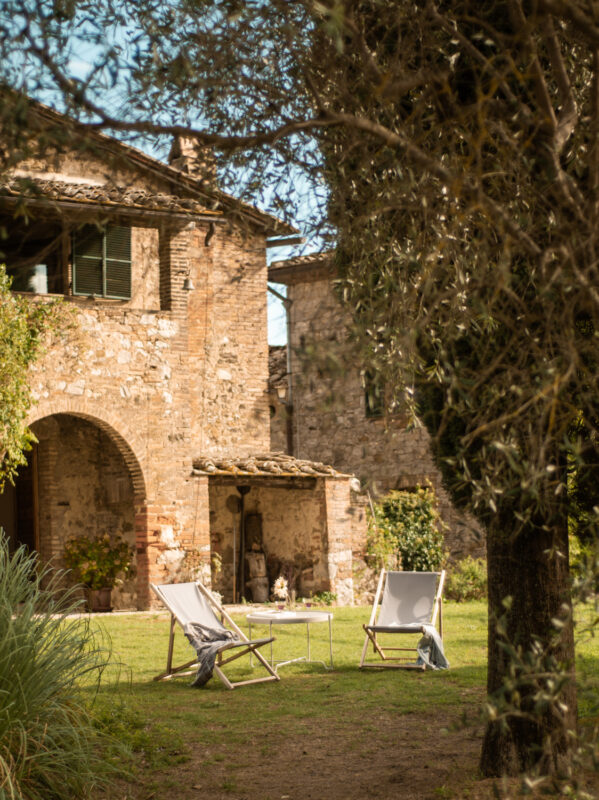
The road to San Casciano dei Bagni cuts through a Tuscany that hasn’t yet made it onto every postcard: bare hills where Tuscany, Umbria and Lazio meet, the old Via Cassia running between them. Just before the village, in the hamlet of Palazzone, a track branches off between rows of vines. At the end of it, below Monte Cetona, waits a country house that looks more found than built.

The Location
San Casciano dei Bagni sits at the southernmost edge of the province of Siena, right where Tuscany, Umbria and Lazio blur into one another. The village is known for its thermal springs, used since Etruscan times, and belongs today to the network of Italy’s most beautiful villages.

Godiluva lies outside it, in the hamlet of Palazzone, among the vineyards of Podernuovo a Palazzone. The house holds itself back: pale, elongated volumes that settle into the curve of the hills, no gesture louder than the landscape around it.


Backstory
Giovanni Bulgari is the son of Paolo Bulgari, who ran the family firm together with his brother Nicola until its sale to LVMH in 2011 — great-grandson of founder Sotirio Bulgari, who opened the jewellery workshop in Rome in 1884. Giovanni himself spent years in the family business as a gemologist, travelling the world to select stones, before turning to agriculture. In 2004, together with his father, he bought the overgrown estate in Palazzone and replanted it, chiefly with Sangiovese, Cabernet Franc and Cabernet Sauvignon. Godiluva followed later, as a guest house for the estate, holding an art collection Giovanni has assembled himself, much as his mother once ran a well-regarded gallery in Rome. The house today is run by Bruno Bosio, who spent decades managing hotels and restaurants in northern Italy before coming south.


Interior & Architecture
There is no architect behind Godiluva — Giovanni Bulgari built the house together with a friend, working by feel rather than by plan. Deliberately mixed styles run through the rooms: different decades, different moods, no throughline except Giovanni’s own eye. The beds and sofas come from a small workshop in Orvieto, ten craftspeople working entirely by hand, who also furnish grand houses in Rome and London.

Large windows bring the landscape into the house rather than keeping it out; inside and outside blur together, with one kitchen indoors and a second outdoors, built for long evenings. Between the rooms hangs art Giovanni has collected on his travels, from twentieth-century names to contemporary photography. The name Godiluva itself nods to Villa Godilonda, a reference to family history and to the sensibility of Gabriele D’Annunzio, the poet who treated luxury as an art form.


A Look Inside
Five suites, each with its own bathroom and its own character — some with a small private sitting room, others with their own terrace. The generous living spaces are built for groups who travel together but still need somewhere to retreat to.

The kitchen exists twice over: a classic eat-in kitchen indoors, a second one under the open sky, looking out over the vineyards. Details like towel quality, linens and lighting meet the standard you’d expect from a house of this pedigree, without any of it feeling like a display. In total, the house sleeps up to ten guests, who have it entirely to themselves.


Culinary
Breakfast is not automatically included, but worth requesting: house manager Bruno Bosio sources it himself, bread and pastries from a particular bakery, real ricotta, real eggs, organic fruit flown in within a day or two rather than shipped for weeks. Served indoors or on the terrace, depending on the weather. For dinner, a personal chef can be brought in, cooking with produce from the surrounding area.

The real culinary centre, though, lies just a few steps away: the winery of Podernuovo a Palazzone, the estate Godiluva belongs to. Winemaker Jacopo Felici is behind wines made from Sangiovese, Cabernet Franc, Cabernet Sauvignon, Merlot, Petit Verdot and a little Malbec, alongside Chardonnay and Grechetto from vineyards on Lake Corbara in Umbria. Tastings can be booked on site, in a winery building that architects Alvisi Kirimoto set into the shape of the hillside itself.


Wellness & Relaxation
The spa has what a house in this category simply has: sauna, gym, pool. What stands out is the wood-fired hot tub outside, which makes just as much sense in winter, when steam drifts out over the vineyards.

At sunset, yoga is offered in the garden, Hatha or Yin depending on what’s needed — not a fixed programme, more an option for anyone wanting to close the day deliberately.


Wellness here mostly means control over your own pace: anyone who wants to swim, swims; anyone who’d rather sit on the terrace with a glass of wine and watch the hills go dark gets just as much room for that.

Surrounding Area
San Casciano dei Bagni is officially ranked among Italy’s most beautiful villages, awarded the Touring Club’s Bandiera Arancione. More recently, though, the village became known for a chance discovery: excavations at the Bagno Grande in 2021 and 2022 uncovered dozens of bronze votive figures, remarkably preserved after lying more than two thousand years in the warm thermal mud — one of the most significant archaeological finds in Italy in decades. Some of them can now be seen at the Museo del Santuario Ritrovato, right in the village.

© Gabriel Tovar, Unsplash
Anyone after something more classic can bathe at Fonteverde, the thermal resort built on a Medici villa. A short drive away, in Montegabbione, La Scarzuola is a genuine oddity: a surreal stone ‘ideal city’ built from the 1950s onward by the architect Tomaso Buzzi inside a former Franciscan convent, still tended today by a foundation, and rarely crowded. The area sits on the border of three regions; if you wanted to, you could have breakfast in Tuscany and lunch in Umbria. Montepulciano, Pienza, Montalcino and Chiusi with its Etruscan museum are all within easy reach, along with Orvieto and its Gothic cathedral. The ruined castle of Fighine, once the seat of power over the land Podernuovo now occupies, still stands on the hill opposite.

© Ввласенко, La Badia di Orvieto in springtime. Italy, adj. colours, CC BY-SA 3.0

© PROPOLI87, Chiusi – Al lago, adjusted colours, CC BY-SA 4.0
Activities
Anyone wanting to explore the area beyond the house will find a first sorting by interest here.
Wine & Food
- Tastings at Podernuovo a Palazzone, right on site
- Truffle hunting with local trifolau, in season
- Olive oil tastings with small producers in the region
Culture
- Museo del Santuario Ritrovato in San Casciano dei Bagni
- The Etruscan museum in Chiusi
- The ruined castle of Fighine, opposite the estate
- La Scarzuola, Tomaso Buzzi’s surreal ‘ideal city’ near Montegabbione
- Evening aperitivo on the piazza in Cetona


Thermal & Relaxation
- Fonteverde, the thermal resort on a Medici villa
- The public thermal springs in the centre of San Casciano dei Bagni, free to use
Active & Outdoors
- Hiking through the hills where Tuscany, Umbria and Lazio meet
- Cycling along the old Via Cassia
- A trip to Lake Corbara in Umbria
Distinctive Experiences
- Guided Vespa tours through the countryside
- A private classic-car collection in Sarteano, with rides arranged
- Fresh pasta workshops and wood-fired pizza evenings with the house team


Details
- Five suites for up to ten guests, each with its own bathroom
- Eat-in kitchen indoors and outdoors
- Spa with sauna, gym, pool, wood-fired hot tub
- Garden with sunset yoga
- Breakfast on request, personally sourced by the house manager
- Wine tastings at Podernuovo a Palazzone, a few steps away
- House manager: Bruno Bosio
- www.godiluva.com