
The road to Bellagio curves along the shore, past villas with a view of the water. Turning off towards Pescallo, you leave the promenade’s bustle for a narrow climb between gardens. Upstairs, there’s no classic reception. The first thing you see is the lake, through the open terrace door.

The Location
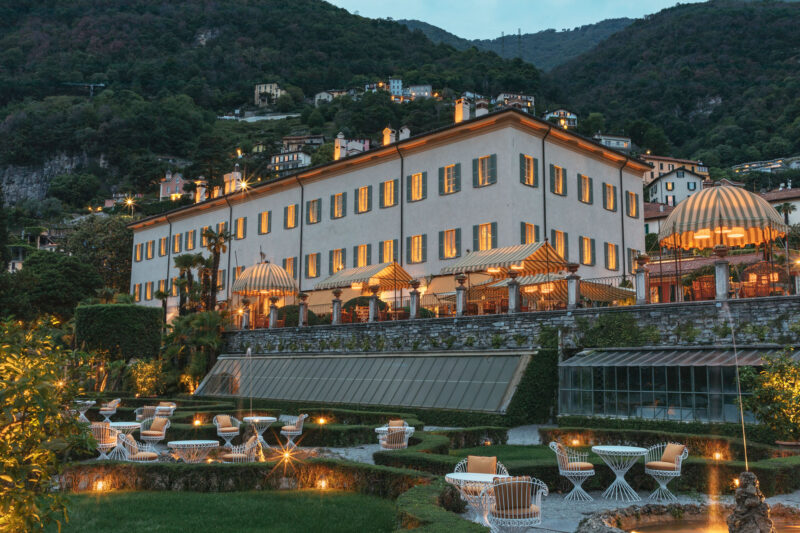
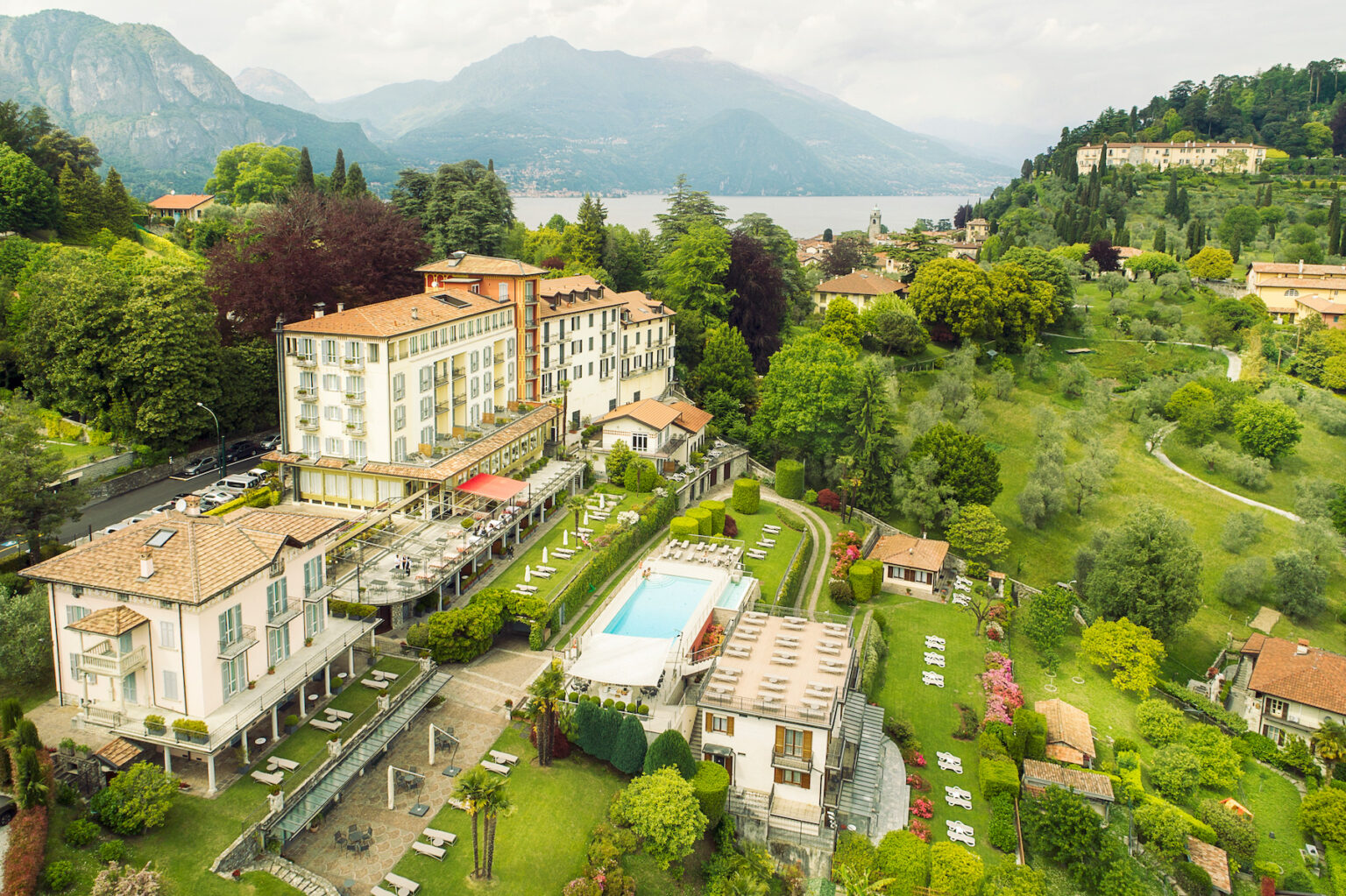
Bellagio sits on the headland where Lake Como splits into two arms, the Alps forming a backdrop on the far side. The Belvedere lies above the former fishing village of Pescallo, a fifteen-minute walk from the busy centre, separated from the worst of the crowds by a single-lane road. Climbing the hill, you see the terraced garden first, then the pale façades of the main building among old trees. From the upper terraces, the view opens onto the Lecco arm of the lake, onto Pescallo and the mountains behind – a view that gave the house its name, long before ‘Belvedere’ became the default name of every hillside hotel.

Backstory
In 1880, the great-great-grandmother of today’s proprietor, Giulia Manoni, opened a two-storey guesthouse above Pescallo, intended for the merchants travelling the lake. Over the generations the house grew, chiefly under Giulia’s grandfather and great-grandmother, who bought up every adjoining plot as soon as it became available.

That leadership mostly stayed in female hands was more circumstance than principle: the men of the family were often occupied elsewhere, and two world wars did the rest. Giulia’s grandmother took over, supported by her husband Luciano, then Tiziana, the only child. Today Giulia runs the house; her mother remains closely involved, particularly in renovations and in the transition of the finances. Giulia herself describes the handover as continuity.

© Belvedere Bellagio

© Gianni Baumann
Interior & Architecture
The main building grew out of three historic structures, extended over the generations and later joined by a tower. Proprietor Giulia Manoni, an architect by training, grew up around the furniture houses Cappellini, Cassina and B&B Italia, and lets that grounding shape every renovation: new elements are chosen with restraint, nothing should look too obviously new or fashionable.

In the restaurant, the original tiled floor survives, patched in places with visibly different replacement tiles, a flaw the family has come to appreciate. For technical reasons, there are plans to replace the windows from the 1960s, though their shape will remain unchanged.The chairs from the same period are only ever reupholstered, never altered in shape. One room alone has stayed completely untouched since 1880: the wine cellar.


A Look Inside
Lobby and lounge areas are kept deliberately small; the house relies on terraces and library rather than scale. 51 rooms, suites and apartments span the main building, two garden villas and an annexe, rising to 56 next season: over winter, the fourth floor went from eleven rooms to six larger ones, the roof renewed at the same time.

Craftsmen from the region built the furniture, designed by Giulia Jannello, in oak, with bathrooms in Carrara and Verona marble.


Suites such as the Panorama or Tower Suite offer private balconies with lake views, the Signature Suite its own garden. The four apartments carry the family’s women’s names: Maria, Tiziana, Antonietta, Lucia.


Culinary
Albòri, the restaurant at the heart of the house, takes its name from a Sardinian dialect word for the moment just before sunrise. Chef Marco Mulas arrived five years ago as sous chef, in a transition year following the departure of the previous chef, trained at Orient Express.

Giulia Manoni and her husband Mattia recognised their own philosophy in Marco’s cooking and made him head chef the following year. Two years of fine-tuning followed, then the decision for a profile of its own: accomplished cooking that never feels inaccessible, familiar dishes alongside more ambitious compositions.


Sommelier Stefano Orrù, Marco’s best friend from the same Sardinian village, joined the house over a bottle of Rinaldi from 1967, opened after an evening together, and has worked here for a year.


Most of the producers Marco cooks with are known to the house personally. The wine cellar, unchanged since 1880, is Stefano’s territory.


Wellness & Relaxation
The heated outdoor pool sits between sky and lake, facing the mountainsides opposite; anyone who’d rather sit than swim finds the whirlpool alongside it.

The spa offers a steam bath, sauna, ice room and salt room, plus treatments with organic oils and natural essences that smell of herbs, not of a brochure. The gym is fitted with Technogym equipment for strength, mobility and endurance; two exercise bikes are positioned so training and the lake view don’t compete.


The garden itself, a good hectare in size, hides olive trees, azaleas and rhododendrons among its terraces – a garden size grown rare in Bellagio.


Surrounding Area
Directly below lies Pescallo, a former fishing village with a handful of boats. The path up from there to Borgo, Bellagio’s oldest quarter, passes lanes barely wider than the shutters lining them, ending at San Giacomo, a Romanesque church from the eleventh and twelfth centuries. In Borgo itself, look into the small workshops still working porcelain and ceramics by hand, away from the souvenir shelves on the lakeside promenade. Further on, the gardens of Villa Melzi offer a neoclassical ensemble with azaleas in bloom each spring, a few minutes’ walk from the town centre.

© GT
About an hour’s drive away, in Ossuccio opposite the Isola Comacina, La Velarca lies at anchor. The 1959 houseboat, designed by the Milanese studio BBPR, was once a meeting point for architect Gio Ponti and poet Eugenio Montale, who won the Nobel Prize in Literature in 1975. It now belongs to the Fondo per l’Ambiente Italiano and is open for visits. To explore the region on foot, take a stage of the Sentiero del Viandante between Varenna and Dervio, an old mule track high above the eastern shore. Wine lovers should make the detour into Valtellina, where Nebbiolo vines grow on terraces you’d hardly suspect from the road.


Right in the heart of the Borgo, near the Church of S. Giacomo, ‘Quelli della Pelle’ (Italian for the ones of the leather’) produce handmade leather goods. Founded in 1978 by a couple, the business is now run by three brothers. Their workshop is not open to visitors, but if you’re lucky, you might be able to catch a quick glimpse inside.
Activities
On the Water: Kayaking or stand-up paddleboarding off Pescallo, guided around the Bellagio peninsula, plus a sail on the Eagle 44, a yacht just over thirteen metres long, built in the style of 1930s J-Class racers. Those needing no yacht take the steps to the house’s jetty and jump in where none has yet anchored.


On Foot: The third stage of the Sentiero del Viandante between Varenna and Dervio, an old mule track high above the eastern shore, or the climb up Monte San Primo, whose panorama takes in the whole lake at once. For shorter walks, the path from Pescallo up to Borgo is enough, past gardens no one tends specially for visitors.
Culture: The gardens of Villa Melzi with their azaleas in spring, the Romanesque church of San Giacomo in Borgo, the small ceramics workshops there.


Taste: A wine tasting with sommelier Stefano Orrù, focused on Nebbiolo from the Valtellina and old Barolo vintages, a picnic between the garden’s two olive trees, or a visit to the herb garden with chef Marco Mulas, who translates his Sardinian roots into Lake Como’s cuisine, favouring neither.
Rest: Library and terraces, for days without a fixed plan.


Details
- 51 rooms, suites and apartments across the main building, garden villas and annexe, rising to 56 next season
- Largest suites: Signature Suite (60 m²), Terrace Suite and Courtyard Suite (52 m² each)
- Restaurant Albòri, chef Marco Mulas, à la carte and three tasting menus, one vegetarian
- Wine cellar unchanged since 1880, curated by sommelier Stefano Orrù
- Heated outdoor pool, whirlpool, spa with steam bath, sauna, salt & ice rooms, gym with lake views
- Garden of roughly one hectare
- Four apartments with kitchenette, named after women of the family: Maria, Tiziana, Antonietta, Lucia
- Pets welcome
- Free parking, shuttle to the ferry landing
- Open from late March/early April to late October