
What visitors should see in Oslo? The question seems simple, especially when it is put to the capital’s former mayor. Yet, Fabian Stang had to think for two seconds before murmuring: the surroundings. Not the Nationaltheatret. Not the museums. Not the fjord from the quays. The surroundings: the Marka, the forests, the islands, the trails. This is not false modesty. Nine Oslites out of ten, asked what makes their city special, mention the surroundings first. The city itself is passed over in silence, almost as though it were an anomaly in this nature, something to be ashamed of.
Oslo is a national waiting room. Everyone comes from somewhere else. Norwegians who settle here keep the dialect of their childhood, a gesture of honour, a signal of true belonging to a place that counts. In its cafés and shops coexist hardanger, telemark, sunnmørsk, the language of the deep north. One can spend an entire lifetime in Oslo and, deep inside, come in truth from Støren, from Sogn og Fjordane, from Kautokeino. The question “Where do you actually come from?” is not impolite in Oslo. It is an attempt to see into someone’s heart.
The writer Dag Solstad puts it with the particular precision of one who has chosen to stay without ever feeling at home: “My heart beats for this city, for its grey, restless big-city atmosphere, and yet I am not an Oslite. I live here because here I am a traveller. I live here because I do not want to live anywhere.”
The only major city in a country of 5 million inhabitants, called by its own national poet the Tigerstad, the city of tigers, cold and hostile to newcomers, is a city that has never quite decided what it thinks of itself.

© Photo:Arsene M Øvrejorde,Unsplash
The anthem that forgot its capital
This ambivalence is not a mood. It is encoded in the founding texts of the nation.
The Norwegian national anthem, “Ja, vi elsker dette landet”, composed by Bjørnstjerne Bjørnson (1832-1910), set to music by his cousin Rikard Nordraak and performed for the first time in Bergen on 17 May 1864 for the fiftieth anniversary of the Constitution, does not mention Oslo. It sings the mountains, the wind, the sea, the eternal snow, the country that “rises from the water”. Its hero is King Sverre who, in 1194, “showed his brow to Rome” by refusing papal interference in the affairs of the Norwegian Church. This gesture, repeated with variations in 1972 and 1994 when Norway voted twice against joining Europe, says something precise about this country’s relation to any external authority and to the very idea of a capital.
Two cities appear in this anthem. The first is Halden, a small border town that voluntarily burned its own houses in 1716 rather than leave them to the Swedes: positive example. The second is Rome, mentioned as a symbol of foreign interference and domination: negative example. Oslo is not in the national anthem of its own country.

©kallerna, Holmenkollbakken 2023 3, adjusted colours, CC BY-SA 4.0
Between 1966 and 1994, Norwegian public television illustrated every broadcast of the anthem exclusively with images of snow and mountains. The arrival of colour changed nothing. It was only in 1995 that a little green appeared, always in front of snow-capped peaks. The urban shines by its absence in the most sung song of Norway.
This is not an oversight. Norwegian national romanticism was democratic, tied to the independence movement, rooted in the conviction that the real Norway, pure, free, egalitarian, existed in the valleys and on the hillsides. The city was associated with Danish law, foreign administration, the language of the dominant. Nynorsk, the second official form of the language built from rural dialects, was invented precisely to counter this influence. This fracture between rural and urban runs through Norwegian politics, art and language. It can be read in Oslo today.
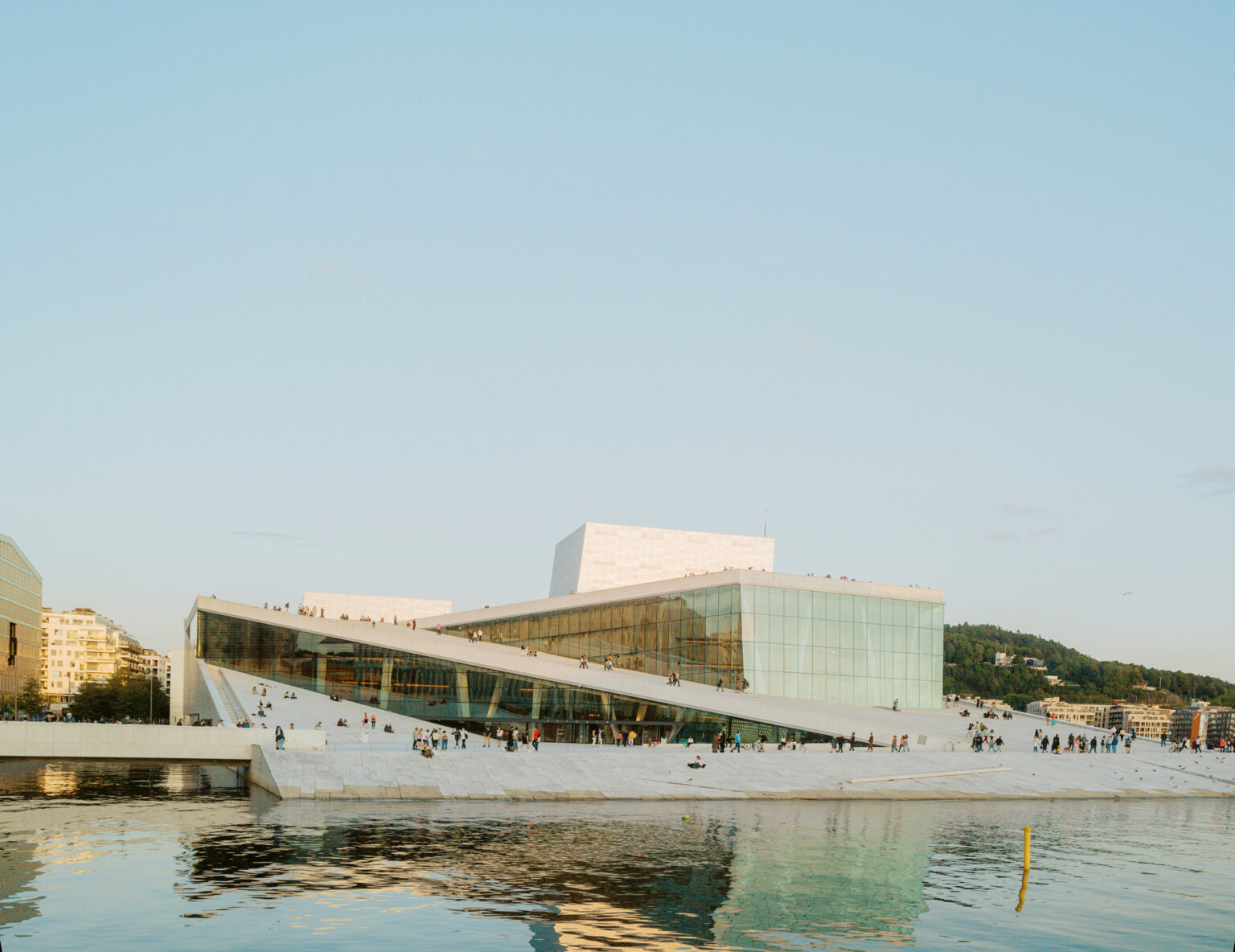
The building that best summarises this tension is the Opera House. Designed by the firm Snøhetta, whose name means “snow hood” and also designates the highest peak of the Dovre massif, the mountain invoked in the national oath (“united and faithful until Dovre falls”), it is entirely covered in white Carrara marble and built to imitate snow-covered hills. Its logo is a plain white diagonal stroke in which, consciously or not, the lambda profile of the former ski jump can be heard. Since its opening in 2008, the Oslo Opera House has been the most visited attraction in Norway. The Holmenkollen has fallen to second place. This fact scandalises Norwegians. They go anyway.

© Anders Beer Wilse creator QS:P170,Q144339, Fridtjof Nansen – No-nb bldsa 1a037, marked as public domain, more details on Wikimedia Commons
What the city will not name
It is Erik Fosnes Hansen who holds this key. Born in 1965 in New York, where his father worked as a travel agency manager for the Norwegian State Railways, he grew up in Grorud, east Oslo. His second novel, “Salme ved reisens slutt” (1990), which follows the Titanic’s musicians to their final hours, has been translated into more than twenty languages. His book “Oslo, mit anderen Worten” (Corso im Verlagshaus Römerweg, 2019) is not a guidebook. It is a key. “A foreign city is like a closed book. This book about Oslo is a key to opening my native city.”
At the centre of this book: Knut Hamsun. “Hunger” opens on one of the most quoted sentences in all of Norwegian literature: “It was in those days when I wandered about hungry in Kristiania, that strange city which no one leaves before it has set its mark upon him.” Hamsun is not from Oslo. He was born in 1859 on the poor island of Hamarøy, north of the Arctic Circle, into a family without resources. He arrives in Kristiania as a young man, unable to earn a living. In this state, he invents words. For a woman glimpsed in the street, he creates the name “Ylajali”. For the imaginary father of this woman, “J. A. Happolati, representative, inventor of an electric prayer book whose letters glow in the dark”, he creates “Happolati”. He follows Ylajali to St. Olavs plass 2, a real building in Kristiania where a pharmacy once stood. She goes in. He stays outside, leaning against a streetlamp. Hemingway said: “Hamsun taught me to write.”
Hamsun received the Nobel in 1920. In 1940, he supported the German occupation and gave his medal to Goebbels. He was convicted after the war, escaped prison on grounds of diminished mental capacity, and went on to publish a final book that proved his capacities were not diminished. Oslo has no street named after him.
Today, at St. Olavs plass 2, one finds the café “Tekehtopa”, Apotheket, the pharmacy, written backwards, and the restaurant “Happolati”, named after a word invented in a hallucinatory state of hunger in 1890. A proposal to rename the square “Ylajalis plass” was debated and rejected. The city honours the fictional characters. It refuses to honour the author.

© here indicating where this image was being used., NOR-2016-Oslo-National Theatre, adjusted colours, CC BY-SA 4.0
Bus 31 to Alhambra
In Granada, Hansen would take a bus numbered 31 from the medieval Albaicín quarter up to the Alhambra. In Oslo, bus number 31 goes to Grorud. In 66 minutes and 40 stops, it crosses 23.4 kilometres from one end of the capital to the other, from Snarøya, where billionaires’ villas line the fjord to the west, to Grorud, a satellite town in the east. The route passes the fjord and its islands, Fornebu, Bygdøy with its museums, the bourgeois Frogner neighbourhood, then the centre with the royal palace, the Nationaltheatret, the University and the Storting, then the old working-class districts, Grønland with its immigrant-run grocery shops, Grünerløkka once grey now fashionable, Tøyen, and finally Groruddalen, the wide valley into which Oslo expanded after 1945. The journey is a tour of the whole city, without any commentary.

Since the 1960s, the Norwegian media have described Groruddalen in nearly invariable terms. The digital catalogue of the National Library lists dozens of reports, white papers and sociological studies on the “problems” of the valley: schooling, youth, integration, criminality, ghettoisation. In 1975, the Stovner report described the children of Stovner as unable to read, to write, or to name the days of the week. The newspaper Aftenposten ran the front-page headline: “The Tragedy of the Satellite Town”. The bourgeoisie of western Oslo came to do slumming, tourism in the poor eastern districts. Hansen: “I believe it was complete nonsense.”
The reality of Groruddalen is another. More than 120,000 people live there, more than in the entire rural district of Sogn og Fjordane in western Norway. Every autumn, during the Norwegian literary season, journalists call the same writers to ask the same question: why do so many authors come from Groruddalen? Roy Jacobsen (born 1954 in Veitvet) is a finalist for the Man Booker International Prize 2017. His novel “Seierherrene” (The Victors, 1991) remains the reference account of the great Norwegian social ascent of the 20th century. Per Petterson (born 1952 in Veitvet) received the International IMPAC Dublin Literary Award for “Ut og stjæle hester” (Out Stealing Horses, 2003). Jostein Gaarder (born 1952 in Årvoll, in the lower part of the valley) has sold 50 million copies of “Sofies Welt” (Sophie’s World, 1991) in 64 languages. Hansen himself grew up in Grorud. His habitual answer to journalists: recent geological research had identified, at a precise point in the valley, a weakly radioactive gas rising from the bedrock, a kind of Bermuda triangle of the satellite town, with measurable effects on the brain’s language centre. The explanation was never published.

The colour Oslo does not recognise
The stone that built Oslo comes from Groruddalen. Grorud granite, nordmarkitt or grefsensyenitt according to geological nomenclature, but which everyone simply calls Grorud granite, is a reddish-pink rock quarried from the valley. It is found in the foundations of the royal palace, of the University of Oslo, in the lion in front of the Storting, in the bridges over the Akerselva, in the thresholds, the staircases, the kerbstones throughout the city centre. After the great Hamburg fire of 1842, large quantities of Grorud granite were shipped over for the reconstruction. “Grorud has coloured Oslo”, Hansen writes. “In soft red.”
At the Grorud T-bane station, a monument executed in 1972 by Kåre Orud (1914-1998) shows a stonemason seated on a stylised block, his heavy hammer resting on his thighs. In the woods around the station, the old abandoned quarries reveal the same colour. The same stone is everywhere in the streets of the centre, in the walls of the most prestigious institutions of the capital. Nobody asks where it comes from.
The literary parallel is exact. The most important novel about Oslo was written by a man who came from the north of Norway and never received a street name. The most translated novelists of the following generation come from the valley the media describe as a ghetto. The stone that built Oslo’s monuments comes from the place Oslo refused to visit. “There may not be much to see in Grorud. But you see Grorud everywhere in Oslo.”
The question Oslo prefers not to ask
Most cities maintain a relationship of self-regard with themselves. Oslo maintains something rarer: a systematic disagreement with what it contains. It recommends its surroundings rather than its streets. It forgets its capital in its own anthem. It disguises its opera house as a ski jump. It names its restaurants after the characters of an author whose name it refuses to honour.
Fabian Stang’s mother was Wenche Foss, the most beloved actress in Norway, an immovable presence at the Nationaltheatret for decades. When Hansen introduced his western Norwegian companion to the mayor and asked him what she should see, the son of Wenche Foss did not mention the theatre.
The granite of the working-class suburb is in the foundations of the palace. The novel of hunger named a café and a restaurant but not a street. The valley that supplies Oslo with writers had already been supplying it with stones. These three facts are not anecdotal. They say something structural about a city that has been underestimating itself for generations with a consistency that looks less like a flaw than a vocation.
Hansen does not correct Oslo. He hands it a key.

© Oscar Daniel Rangelsur Unsplash