
You arrive as a guest in a private house that happens to be larger than expected. A car carries you up the switchbacks, the gate swings open, and the lake is suddenly below you, stepped into terraces. Someone is playing the piano. It smells of citrus and wet stone. The outside world goes quiet, almost rudely fast.

The location
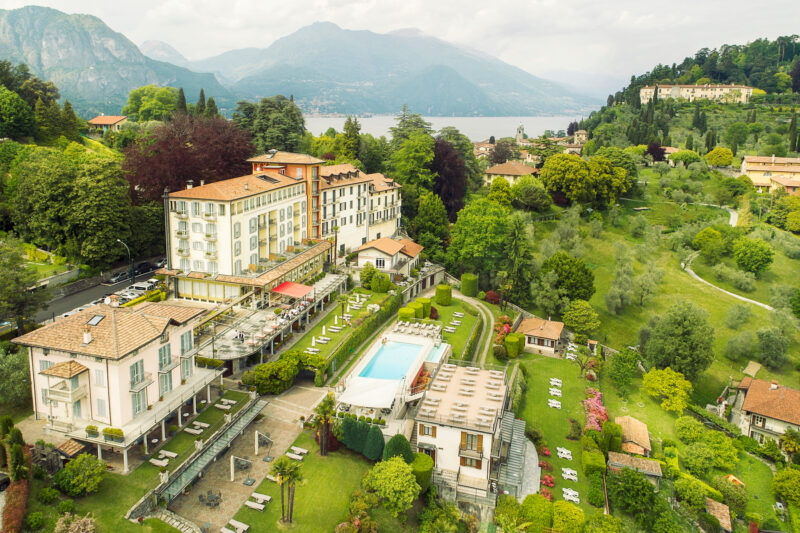
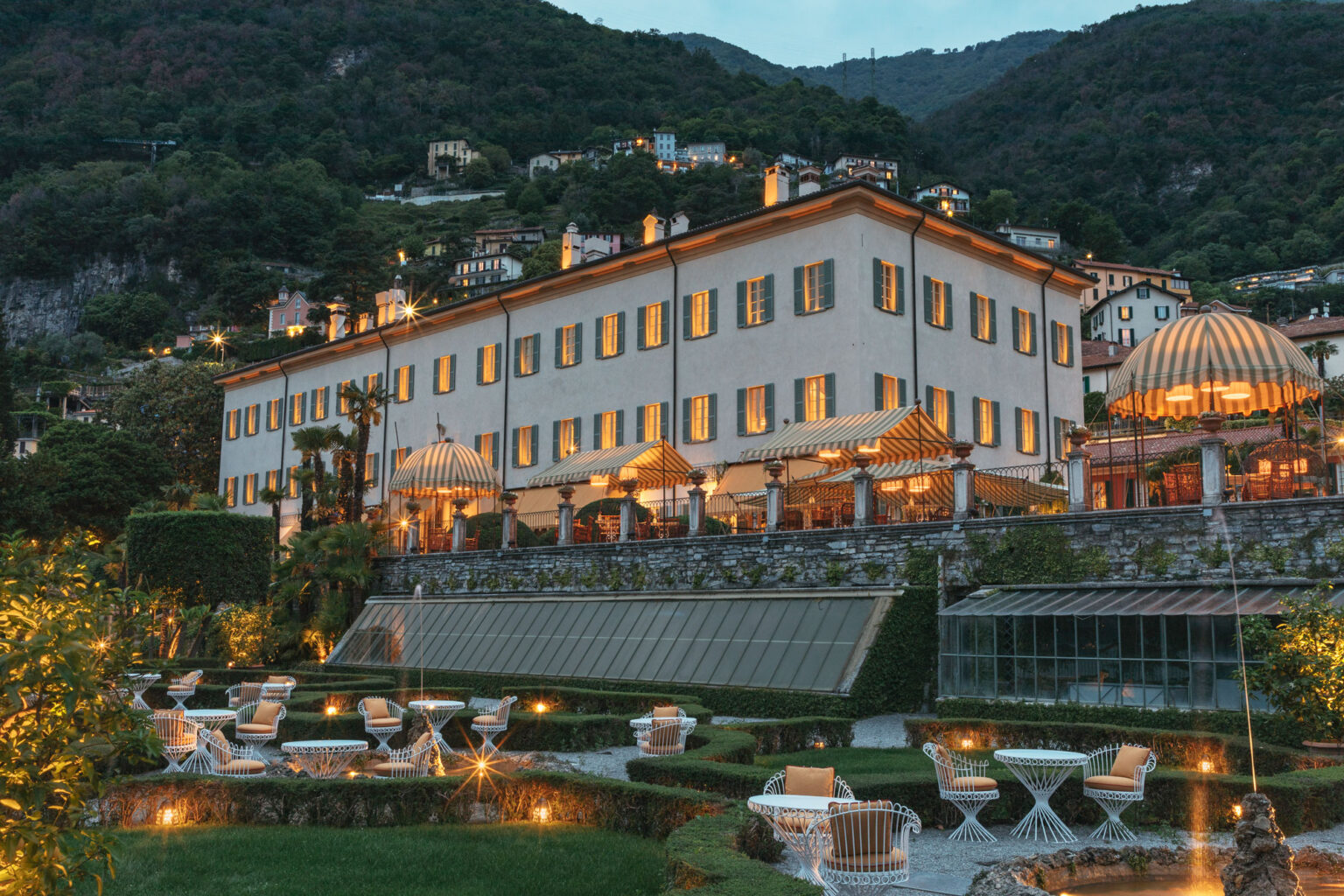
Forty minutes from Milan, just short of Cernobbio, the western shore starts to take itself seriously: a narrow lakeside road, walls, oleander, the mountains rising sheer behind. Moltrasio is a fishing village with a past, built from the grey limestone that comes out of the hillside here. The villa stands above it, ochre-coloured, with green shutters, framed by cedars and magnolias older than most of what surrounds them. From the road you see almost nothing. Only past the gate, from above, does the whole estate reveal itself: seven hectares of garden falling in terraces to the water, fifteen fountains, a small harbour.

Backstory
Count Andrea Lucini Passalacqua had the house built at the end of the 18th century, gardens and tunnels and all, along with the stairway they call the Scala Santa. In 1829 Vincenzo Bellini moved in and wrote part of Norma and La Sonnambula here; his piano still stands, his operas still play in the rooms on a channel of their own. Churchill came later, and, by legend, Napoleon. Then the estate declined, the way lakeside villas decline, slowly and with dignity. In 2018 the De Santis family bought it, hoteliers from Como who also own the Grand Hotel Tremezzo. Three years of restoration, and the house opened in 2022. Valentina De Santis, who runs it with her parents Paolo and Antonella, treats the place as a private home that happens to receive guests. You notice the difference at once.


Interior and architecture
Three buildings, three temperaments. The Villa is baroque, with frescoes, stucco and ceilings under which you instinctively lower your voice; the Palazz, the former stables, is rougher, with wooden beams and hand-painted walls; the Casa al Lago, down by the water, is light and offhand. All of it is built from the grey stone of Moltrasio. Inside, Italian craft accumulates without showing off: fabrics by Rubelli and Fortuny, Murano glass by Barovier & Toso, mirrors by Barbini, Beltrami bed linen made from birch fibre, softer than silk.

Leather trunks by Bottega Conticelli hide the televisions. The door handles, the lamps, the scents—Aqua Como 1787—are made to order. Little looks new; almost nothing looks accidental. The restoration set out to keep rather than replace; what had to be remade was remade by craftsmen from the area.

© Stefan Giftthaler

© Stefan Giftthaler
A look inside
Twenty-four suites, no two alike. Twelve sit in the Villa, with lake views, high ceilings and original stucco; eight in the Palazz, smaller, with beams; four in the Casa al Lago, each with its own garden by the water. There is no conventional lobby; you are received, not checked in. The largest, the Bellini Suite, runs to some 250 square meters—the biggest on the whole lake—with a grand piano, Murano chandeliers and the hall where Bellini composed.

The smaller rooms start at thirty square metres and still don’t feel small. Each holds an Illy machine, a Smeg kettle, a minibar with things from the kitchen, free; the sound system has three channels, one of them playing Bellini without pause.


The beds are good enough that guests ask for the brand. It is Beltrami.

Culinary
The kitchen is run by Viviana Varese, born 1974 on the Amalfi coast, decorated in Milan with a Michelin star. In 2024 she left her restaurant there and moved to the lake. Her concept is called Grand Villa Cuisine and means the return of the home cooking that, in the 19th-century summer villas, was a high art: timballi, parmigiana, game, fish from the lake, carved at the table.

Much is portioned in front of the guests, some of it comes from the estate’s own garden, the eggs from the house hens. Varese doesn’t cook loudly. She brings back the dishes everyone carries in their head and makes them more precise. Whoever comes for the grandeur is surprised here: at the table it turns simple, almost domestic. The kitchen is open; you may walk in and talk to the chef as if visiting friends. Since late 2024 outside guests may reserve too, which is hard and worth it. Breakfast goes on for much of the morning.


Wellness & relaxation
The spa lies underground, in the tunnels the Count once had cut into the rock as a delivery road. You pass through colonnaded halls and grottoes of Moltrasio stone, past a sauna, a steam bath and an onyx shower, fifty metres through half-darkness, until light stands at the end: an 18-metre pool in the former greenhouse, laid with a mosaic of Palladiana marble, looking out onto the Italian garden.

© Ruben Ortiz
The chandeliers are by the light artist Yahya, the treatments by Seed to Skin from Tuscany. Anyone who prefers the open air takes their massage in a pavilion in the orchard. It is quiet down there, in a way you rarely find.


Surrounding area
Moltrasio itself is small and unhurried. Up in the hamlet of Vergonzago stands the Romanesque church of Sant’Agata from the eleventh century, built entirely of the village’s grey stone, with frescoes uncovered only two decades ago; most guidebooks pass it by. From the village a shore path runs seven kilometres to Laglio, high above the water. Anyone going further drives to Como, a quarter of an hour along the lake.

Como is the quiet capital of Italian Rationalism: here Giuseppe Terragni built the Casa del Fascio and the Novocomum, here stands the war memorial after a design by Antonio Sant’Elia, the architect who left almost nothing but drawings and died at twenty-eight in the war. His sheets hang in the Pinacoteca. Whoever wants cloth instead of concrete goes to the silk museum—Como wove the silk for half of Europe for centuries. And whoever wants to follow Bellini to the end buys a ticket for the Teatro Sociale, where his operas are still staged, often the very ones he wrote up here.


Activities
On the water. Beppe the boatman takes guests out in two old wooden boats; you can swim from the private dock. Day trips run to Bellagio, the Villa del Balbianello and the solitary Isola Comacina.
On foot. The panoramic path to Laglio, seven kilometres high above the shore. For something steeper, take the funicular from Como up to Brunate and walk from there.
Architecture. A Rationalism tour through Como—Terragni’s Casa del Fascio, the Novocomum, the war memorial after Sant’Elia—and the Romanesque churches around Moltrasio.


Silk and craft. The silk museum in Como, plus the few workshops where genuine Como silk is still made.
Opera. A Bellini performance at the Teatro Sociale, ideally one of the operas he wrote up in the villa.
Wellness. The rituals in the underground spa, yoga in the garden at dawn, a terrace built for meditation.
The table. Varese’s restaurant, long lunches by the pool, and the trattorias behind Como’s cathedral for later.
With children. Collecting eggs from the house hens, boat circuits, bocce and a clay tennis court.
In the evening. Films under the open sky, an aperitivo at the bar, then silence.
Doing nothing. Fifteen fountains, a rose garden, cedars under which nobody wants anything from you. The house calls it dolce far niente and means it.


Details
Rooms: 24 suites across three buildings — 12 in the Villa, 8 in the Palazz, 4 in the Casa al Lago, each individually furnished. Largest and most famous is the Suite Bellini, around 250 square metres, with a grand piano and its own music hall.
Spa: 18th-century tunnel complex, 18-metre indoor pool in the old greenhouse, sauna, steam bath, onyx shower, two treatment cabins, Seed to Skin products, massage pavilion in the orchard.
Restaurant: one, the kitchen of Viviana Varese, open to outside guests by reservation.
Also: a long breakfast with eggs from the estate’s henhouse, yoga, meditation, film nights, a clay tennis court, bocce, a gym in the olive grove, two wooden boats, a private harbour. Rooms from €1,500.