
You arrive in Positano the way everyone does, badly — down a road that hairpins off the mountain as if reluctant, depositing you in a town with no level ground and no intention of acquiring any. Then a discreet doorway, a few steps down, and the noise simply stops. Below you, the sea; the hotel arranged around it like a held breath.

The location
Positano is built the way coral grows, upward and sideways: a thousand pastel houses stacked on a near-vertical cliff above a small grey beach. There is one main street, and it mostly consists of stairs. Le Sirenuse sits on Via Cristoforo Colombo, a few minutes above the water — an eighteenth-century palazzo in oxblood red and white, the arches of its loggias spilling bougainvillea, its tiled dome catching the light. From the road it gives away almost nothing. The drama, as the family worked out long ago, is kept for the inside and the view.

Backstory
In 1951 four Neapolitan sibling—Anna, Aldo, Paolo and Franco Sersale—turned their family villa into an eight-room hotel, on the sound hunch that foreigners kept falling in love in Positano and needed somewhere to do it. John Steinbeck arrived the next year and obliged with a rapturous essay.


Franco, an engineer who preferred auctions and photography, spent four decades filling the place with antiques and harmony-through-contrast until his death in 2015. His son Antonio now runs it with his wife Carla, who founded the fashion label Emporio Sirenuse; their sons Aldo and Francesco joined in 2020. Nobody here hurries. They measure plans in decades.

Interior & architecture
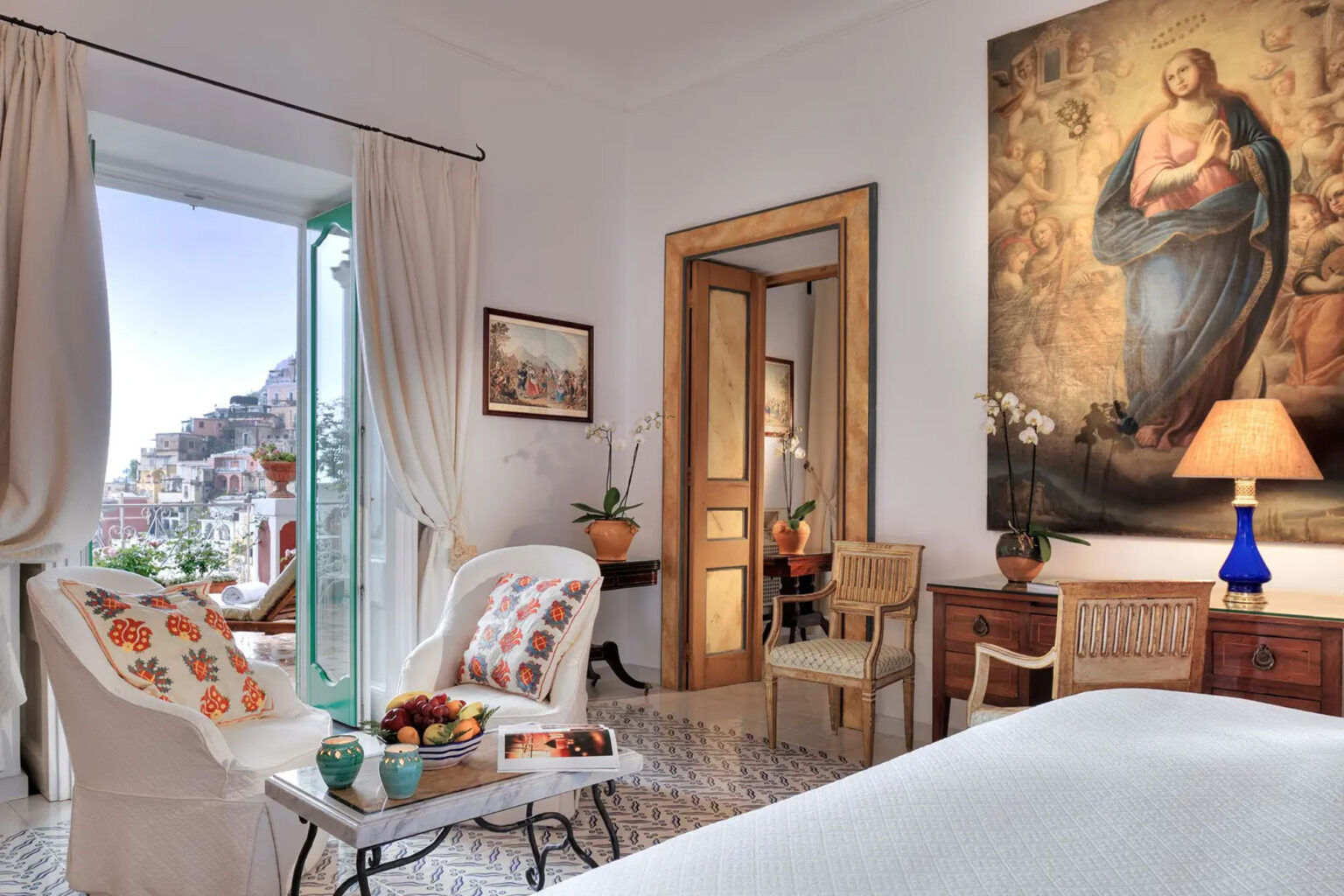
The house is really several houses, knitted together over seventy-odd years of buying up the neighbours, which is why it rambles: half-levels, sudden terraces, a corridor that becomes a sitting room. Ceilings curve into Amalfi cross-vaults; floors are laid with hand-painted majolica from Vietri sul Mare, some of it reproduced by Fornace De Martino, the Salerno workshop Franco first called on in the 1980s.

The walls are repainted white every winter, a quiet annual reset. Against them: museum-grade antiques from European auctions, old-master watercolours, a sofa you sink into without ceremony. The scent in the corridors is Eau d’Italie, the fragrance the family invented because nothing on the market smelled enough like home.


A look inside
All fifty-eight rooms differ—in size, angle, terrace—because the building never planned to become a hotel. They share a vocabulary: whitewashed walls, vaulted ceilings, Frette linen, a balcony tilted at the sea.

The entry-level Inner Courtyard rooms trade the view for silence; everything above them faces the Mediterranean and the Li Galli islands, the rocky trio that gave the hotel its name.


The Classic Sea View rooms are compact and serene at twenty-four square metres. The hierarchy climbs through the Junior Suites to the One- and Two-Bedroom Sea View Suites at the top, the largest of the house, where the whirlpool tub is angled, sensibly, at the water rather than the wall.

Culinary
Dinner at La Sponda is the hotel’s set piece, and it knows it: four hundred candles lit each evening, no electric light, a terrace looking straight down the cliff. The kitchen is led by Gennaro Russo, a Neapolitan from Somma Vesuviana who trained in Paris at Lasserre and L’Ambroisie before concluding that the Campanian tomato needed no improvement.

His cooking is local and seasonal in the sense the phrase had before it became marketing. Elsewhere the register loosens: Aldo’s for raw fish and sharing plates, Franco’s up the street for the aperitivo, and the Don’t Worry Bar, a vinyl-only listening room built by Aldo Sersale after the genre got hold of him in Tokyo. From 2026, Russo also oversees the kitchen at Le Sirenuse Mare, the family’s new beach club down the coast at Nerano.


Wellness & Relaxation
The pool is a small heated rectangle on the main terrace, its floor a mosaic by Nicolas Party that you swim across without quite registering you are inside an artwork. The spa is the work of Gae Aulenti, the great Milanese architect, who in 2000 gave it her trademark restraint: pale stone, low light, none of the usual spa-resort kitsch.

There is a sauna, a Turkish bath, an ice room, and treatments scented with the house Eau d’Italie. The fitness room runs to two Megaformer machines, though the family’s real idea of exercise is the web of old goat paths in the hills, walked off before breakfast.


Opened in 2026, Le Sirenuse Mare extends the world of Le Sirenuse to the shores of Nerano. Terraced above the sea, the beach club brings together contemporary art, Mediterranean gardens, local craftsmanship and effortless coastal living, creating a refined yet relaxed destination on one of the Amalfi Coast’s most understated stretches of coastline.

© Stefan Giftthaler
Surrounding area
Beneath the main church, Santa Maria Assunta, lies the town’s best-kept secret: a Roman villa entombed by the same eruption that buried Pompeii, its frescoes brighter than anything at the larger sites, opened to small guided groups only in 2018. Most visitors walk over it without a clue. Offshore float the three islets of Li Galli—the original Sirenuse, mythical home of the sirens, later owned by the dancers Léonide Massine and Rudolf Nureyev.

For shopping that isn’t interchangeable, the sandal-makers cut leather to your foot in ten minutes flat, a trade unbroken here since 1950. Walkers take the Sentiero degli Dei, the Path of the Gods, along the ridge to the hamlet of Nocelle. Further out, past the ten-kilometre mark, Ravello repays the climb: Villa Rufolo, whose gardens sent Wagner into raptures, stages a summer music festival on a platform cantilevered over the drop. Amalfi keeps a working paper mill turned museum; Vietri sul Mare still fires the coast’s loud, beautiful ceramics. Down at Marina di Cantone—site of the hotel’s new beach club—the trattoria Lo Scoglio serves the zucchini-and-cheese spaghetti the village gave its name to.


Activities
For walkers and the restless: the Sentiero degli Dei along the ridge to the hamlet of Nocelle; pre-breakfast circuits on the old goat paths with the hotel’s resident coach; Dolce Vitality, the spring wellness-and-yoga retreat run by Francesco Sersale.
For art lovers: the thirteen site-specific works of Artists at Le Sirenuse, from Martin Creed’s neon “Don’t Worry” to Nicolas Party’s pool mosaic; the Roman frescoes hidden beneath Santa Maria Assunta; the villa gardens and summer concerts of Ravello.
For the sea: sunset cruises on the Sant’Antonio, the family’s wooden gozzo; the fast shuttle to the new beach club at Nerano; long afternoons swimming off the Li Galli islets.
For food and wine: dinner at La Sponda by candlelight; a cellar deep in champagne and white Campanian wines; mornings on local cooking and lemon lore; the hotel’s own Little Books on the regional tomato and lemon.


For families: the heated terrace pool; boat days on the gozzo; the short, steep walk into town for gelato.
For shoppers with an eye: Emporio Sirenuse, Carla Sersale’s label, a few steps from the door; leather sandals cut to measure in the old workshops; the ceramics kilns of Vietri sul Mare.
For night owls: vinyl and classic cocktails at the Don’t Worry Bar, Positano’s discreet listening room; a final aperitivo at Franco’s, perched above the street.
Details
- Rooms: 58, each individual. Largest categories: Two-Bedroom Suite Sea View, One-Bedroom Suite Sea View, Junior Suite Superior.
- Dining: La Sponda, Aldo’s, the Pool Bar, Franco’s Bar, the Don’t Worry Bar; from 2026, Le Sirenuse Mare beach club at Nerano.
- Spa & fitness: spa by Gae Aulenti with sauna, Turkish bath and ice room; two Megaformer machines; Eau d’Italie amenities.
- Also: heated pool with a Nicolas Party mosaic; the Artists at Le Sirenuse programme; Emporio Sirenuse boutique; gozzo cruises and weekly activities; valet parking.
- Season: April–October