
You don’t find Mona; you are let in. The façade gives nothing away—a narrow lane, a red rose sprayed beside the door, a buzzer. Then an interior opens that has little to do with the silence outside: warm light, peeling walls, a sofa that looks as though it has overheard a few stories. Athens out there, a different state of matter for the city in here.

The location
Psirri sits in the dead centre of town and still behaves like a village that never quite agreed to grow up. Tanneries, spice traders, workshops, and among them galleries and bars that only come round after midnight. Early last century the streets belonged to day labourers and refugees from Asia Minor, the manges and rebetes; their songs of loss and unanswered love still hang in the air. Monastiraki Square is under two minutes away. The factory stands symmetrical and severe, striped marble and metal, a building that doesn’t flatter. Above the door, the rose. Anyone who doesn’t know what’s here walks past, which is presumably the point.

© Eftihia Stefanidi
Backstory
House of Shila began in 2020 with Shila, a hôtel particulier in Kolonaki: six suites within a 1920s neoclassical residence. Mona followed two years later, larger in scale and housed within a former industrial building in central Athens. The team behind both projects includes Shai Antebi, a New York-based entrepreneur, Eftihia Stefanidi, an art director and photographer from Athens, and French designer Anna Bonnet. What they have created extends beyond hospitality. The company also operates a design studio, showroom, journal, artist residency programme and members’ club. The result functions as a contemporary salon of sorts, bringing together artists, designers, entrepreneurs and travellers. The House often speaks of its spaces as characters with distinct identities, blurring the line between place, narrative and experience.


Interior & architecture
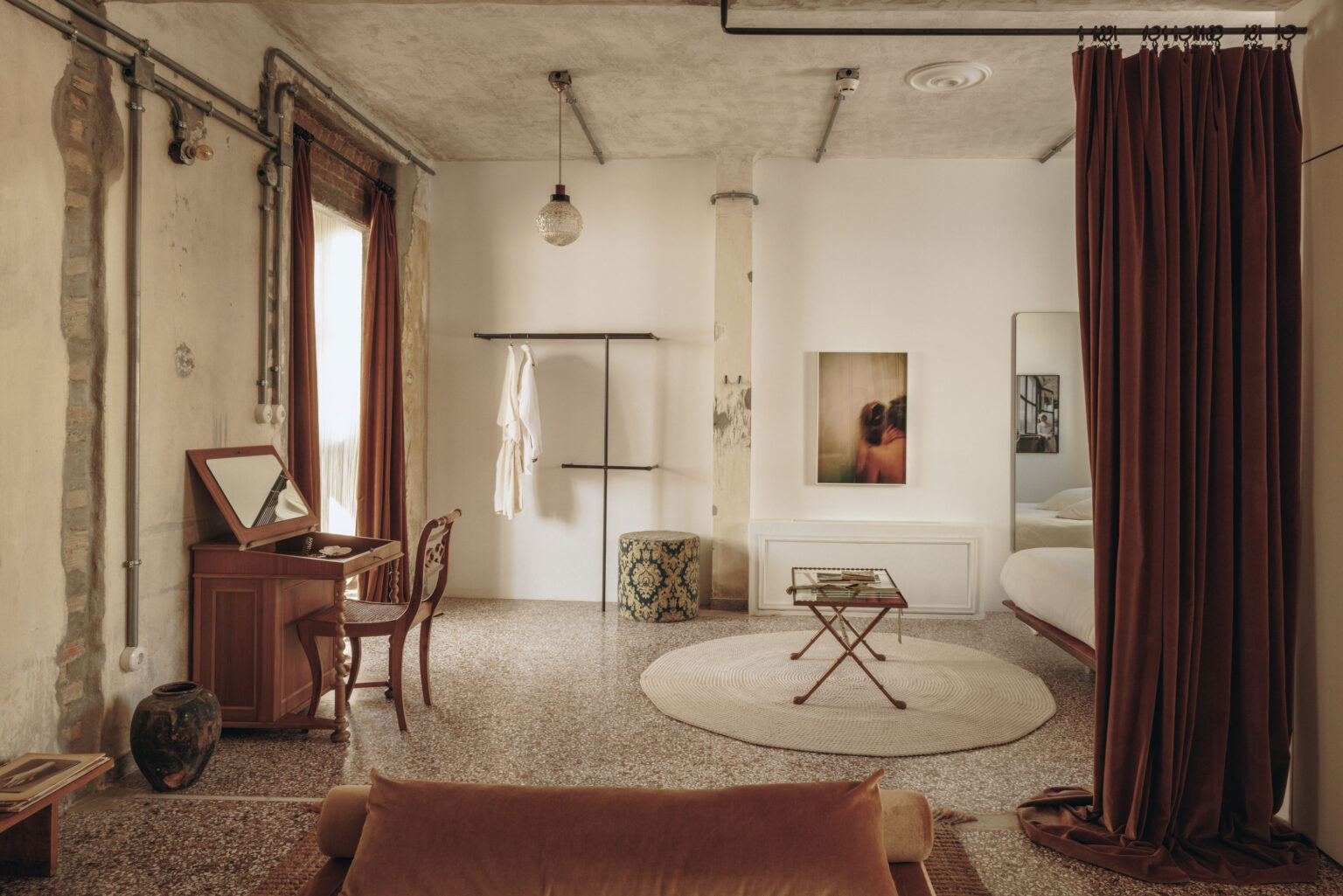
The conversion mostly left the building alone. Seventy years of factory remain in plain sight: the curved iron staircase, terrazzo floors, the original metal windows, the marble façade. On the walls the layers of paint have been stripped back until they resemble painting, which they are not. Concrete and stone form the backdrop; against it the in-house studio, Shila Maison d’Objets, sets its warmer registers: velvet, sheer cotton, hand-knotted rugs, furniture with a past.

© Eftihia Stefanidi
Much of it was made from material the team found lying inside when they first arrived, sustainability less as a creed than as salvage. A sofa of recycled brick recurs in several rooms, a quiet refrain. The lighting is made to order, the fittings look sought out rather than bought. The effect: raw concrete makes soft things softer, and the eye is put to work without noticing.

© Eftihia Stefanidi

© Gella Valavanis
A look inside
Public life unfolds across three spaces: the Living Room on the ground floor, a lounge and gathering space where breakfast is served to guests and members; the Underground in the basement, a multi-disciplinary venue hosting private events and cultural programming; and the rooftop, reserved for hotel guests and members, with an honesty bar overlooking the city.

Between them, twenty open-plan rooms in six categories. The smallest, the Intimates, measure barely sixteen square metres and come with an open toilet, which won’t suit everyone. It grows more generous upward: Velvet, Floret, Amour, then the penthouses.

© Artist: Spyros Vassilas, Photo: Eftihia Stefanidi

© Tristan Hollingsworth
The Florets share an outdoor space, a few rooms have balconies; the range runs from sixteen to fifty-five square metres. The largest is simply called Mona’s Suite, with a walk-in bathroom and a strip of Acropolis in the window. Corian tubs throughout, espresso machine, handmade mattresses. The beds mean it.

© Tristan Hollingsworth
Culinary
There is no restaurant in the conventional sense, and Mona doesn’t pretend otherwise. Breakfast is included and served in the room, the roof or the living room, carefully assembled and closer to domestic generosity than hotel routine. Every room has an espresso machine with freshly ground beans, while the Living Room offers a relaxed setting for guests and members throughout the day. The real culinary stage is the rooftop: an honesty bar serving natural wines, local beers, select spirits and small snacks with the city and the Acropolis as table decoration that is hard to beat.

The House periodically hosts its Supper Club Series, bringing together guest chefs for intimate dining experiences and one-off culinary collaborations. earlier editions brought in Michelin-starred cooks from Turkey, Taiwan, Italy and Greece. Anyone who wants to eat like an Athenian goes out the door anyway. The neighbourhood handles the rest, at any hour you’re willing to admit to being hungry.

Underground
Below, the Underground is Mona’s most adaptable space, hosting everything from live music and exhibitions to dinners, wellness sessions and private gatherings. Its use changes frequently, reflecting the fluid nature of the House and its evolving programme.

Wellness & Relaxation
There is no spa to look for, and no pool; Mona opts for a more private kind of rest. It starts in the tub. Every room has a freestanding white Corian bath and natural toiletries, and the old factory’s thick walls keep the noise where it belongs. For those seeking additional indulgence, spa treatments and wellness services can be arranged in-room through the concierge.

The towels are woven to order, the luxury more tactile than technical. Above, the roof, less a facility than a vantage point where, over a glass of wine, you change pace.


Surrounding Area
Psirri rewards drifting more than ticking off. By day the quarter is quiet, which is when the murals read best, stuck to nearly every corner. The gallery map is dense and unshowy: A. Antonopoulou Art, Alpha Delta Gallery, the Project Gallery, all set on contemporary work. Six D.O.G.S, somewhere between arts centre, concert hall and backyard, gathers the programme that would otherwise be scattered across town. A few minutes on lies Monastiraki: vinyl, vintage and handmade sandals on Ifestou Street, and otherwise the city’s largest antiques market.

© Bruna Santos on Unsplash
For records, To Diskadiko on Protogenous Street keeps punk and psychedelia, with Café Barrett next door, named after Syd, which sets the tone. Evripidou Street smells of spices: Bahar sells them by the sack, and Miran, in place for over ninety years, deals in pastourma and aged cheese. In neighbouring Metaxourgeio, a walk away, off-galleries and studios are clustering, the district mid-tilt. On Sundays the flea market spills across Avissinias Square, antiques beside junk, the line between them loose. And when thirst arrives, a few steps further The Clumsies mixes cocktails that land regularly on the relevant world lists; Athens can do that now.
Details
- Twenty rooms across six categories (Intimate, Velvet, Floret, Amour, Penthouse, Mona’s Suite).
- The three largest: Mona’s Suite (55 sqm, walk-in bathroom, Acropolis view), Penthouse (45–55 sqm), and Amour (36 sqm).
- No spa or pool; freestanding white Corian baths in every room. Massage and wellness treatments can be arranged in-room through the concierge.
- Breakfast is included and served in the room or in the public spaces.
- Rooftop terrace with honesty bar (reserved for hotel guests and members), underground venue, and the Living Room lounge on the ground floor.
- Living gallery and showroom: artworks, furnishings, and selected objects throughout the property are available for purchase.
- Event spaces available for private hire, alongside a members’ club and a team with extensive local knowledge of the city.
- Monastiraki Square and the metro one minute away.