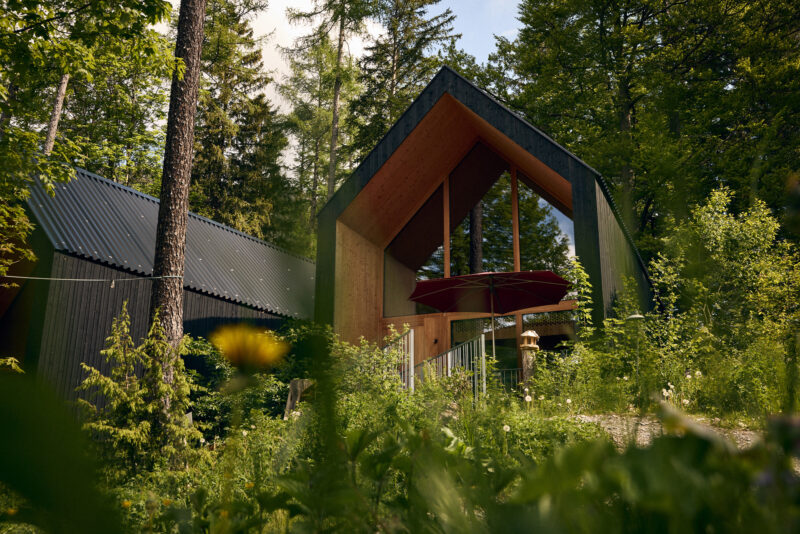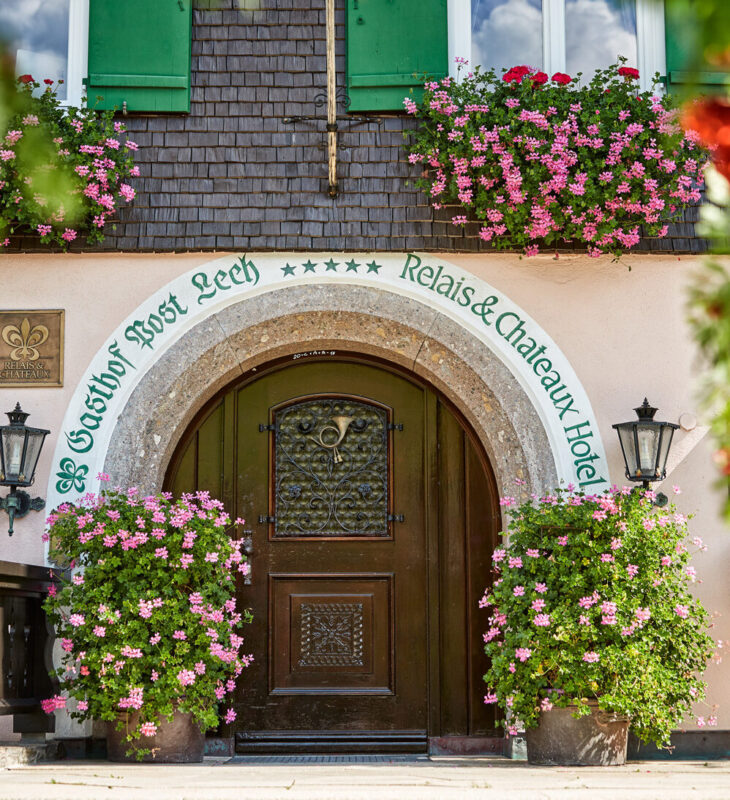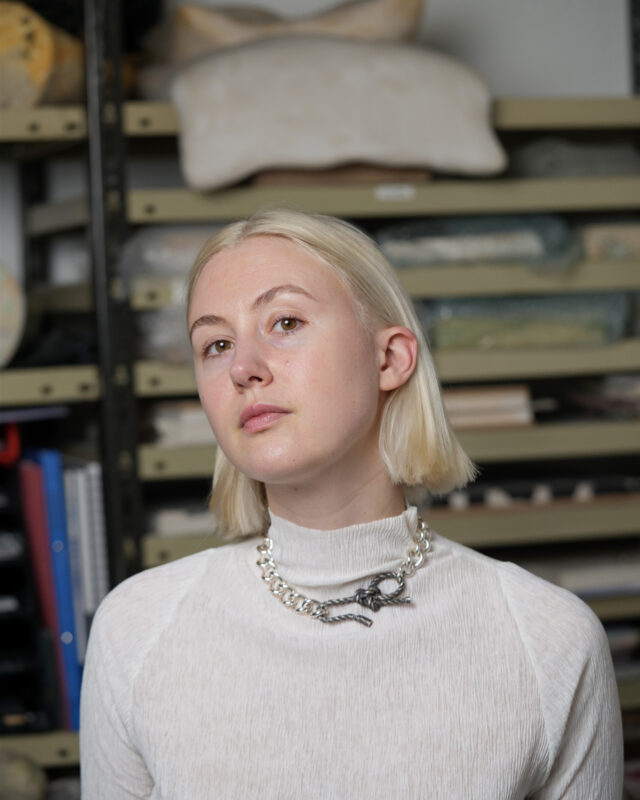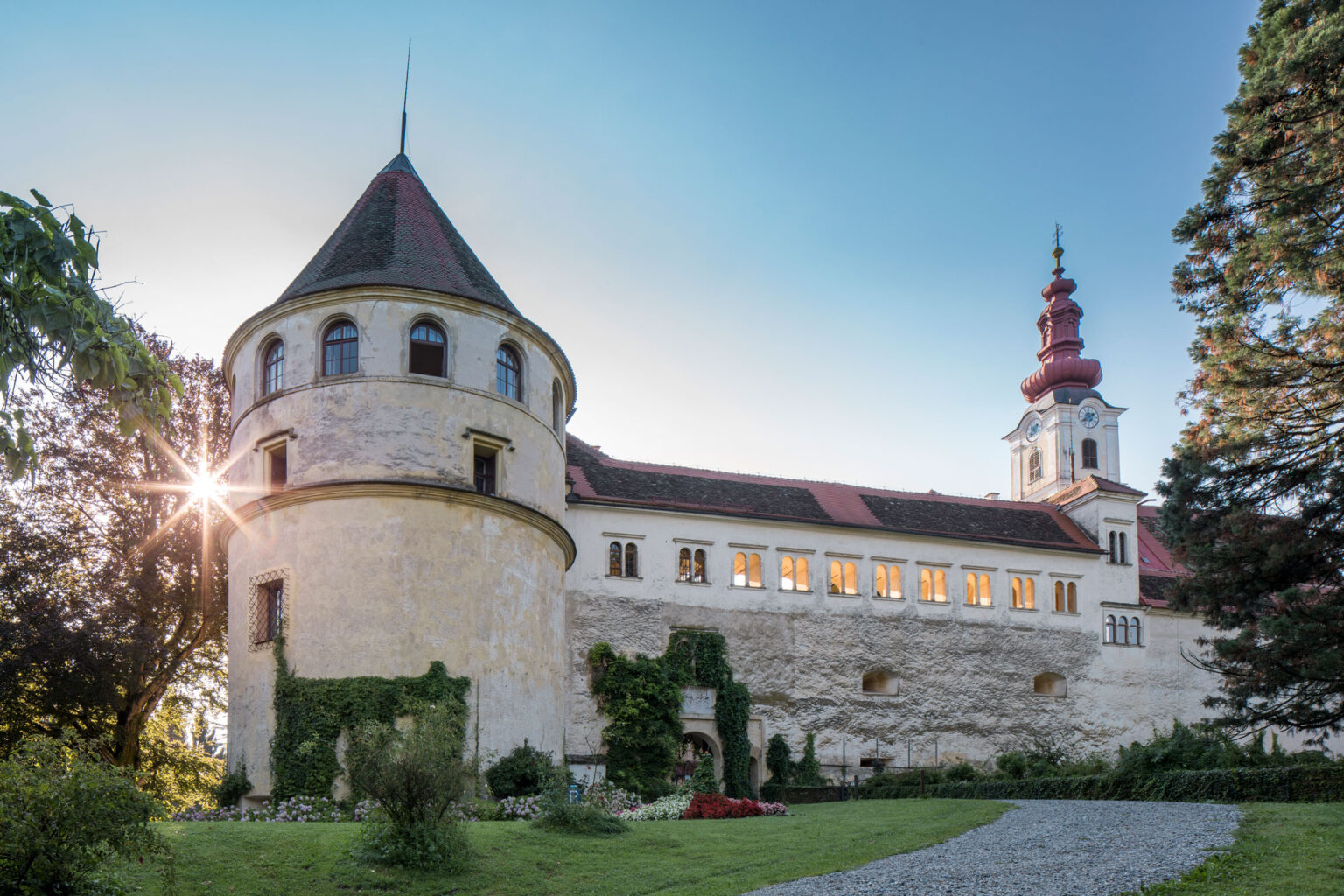

From Graz you drive southwest for barely an hour, through hills, forest and the vineyards of western Styria, until at the end of a climbing road the castle appears above the village of Hollenegg. People live and work here: the Liechtenstein family inhabits the house, and in the middle of that daily life new design objects take shape each summer. The place itself is part of the programme. Its corridors, furniture and collections give the designers material, subject and resistance in one.

The Location
Hollenegg lies in western Styria, south of Graz, where the hills steepen and the forests grow denser. Around it, vineyards, sawmills and roads with little traffic; the city is near enough for a visit, far enough for quiet. The castle stands above the village, a building assembled over many centuries, with some fifty rooms, whose size reveals itself only up close. Through the gate you reach an arcaded Renaissance courtyard; beyond it, stairs and corridors lead into halls that stay cool even at the height of summer. You park in the courtyard, a dog barks somewhere, and you find yourself, without warning, inside the Liechtensteins’ inhabited family seat. The first impression is concentration. The house slows your pace almost before you are through the door.

The place as a creative ground
The appeal of Hollenegg lies in the meeting of contemporary design work and a house full of old things. The principle of the residency is simple: Stori Liechtenstein gives each designer a theme and a specific room in the castle, and from it they develop a new object that answers the history of the place. The castle is crowded with holdings from several centuries—Venetian glass, silver tableware, furniture, textiles, the Far Eastern souvenirs of earlier inhabitants.

This inventory becomes a counterpart the designers have to reckon with. Material appears here as something that carries origin, technique and history, and many of them come precisely for that charge. Add to it the surroundings—forests, sawmills, old glassworks within reach. In Hollenegg you work more slowly than in a city studio, and that slowness is part of the method.


Backstory
The castle reaches back to the twelfth century and has belonged to the Liechtenstein family since 1821, who live in it still. Over generations, what travel and status brought home accumulated here: glass, furniture, paintings, souvenirs from the Far East. Hollenegg became a place for design only through Alice Stori Liechtenstein. Born in Milan, raised in Bologna, she studied the design of public space at Elisava in Barcelona and came to this place through her husband, Alfred Liechtenstein. In 2015 she founded the non-profit association Schloss Hollenegg for Design and began bringing designers into the house each year.

Her idea is sober: let contemporary design emerge where people have shaped, collected and built for centuries. She describes the castle as an enabler, a means of fostering a community of creatives in an unusual place. She has curated and run the programme ever since.

© Photo by Lipp Zahnschirm

© Photo by Julius Hirtzberger
Architecture, studios and working spaces
The working spaces in Hollenegg are the rooms of the castle itself. A Renaissance courtyard, a Baroque church, Rococo halls, Gothic Revival chambers, and storerooms full of glass, furniture and fabric: the medieval core and later alterations lie one on top of the other, with all their breaks. Each resident is assigned a particular room and designs for that room alone—the object emerges in relation to the proportion, light and patina already there.

There are barely any studios of the usual kind; production mostly happens elsewhere, together with carpenters, glassblowers and silversmiths from the region. So the castle works as a place of design and as a stage: in May the finished pieces are shown in the very rooms they were made for. Architecture and collection set the measure against which every design is judged.


The residency life
Anyone taking up a residency moves into the inhabited castle for about three summer weeks. You sleep among holdings that would sit behind glass elsewhere—Venetian glass, Lobmeyr chandeliers, furniture from several eras—and work on something new there. The group is small, everyone takes on the same annual theme, and much of it comes together at the shared table and in the courtyard. The programme includes visits to local businesses: sawmills, glass studios, the workshops of carpenters and silversmiths, along with lectures on, say, wood in architecture or the consequences of climate change.

Research, material trials and design lie close together, and a piece is often made directly with its later production partner. In May, during Design Month Graz, the exhibition opens, and for a few weeks the castle fills with visitors: tours, an opening dinner, sometimes a DJ in the ballroom. Then the designers leave; their work stays in the house and passes into the collection.


Artists, designers and projects
The list of residents shows what the place attracts: designers who think through material and treat production as part of the design. The Viennese studio Mischer’Traxler let a pendulum swing for a week, tracing a recess into a tabletop. For the glass exhibition “Ashes & Sand”, the Copenhagen duo Christian+Jade cast a deep-green wine fountain from sand left over from digging a tunnel on the estate. For “Wood Land”, the Irish designer Joseph Walsh built a piece of furniture from a hundred-year-old elm that had to be felled in the castle park. The Brooklyn designer Katie Stout developed a porcelain service with the Viennese heritage manufactory Augarten.

© Photo by Simone Sandahl
The Finnish designer Hanna-Kaisa Korolainen screen-printed a twelve-metre fabric canopy with the Vienna workshop FabricFabrik. For the 2026 metal show, Ildar Wafin worked with the Viennese silversmith Vaugoin on a table centrepiece, while the Japanese smith Junko Mori forged her pieces by hand. The frame for all of it is the annual exhibitions—”Morphosis,” “East to West”, “Ashes & Sand”, “Wood Land”, most recently “Element: Metal”—curated by Stori Liechtenstein, often with partners such as the Finnland-Institut, the Holzcluster Steiermark or the MAK in Vienna.

© Photo by Lipp Zahnschirm

© Photo by Julius Hirtzberger
The programme
The programme is aimed at emerging designers with a clear, conceptual practice, mainly in product, furniture and object design. Those accepted receive a theme, a room in the castle and the commission to develop a new object from it; accommodation in the house is included, and production often runs with partners from the region. The stays fall in summer and last a few weeks. Alice Stori Liechtenstein makes the selection herself, partly through open calls, partly with partners such as the Finnland-Institut in Berlin, which has repeatedly sent Finnish designers to Hollenegg. The results are shown in May, set within the annual themed exhibition. Specific application deadlines change; the current state of things is reliably found on the official website. The finished prototypes stay at the castle and pass into its collection.

Surrounding Area
Hollenegg is well connected. Graz is barely an hour away by car, a UNESCO City of Design since 2011, and Design Month Graz provides the frame for the exhibition each May; Vienna is about two and a half hours off. Western Styria itself is workshop country: sawmills, joineries and glass studios shape the area, and the Holzcluster Steiermark has more than once found the right production partners for the residency. The region historically lived from glass—until the nineteenth century it was blown and traded around Hollenegg, before industrialisation pushed out the local craft; traces of that survive in the landscape as sites to be found. Around it stretch the Schilcher vineyards of western Styria, with forests and quiet valleys between them. Anyone driving to Hollenegg comes to know a region where material, craft and landscape still hang closely together. For Gentle Traveller, then, the castle is a point of access: a door to a whole area and to a design culture still alive in Graz and around it.

© Leonhard Niederwimmer on Unsplash
Practical notes
Location: Hollenegg 1, 8530 Bad Schwanberg, western Styria, Austria (barely an hour south of Graz)
Disciplines: design (product, furniture, object), material research
Founded: 2015 by Alice Stori Liechtenstein
Direction: Alice Stori Liechtenstein (founder and curator)
Programme: summer residency and annual themed exhibition

Duration: a few summer weeks
Accommodation: in the castle
Studios / workshops: the castle’s rooms; production with regional partners
Application: through the official website
Public programme: exhibition in May, Design Month Graz; admission 6 euros
Open studios, exhibitions, lectures, workshops, excursions, and public programs.
Closing note
Hollenegg shows what happens when new design takes shape in an old, inhabited house. Alice Stori Liechtenstein has turned the family castle into a place where material, history and the present meet. For travellers who like rooms where work is actually done, Hollenegg is a rare address—a castle that puts its past to work for the present.