The drive out of the city passes mudbrick walls, then the road tips into palm shade. Behind an unassuming gate lies an estate with 44 rooms and suites, two restaurants and a hammam, spread across low pavilions among the trees – from the gate itself, none of it is visible.

The Location
The Palmeraie, Marrakech’s old date-palm grove north of the city, is today half villa district, half pasture – sheep still graze between the boundary walls. Les Deux Tours hides behind ochre walls on the Circuit de la Palmeraie, fifteen minutes from the Djemaa el-Fna.

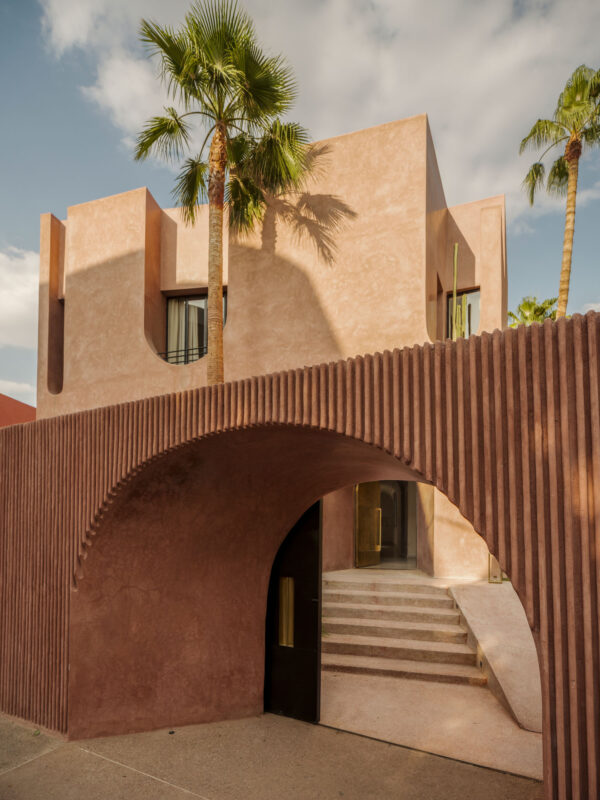
From outside, nothing hints at the three hectares behind it: no sign, no grand entrance, just a door set into the wall. Only inside does the ensemble reveal itself – low pavilions, century-old olive trees and shaded paths, laid out by Charles Boccara in the early nineties, long before the Palmeraie became the city’s affluent fringe.


Backstory
Charles Boccara, born in Tunisia and raised in Morocco, studied architecture at the Paris École des Beaux-Arts and returned to Morocco in 1971. His building style – Zellij, Tadelakt, rammed earth, but without folkloric excess – later shaped whole generations of Palmeraie hotels. In the early nineties, he drew up the plans for Les Deux Tours, first as a villa ensemble, then from 1998 as a guesthouse. His son Mathieu took over in 2008, added new suites and initiated a comprehensive renovation in 2022. In November 2024, the Boccara family sold to the Moroccan entrepreneurial family Benabbés-Taarji, who have run Les Deux Tours since as part of their newly founded hotel collection Akan – with the stated aim of preserving the house’s character and staff. On-site management is led by Mohamed Hejjaj.


Interior & Architecture
Boccara’s basic idea was a village of independent pavilions, linked by narrow paths, small canals and gardens within the garden – a principle his son Mathieu once described as a labyrinth. Zellij floors, Tadelakt walls, rammed earth – the material palette was left untouched in the 2022 renovation; only the furnishing was opened up: pieces from the fifties alongside hand-knotted Berber rugs and brick vaults with horseshoe arches.

In some rooms, the ceilings are made of woven oleander branches, a traditional technique called Tataoui that hardly anyone still masters. A suite has now even been named after him: the Charles Boccara Suite holds furniture from the architect’s estate.


On the environmental side, the house has visibly upgraded in recent years: biomass boilers instead of gas heating for hot water and pool heating, drip irrigation across sixty per cent of the garden, LED path lighting, no more plastic straws. A new water management system for the whole garden is currently in planning, described by management as a key project for the coming years.


A Look Inside
Forty-four rooms and suites are spread across independent pavilions: ten Classic Rooms, thirteen Junior Suites, eight Premium Suites, plus Pool Suites and so-called Exceptional Suites. The latter are individually named, each with its own character – the So Chic Suite with a private pool, garden and wood-burning stove, the Grand Bain Suite with a whirlpool, the Charles Boccara Suite with furniture from the architect’s estate.

Those travelling in a group book the Large Family Suite with three bedrooms, or La Tour, the newest addition from 2022: three bedrooms over two floors in its own tower, six beds, a private garden.


Board games are laid out in the salons, and a fire burns at the bar in winter – Marrakech’s nights in January average around five degrees. Even the house scent is curated: orange blossom in the rooms, wood fire in the shared spaces – now also available as a bottled scent in the hotel’s own boutique.
Culinary
Head chef Noureddine Moani cooks terroir cuisine from the hotel’s own organic vegetable garden, served in two very different settings. Under the vaults of the Salammbô, or outside on the terrace, Moroccan classics – tagines, pastillas, couscous – meet French technique and the occasional excursion towards Siam, from half past seven in the evening, with room for up to seventy guests. By day, La Pergola takes over by the pool, lighter and more seasonal, with salads, sandwiches and grilled dishes until four in the afternoon.


A third, curious chapter: the Yoshi Bar, a sushi counter in the style of the Tsukiji fish markets, named after Yoshi, the hotel cat. It is closed on Mondays; on other days, it delivers to the room or the pool on request. At the bar, cocktails are made with herbs and fruit from the hotel’s own garden – coriander, basil, lemon – alongside a selection of Moroccan and French wines. Breakfast brings cheese, cold cuts and Moroccan pancakes from the buffet, mostly served outside beneath the trees. Those wanting more can book the Dîner des Mille et Une Bougies: a single table, hundreds of candles, set in the middle of the vegetable beds – according to the hotel, the most romantic address in the city.


Wellness & Relaxation
The hammam sits beneath domes that filter light onto the hot water basin, built in a traditional style increasingly rare in the city. Treatments – relaxing, firming, oriental – use argan oil and herbs from the Atlas foothills, from the brand Nectarome, available in the spa, in the room, or in one of the open-air massage pavilions in the garden.

The main pool holds a constant 28 degrees year-round; private pools in the suites can be heated on request. Those after muscle work rather than massage will find a Technogym fitness studio. But the most curious address in the garden is the barber: an open pavilion beneath the palms, a haircut and beard trim that come with a cocktail and a cigar, more ritual than service. Those staying longer can book one of the yoga packages.


Surrounding Area
The Palmeraie proper begins right outside: a date-palm grove said, according to legend, to have grown in the eleventh century from date stones spat out by the resting soldiers of the Almoravid sultan Youssef ben Tachfine – impossible to verify, but a story people still like to tell. Goats still graze among the palms today, alongside two twenty-seven-hole golf courses, Palmeraie Golf and Amelkis.

© Viault, La Palmeraie de Marrakech 708, adjusted colours, CC BY-SA 3.0
Early risers will also find hot-air balloon operators in the region, flying over the snow-capped peaks of the Atlas – one of their pilots, Alex Béjat, is the reigning French ballooning champion. Further towards the city lies the Jardin Majorelle, a good fifteen minutes away, worth seeing but usually crowded. Things are quieter at MACAAL, the Museum of Contemporary African Art in Al Maaden: seven exhibition rooms, striking architecture, still barely discovered by tourists. Anyone after craft rather than souvenirs continues to the industrial district of Sidi Ghanem: former warehouses now house studios for ceramics, leather and rugs, with the rooftop Café Kaowa in between, its view stretching over workshop roofs and palms to the Atlas peaks.

Activities
For those wanting to go beyond the hotel’s own programme, here is a first sort by interest and audience, from culture to pure relaxation.
Culture and Craft
- Bahia Palace and Ben Youssef Madrasa in the Medina, classic choices, but for good reason
- Dar El Bacha, a small museum of travel and encounters, considerably quieter than the big houses
- Ensemble Artisanal, the state-run craft cooperative with fixed prices instead of haggling
- the Mellah, the former Jewish quarter, with small workshops and quieter lanes
- the souks and tanners’ quarter in the Medina, fifteen minutes away
Active and Outdoors
- horse riding or camel riding through the palm grove, bookable right at the door
- quad bike or buggy tours through the Palmeraie, suitable for older children too
- a day trip to the Agafay desert or the Ourika Valley at the foot of the Atlas
- a horse-drawn carriage ride through the old lanes of the Medina, loveliest in the evening

© Abdou Faiz, Unsplash

© Aline Friant Hoste
Food and Drink
- a candlelit dinner in the middle of the vegetable garden, surrounded by hundreds of candles, for special occasions
- sushi from the Yoshi Bar, named after the hotel cat, also orderable by the pool
- a tasting of Moroccan and French wines at the bar
- a cooking demonstration with the head chef in the vegetable garden, subject to availability
Retreat and Family
- yoga programmes in the garden, bookable as a multi-day package
- a beard trim at the in-house barber, with cigar and cocktail
- private massages outdoors, away from the spa and the room
- a children’s menu in both restaurants and family suites for multiple generations

© Darya Luganskaya, Unsplash

© Aline Friant Hoste
Details
- 44 rooms and suites, largest: Large Family Suite and La Tour, each with three bedrooms, six beds
- Hammam, spa and fitness studio, Les Bains des Deux Tours
- Restaurants Salammbô and La Pergola, plus the sushi counter Yoshi Bar
- Bar with fireside room, in-house barber in the garden
- Children’s menu in both restaurants, family suites available
- Main pool heated to 28 degrees year-round, private pools heatable on request
- Organic vegetable garden, biomass heating, drip irrigation across 60 per cent of the garden
- Three hectares of garden in the heart of the Palmeraie, fifteen minutes from the Medina