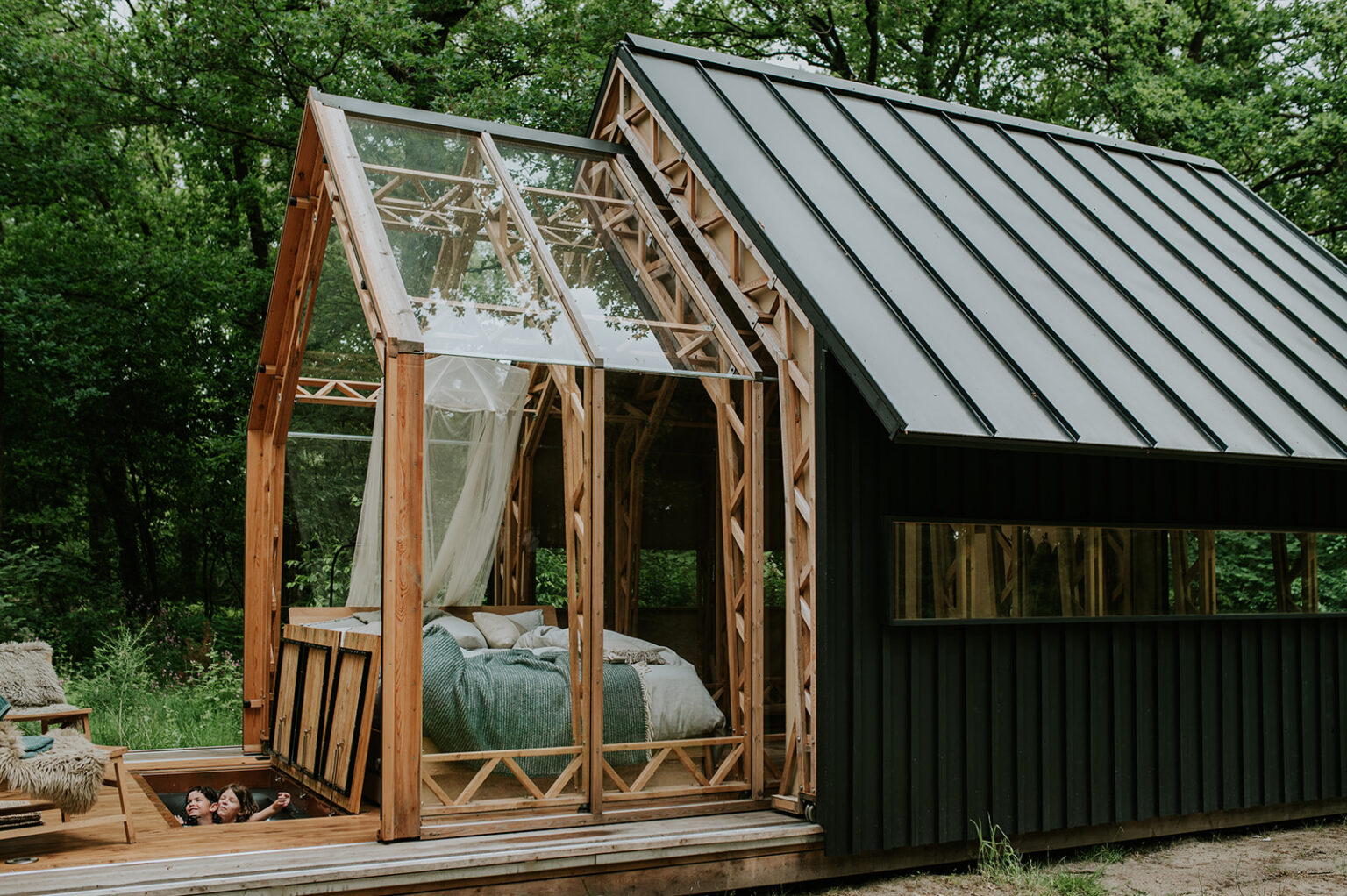

You leave the car at the edge and walk into the forest, past drifting sand and heath. Then, among the pines, there she stands: ANNA, a wooden cabin with a glass core, whose layers can be slid apart. No reception, no key-card beep, only birdsong and the smell of resin. You push the wall open, and the room becomes the forest.

The Location
Holenberg lies near Schaijk in North Brabant, at the edge of De Maashorst, the largest contiguous nature reserve in the province, a landscape of forest, heath, streams, bogs and drifting sand. The cabins are spread widely across the wooded grounds, behind dunes and plantings, with plenty of distance between them; the forest is open to guests alone. From outside, ANNA looks like a plain wooden house with a metal gable roof and a terrace, almost too simple for what it can do. Only on approach do you see the two nested shells, one of wood, one of glass, both movable. The cabin in the Biesbosch lies alone on a peninsula.

Backstory
Behind ANNA stands Caspar Schols, a Dutch physicist who became a designer without architectural training. In 2016 he built his mother Anna a garden house, a flexible space for reading, painting, family dinners and the grandchildren’s theatre plays, meant above all to bring her close to nature. An article in the magazine Dezeen changed his life: for weeks letters reached him from around the world, plus a scholarship to the Architectural Association in London.


There he developed the garden house into Cabin ANNA, a sellable, inhabitable flat-pack house that can be built and rebuilt anywhere in the world. In 2021 ANNA Stay won the Architizer A+ Award as Project of the Year. Holenberg is the place where you can experience her.

Interior & Architecture
ANNA is made of two nested shells, an outer one of wood and an inner one of glass, both set on rails with industrial wheels. So the cabin can be closed entirely, opened in the middle or stretched into one long space; the bedroom becomes an open-air platform with a few movements. It is built of untreated Siberian larch outside and pale birch plywood inside, insulated with sawdust; much of the wood is left bare.

Horizontal windows offer a view at the eye level of someone lying down and keep the room from heating up. The design is modular, delivered in twenty-six parts, removable without a trace, with a patented rail system that keeps ANNA wind- and watertight. Schols calls his principle: to live with the elements rather than against them, the way you dress for the weather.


A Look Inside
In De Maashorst stand six cabins, hidden in the forest: the original ANNA Origin behind a drifting dune, four ANNA Stay models named Quercus, Cytisus, Ulex and Molinia, and the newest ANNA Collection. Origin is the most elemental, with a wood stove, a sunken bath and a movable kitchen unit; toilet and shower lie in two small huts beside it. The four Stay models offer more comfort, with shower and toilet inside, a fixed kitchen and a sleeping place for two children in the upper part, suited to a family.

Each has a comfortable double bed, a wood stove and the bath set into the floor. The Collection in the Biesbosch lives fully off-grid, alone on its peninsula. All share the same principle: inside becomes outside with a single move.


Culinary
There is no restaurant, but a breakfast of regional produce, included in De Maashorst and brought to the cabin in the morning, so you eat it on your own terrace among the trees. Those who want more book a dinner straight to the ANNA or the “Primal Cooking” package, cooking over an open fire, fitting the spirit of the house.

Company is found in the Boshut at the neighbouring Charme Camping Hartje Groen, a cosy parlour with an outdoor terrace for a snack or a drink. In the Biesbosch, by contrast, no breakfast is included; there you fend for yourself, in the middle of the wilderness.


Those who want to eat out find places in nearby Uden and Oss; the region is known for its beer culture and its farm shops. Cooking yourself in the small kitchen is part of the experience, as is the coffee in the morning with a view into the forest. Breakfast brings regional produce from the Maashorst, by season.

Wellness & Relaxation
There is no spa or pool; nature takes their place. The heart of each cabin is the bath set into the floor: you lift the floorboards aside, run the water and lie back while above you the glass shell shows the starry sky or, fully opened, leaves nothing at all between body and night. Plus the wood stove that warms the cabin and crackles. Relaxation here means sliding the walls, listening to the rain on the roof, waking to birdsong in the morning. Those who wish set off walking or cycling straight from the forest and return to their own bath. The quiet of the Maashorst does the rest, especially on weekdays and out of season.

Surrounding Area
De Maashorst is a nature reserve in transition, a landscape where bison, Konik horses and Tauros cattle have been rewilded for years to bring back the old grazing land; on marked paths you come close to them. The drifting sand and the heath recall the region’s bare past, the streams and bogs its rewetting. For culture, the way to Oss rewards, with the Jan Cunen Museum of modern art in an old town mansion and the famous Iron Age burial mounds of the Lady of Oss. In Uden, the Museum Krona tells of monastic art. To the north lies ‘s- Hertogenbosch, the city of the painter Hieronymus Bosch, with the Noordbrabants Museum and the art centre that makes his work digitally tangible.

Those after regional craft and pleasure find farm shops, beekeepers and small breweries around the Maashorst, plus the beer culture of the Catholic south. The Biesbosch, in turn, one of the last freshwater tidal areas in Europe, is best explored by canoe or whisper boat, past floodplain forests, beaver lodges and sea eagles. In Nistelrode and Schaijk, old Brabant inns invite you in.
Activities
For art lovers. Walks through De Maashorst to the rewilded bison, Konik horses and Tauros cattle, over drifting sand and heath, on marked node routes straight from the cabin, different in every season.
For cyclists. Tours across Brabant’s dense node network, through forests, heath and old villages, with rental bikes and route maps from the Boshut at the edge of the grounds.
For art lovers. The Jan Cunen Museum in Oss, the Noordbrabants Museum in ‘s- Hertogenbosch and the digital Bosch experience in the city of the great painter.
For history travellers. The Iron Age burial mounds of the Lady of Oss, the monastic Museum Krona in Uden, the old villages and inns at the edge of the Maashorst.
For families. The child-friendly Stay cabins with a sleeping place in the gable, wildlife watching in the reserve, the paths for walking and cycling and playing in the forest right at the door.


For water lovers. De Biesbosch National Park with its creeks and floodplain forests, best by canoe or whisper boat, one of the last tidal freshwater areas in Europe.
For the appetite. The regional breakfast in the cabin, the “Primal Cooking” over an open fire, a dinner in your own ANNA, plus the farm shops, beekeepers and small breweries around.
For those after calm. Long hours in the sunken bath under the glass roof, sliding the walls to suit weather and mood, listening to rain and birdsong in the quiet forest.
For stargazers. Nights under the open glass roof, far from the city’s lights, when the outer shell slides fully back and nothing stands between bed and sky.
Details
- Seven cabins: six in De Maashorst (ANNA Origin, the Stay models Quercus, Cytisus, Ulex, Molinia, plus ANNA Collection), one ANNA Collection off-grid in the Biesbosch.
- Each with a wood stove and a bath sunk into the floor; Stay models with an indoor bathroom and a sleeping place for two children.
- No restaurant; regional breakfast included (Maashorst), dinner and “Primal Cooking” bookable, the Boshut at the campsite.
- No spa, no pool; walking and cycling from the cabin.
- Max. two adults plus two children; up to two dogs (Origin); minimum stay two to three nights.
- Located in Schaijk, North Brabant; part of Charme Camping Hartje Groen.