

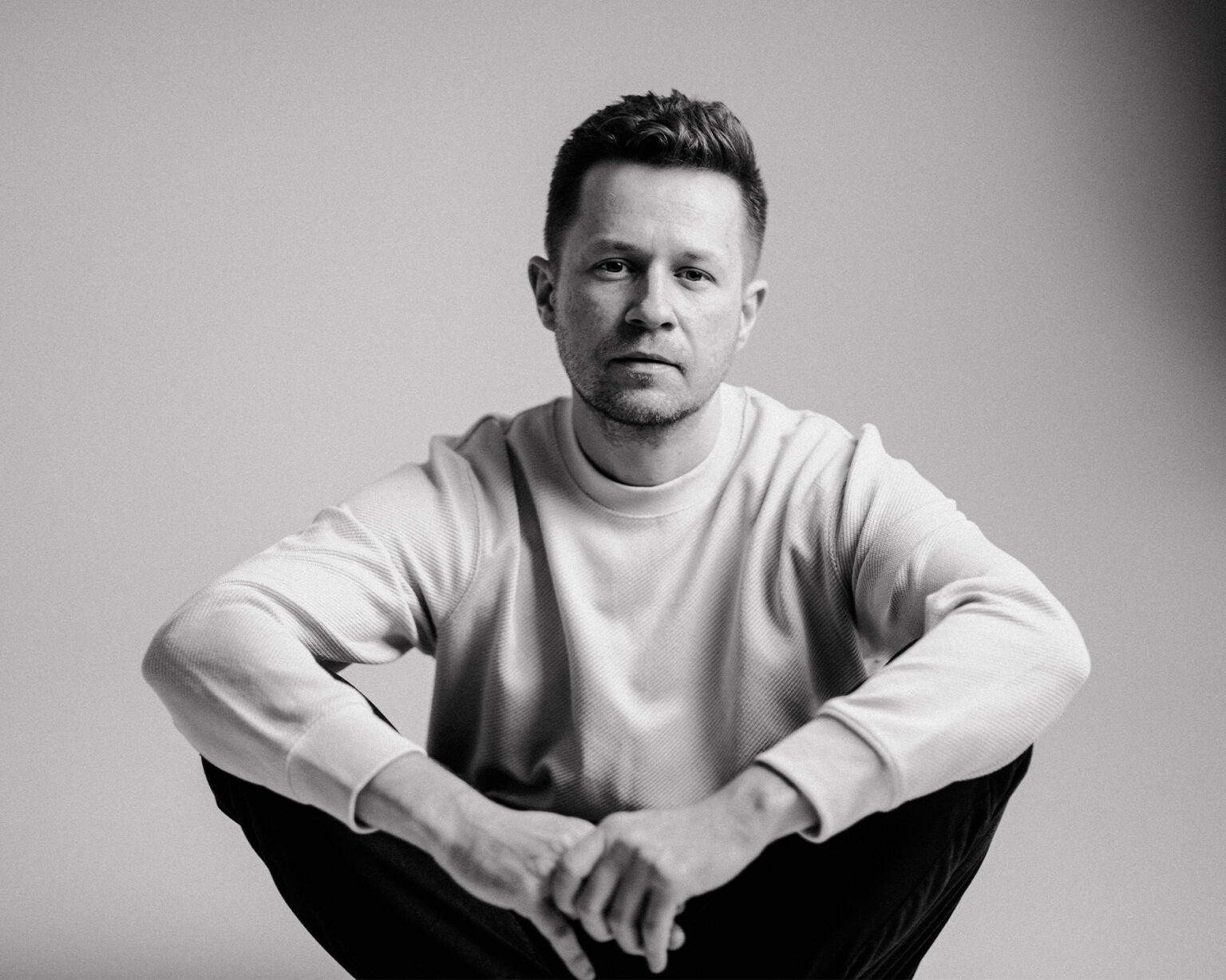
Wojciech Mierzwa works from his apartment in Gdynia’s Chwarzno district, where everyday family life blends naturally with the creative process, often at the kitchen table surrounded by sketches, samples, and materials the apartment slowly becoming an archive of prototypes and objects. He describes his practice as ten percent pure design and ninety percent organisation, spending much of his time travelling across Poland to collaborate with factories and workshops, where sketches become physical objects people can touch and use. For Mierzwa, design is never confined to working hours — ideas are gathered constantly, through observation, travel, and the quiet rhythm of daily life.

© Courtesy of the artist
Which place do you currently call home and where do you work on your projects?
My name is Wojciech Mierzwa, and I’m a furniture and lighting designer with over a decade of experience. The place I currently call home is Gdynia, Poland — a beautiful young modernist city on the Baltic coast, overlooking the Bay of Gdańsk. My apartment, where I live with my family and work on my projects, is located in the Chwarzno district of the city.
Where is your studio located & how does it look?
I work from home, although “studio” might not be the perfect word for it. It’s really a living space where everyday family life naturally blends with the creative process. I do have a separate office, but most of the time I prefer working in the kitchen, sitting at a large table where I can spread out with my drawing board, sketches, samples, and materials around me.
I try not to limit creativity only to working hours. I carry ideas with me constantly — whether I’m at home, traveling, or simply walking through the city. Designing, for me, is an ongoing process of observing, thinking, solving problems, and collecting inspiration from everyday life.
In reality, my work is probably 10% pure creative design and 90% organizing everything needed to make an idea become real. A large part of my process is based on collaboration with factories, workshops, and manufacturers. That’s where the real magic happens — where sketches and concepts slowly transform into physical objects that people can touch, sit on, and experience.
Because of that, I also spend quite a lot of time traveling across Poland, usually by car or train, visiting factories, prototype workshops, and clients I collaborate with. Most of my clients are Polish companies, although I’ve also had the opportunity to work with international brands and manufacturers. These journeys became an important part of my creative rhythm and often help me reflect on projects away from the computer screen.
Over time, my apartment has naturally turned into a growing archive of materials, prototypes, patterns, and objects. Recently, it has mostly been occupied by chairs, because I’m currently focused on several chair design projects. Alongside that, I keep building my own small library of materials.
I usually work surrounded by good music. My apartment is both my home and my creative space — a calm place where ideas can quietly grow and become part of everyday life.

© Courtesy of the artist

© Courtesy of the artist
Are there any projects that are personally important to you—whether recently completed or currently in progress?
Yes, at the moment I’m involved in three projects that occupy most of my time and attention, and all of them are personally very important to me.
The first one is a collection of chairs I’m currently developing for one of the manufacturers in Poland. It’s a long process of building an entire product line, and it constantly stays on my mind. Chairs are incredibly demanding objects to design — they combine comfort, engineering, proportions, and emotion in a very unique way — so this project became a major part of my everyday creative thinking. Coming soon.
Another very important collaboration is with the lighting company Argon, where we are developing a new collection of lamps together. This is one of those projects that truly captures the spirit of creativity for me. What I love most about this collaboration is the possibility of creating objects that genuinely enter people’s everyday lives. These are not conceptual pieces made only for exhibitions — they are real products, produced on a larger scale and used by people in their homes. That’s something deeply satisfying as a designer.
The third project is a revitalization of an armchair for 366 Concept. This project feels especially meaningful because it goes beyond pure design work. In some way, it also has a cultural and social dimension. We are revisiting and reinterpreting designs connected to the history of Polish modernist furniture, and the armchair I’m currently working on is part of that process.
I truly believe that the work done by 366 Concept contributes to preserving and continuing the legacy of Polish design culture. It’s inspiring to participate in creating pieces that could one day be seen as contemporary Polish classics — objects connected not only with aesthetics, but also with history and identity.
If I had to choose only one of these projects as the closest to me, it would honestly be very difficult. Each of them represents a different side of what I value in design, and each of them inspires me in a different way.

© Courtesy of the artist

© Courtesy of the artist

© Courtesy of the artist
Do you have a favourite place in your area where you like to relax and linger?
One of my favourite places to relax is definitely the northern part of the Kashubia region and the Baltic coastline around Hel and Jastrzębia Góra. Living in Gdynia gives me access to incredibly diverse landscapes, and outside of design work, this is where I truly recharge.
I especially love Kashubia because it still feels somehow undiscovered. It’s a beautiful region for slowing down, spending time in nature, cycling, hiking, or simply escaping into the forests.. There’s something very peaceful and authentic about it. I think anyone looking for a more gentle, rural European landscape would find something special there.
At the same time, I’m deeply attached to the Baltic coast. Hel, in particular, feels completely unique to me. It’s such a narrow peninsula that sometimes, while driving through it, you can see water on both sides of the road at the same time. There’s something almost surreal about that landscape — wild forests, wide beaches, and sand so clean and bright it almost looks unreal.
I truly love that place, especially outside the summer season. In autumn and spring it becomes wild, quiet, and slightly melancholic. In winter it feels raw and almost cinematic. During summer it gets too crowded for me, so I usually avoid it then, but outside the tourist season it becomes something magical.
Another place I often return to is the coastline between Jastrzębia Góra and Karwia. There’s a beautiful beach there that I’ve loved for years. It’s one of those places where you can simply sit with a book, rest on a blanket, listen to the wind and the sea, and completely slow down — even when the weather isn’t perfect. For me, those places are a real escape and a source of calm.

© Dawid Zawiła, Unsplash
Are there any urgent political issues or problems in your region?
Honestly, I don’t feel that my region is facing any major problems in everyday life. I chose to live here because I truly believe it’s a beautiful, peaceful, and very safe place to live.
For me, Poland belongs to a rare group of countries where you can genuinely feel free and comfortable in daily life. Safety and a sense of stability are something I consider an important part of our identity today. Of course, like every country, we have our own history and difficult moments in the past, but over the last decade this has become a very good place to live and raise a family.
Living in Gdynia, close to nature and the sea, gives me a strong sense of balance and calm. There’s space here to work creatively, spend time outdoors, travel, and simply enjoy everyday life without constant tension or fear. I feel grateful for that.
I believe that if you have your health, loving family, supportive people around you, and a peaceful place to live, you already have everything necessary to live fully
In your opinion, what has developed well in the last 5 years—and what has not?
From my perspective, having moved here around ten years ago, I’ve seen a remarkable amount of positive change.
Probably the most noticeable improvement has been the culinary and restaurant scene in the Tricity area (Gdynia, Gdańsk, and Sopot). Today, there is an incredible variety of places to eat, ranging from refined fine-dining restaurants to creative street food concepts. The quality and diversity of the food scene have grown enormously, and I genuinely believe it now stands out compared to many other European cities. It’s one of the most exciting developments I’ve witnessed during my time here.
Another major improvement has been infrastructure. Traveling across Poland has become much easier thanks to the continuous development of modern roads and expressways. Over the past decade, the road network has improved significantly, making journeys both safer and faster. As someone who spends a lot of time traveling between factories, clients, and production sites, I experience these changes firsthand and appreciate them greatly.
I’ve also noticed a growing cycling culture. More and more people choose bicycles as part of their everyday lifestyle, and this has encouraged cities to invest in cycling infrastructure. New bike paths and cycling routes continue to appear throughout the region, making it easier and more enjoyable to move around in a sustainable way.
Overall, what I appreciate most is that these improvements have made everyday life more comfortable, connected, and enjoyable while still preserving the natural beauty and character of the region.

© Photo: Kajetan Sumila, Unsplash

© Photo: Kajetan Sumila, Unsplash
Do you know a hidden gem when it comes to local manufacturers—whether it’s arts and crafts, sustainable products or food?
Absolutely. One of the things I enjoy most about living in the Tricity area is the growing food culture, and there are a few places I always recommend to visitors.
The first is F. Minga in Gdynia. It’s a place I’ve visited many times with my family over the years. I still remember their legendary brownie, which became almost a ritual for us. Located close to the city beach, it offers a beautiful atmosphere and captures the relaxed spirit of Gdynia perfectly.
Another favourite is Haos, which serves some of the best Asian-inspired food I’ve ever had. It’s creative, vibrant, and consistently excellent. Whenever someone asks me where to eat in Gdynia, it’s one of the first places that comes to mind.
I also have to mention Serio, a fantastic pizzeria that serves some of my favourite pizza in the city. It’s simple, authentic, and always worth a visit.
If you decide to travel towards the Hel Peninsula, I would strongly recommend Kutter in Hel. I visit it regularly and always enjoy coming back. It’s one of those places where the food, the atmosphere, and the location come together beautifully. For me, it has become an essential stop whenever I’m exploring that part of the coast.
Beyond restaurants, I would also like to recommend Tamo, a furniture brand that is particularly close to my heart. I spent almost five years helping to build the brand, so naturally I feel a strong connection to it. Tamo creates beautiful contemporary furniture and objects, combining craftsmanship, thoughtful design, and a distinctive aesthetic. I was fortunate to contribute to part of its journey, and I continue to follow its development with great admiration.
If someone visits the Tricity area and is interested in design, I would definitely encourage them to visit the Tamo showroom. It’s a wonderful opportunity to discover contemporary Polish design and experience beautifully crafted objects firsthand.
What I love most about this region is that you can spend the morning walking through forests or along the Baltic coast, enjoy great food in the afternoon, and discover inspiring local design along the way. It’s a very gentle and rewarding way to travel.
Is there anything particularly innovative in your region? Also in comparison to other places you have already visited?
What makes this region special is its unique combination of the Baltic Sea, the Kashubian landscape, and the Hel Peninsula. I honestly believe there is no other place quite like it in Poland, and perhaps not even in Europe.
It has a distinct Baltic character — shaped by the sea, maritime history, forests, beaches, and a slightly rugged beauty. The longer I live here, the more I appreciate how unique and inspiring this place really is.
Do you have a secret restaurant tip that you would like to share with us?
At F. Minga, I still think about their famous brownie, which has become something of a local legend for me.
I also love Haos for their excellent Pad Thai — one of my favourite dishes in the Tricity area.
And if you want to try something truly local, visit Gdynianka, a long-established pizzeria serving its iconic thick-crust pizza, a Gdynia classic for generations. Gdynianka is a true local institution, serving its iconic pizza on a thick, fluffy yeast dough. It’s very different from modern Neapolitan-style pizza and has become a beloved Gdynia classic.
What are your 3 favourite apps that you use every day and couldn’t live without?
The apps I use most often are probably Google Apps: like Search, Google Meet, and Google Calendar. Together, they define the rhythm of my work. Most of my projects involve collaboration with manufacturers, clients, and teams, so communication, scheduling, and access to information are essential parts of my daily routine.
One app that might surprise people is BirdNET. I’m actually the only person I know who uses it regularly, but I absolutely love it. The app identifies bird species by their songs and calls. Whenever I’m walking in the forest or countryside with my children, we use it to discover which birds we can hear around us. I’ve always been fascinated by birds. I’m not an ornithologist and have no formal training in the subject, but I find them endlessly inspiring and beautiful.
And finally, Spotify. Music is a constant companion in my life and work. Whether I’m designing, traveling, or simply relaxing at home, there is almost always music playing somewhere in the background. Without Spotify, it would be difficult to imagine my everyday routine.
Do you have any favourite newspapers or online magazines? And how do you keep up to date with politics or social and cultural issues?

© Upadek Matmy, Unsplash
Imagine you could be mayor for a year—what would you change?
If I were mayor for a day, I would focus on long-term urban planning.
As a designer, I naturally pay attention to how spaces are created and how people interact with them. I believe that many Polish cities, including Gdynia, still struggle with long-term planning and the thoughtful development of public spaces.
I would create a dedicated urban planning team that works closely with residents and incorporates public consultation into the decision-making process. Its role would be to think not only about the city’s current needs but also about how it should develop over the next several decades.
One last question: If you could choose another place to live—regardless of financial or time constrains—which one would you choose?
If I had to choose another place to live outside of Poland, I would probably choose Northern Italy. I’m drawn to its food, climate, history, architecture, and the way everyday life seems to be celebrated there. It’s a place with a strong cultural identity and a deep appreciation for beauty, craftsmanship, and simple pleasures — qualities that resonate with me both personally and professionally.
That said, it’s difficult for me to imagine living far away from my family and my roots. Poland will always be my first choice. It’s home, and the place where I feel most connected to the people and landscape that have shaped who I am.


