

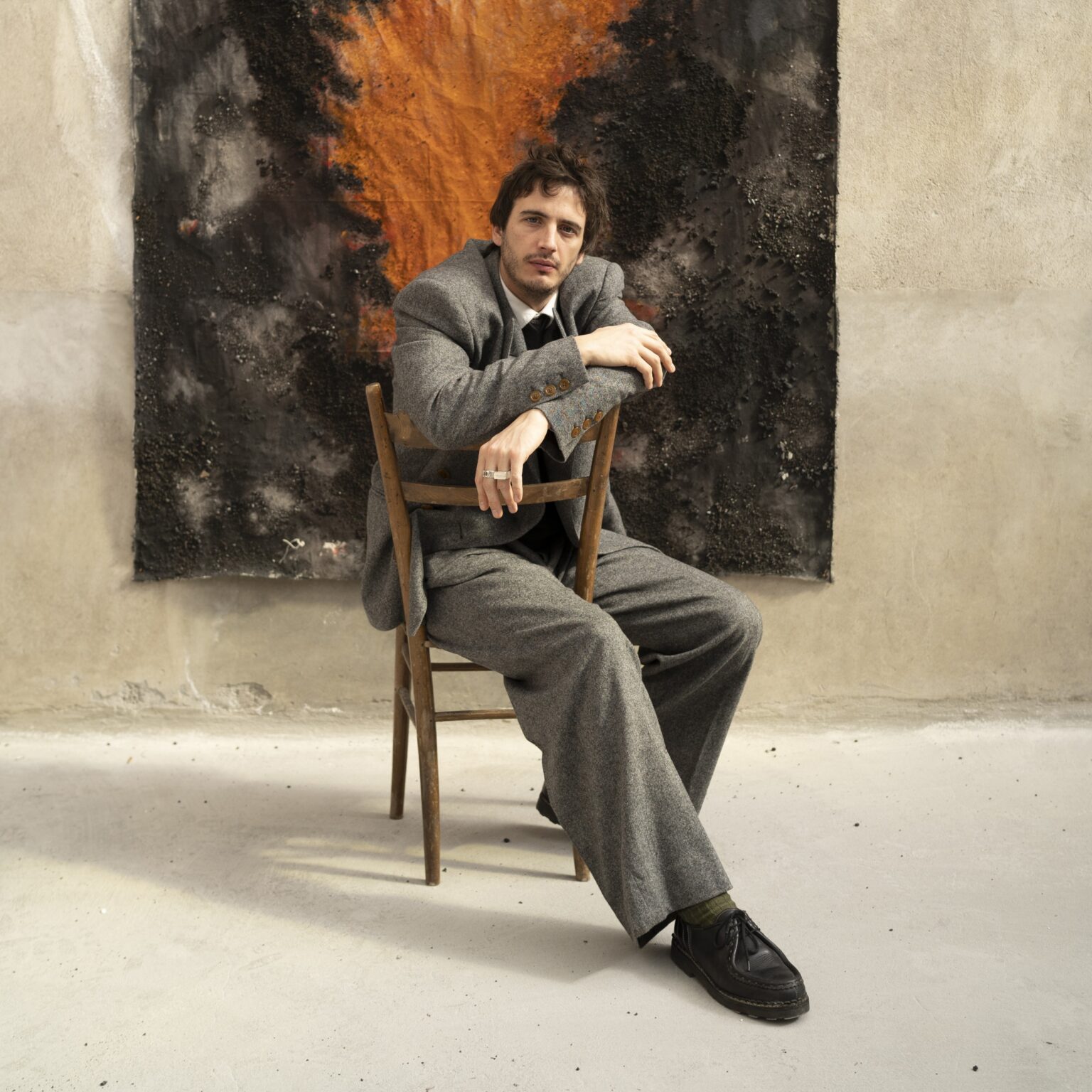
Between the hum of industry and the wilderness surrounding it, Léo Orta has built a practice that treats making itself as a form of listening. Fascinated by the intersection of subconscious expression, industrial production, and nature’s impermanence, he uses art and design to imagine new cycles of creation and connection.
His sculptures often begin with what a place already offers, reclaimed materials, vernacular techniques, plants gathered on site, echoing traditions of craft that risk being forgotten. By using intense color and organic shape through various media, Orta continuously explores the relationship between nature and industry.

© Courtesy of the artist
Which place do you currently call home and where do you work on your projects?
Right now, the place I call home is Les Moulins, in Boissy-le-Châtel, about 60 km east of Paris. I also live and work on the site, making it both my home and my creative workspace. Les Moulins is a former 19th-century paper mill located along the Grand Morin River. My parents, Lucy + Jorge Orta, have been leading the rehabilitation of this industrial heritage site since 2009, and I joined the project to help develop its cultural mission.
Today the space spreads through exhibitions spaces, storages and studios in which several artists have joined and where the Galleria Continua has settled their headquarters as well. I work from my studio, located at the far end of the site, within a 1,000-square-metre building that has been converted into workshop areas. Being immersed in this environment where art, heritage, and daily life intersect allows me to fully engage creatively and has shaped my practice profoundly.
Where is your studio located & how does it look?
I am based at the very back of the factory, which means that on one side I am completely immersed in the industrial complex, while on the other I am surrounded by nature. I feel that this reflects the way I work, constantly moving back and forth between these two worlds. I am drawn to industrial processes, yet the forms I create often feel quite organic. Beyond the studio, the site is surrounded by agricultural fields, the river, old water tanks and former warehouses. The factory once employed around 400 people before it closed in 2006. Being able to take over this space, bring it back to life, and transform it into a kind of creative machine feels like a real blessing.

© Courtesy of the artist
Are there any projects that are personally important to you—whether recently completed or currently in progress?
The AlUla residency was a turning point for me and my practice. I encountered craftsmen restoring the old town in adobe, which sparked my interest in building organically; not only through shapes, but also with the materials I find on site. It introduced me to vernacular building techniques that are site-specific and therefore material specific such as : …. Now I am interested not only in the object itself, but also in the materials available on site and the making processes that belong to each territory.
With my current residency in Camargue, I wanted to prolong this approach. I fully immersed myself in the craft of basketry and the plants associated with it. Very organically, we were able to appropriate the method, learn the craft and contribute to reactivating this body of knowledge, which today seems to have been somewhat set aside.

© Courtesy of the artist

© Courtesy of the artist

© Courtesy of the artist
Do you have a favorite place in your area where you like to relax and linger?
Les Moulins has this particularity of being both very big and surrounded by nature. Even yesterday, we saw a deer jumping right next to the studio. The whole environment is incredibly peaceful. We have a skate park, my family’s studios, and a little bar called La Cachette, where we sometimes play pétanque while having a drink. The river is also really relaxing after a full day of work, even though it’s very cold.
Twice a year, we organize group exhibitions and invite locals and visitors to explore the site as well, because the whole point is to share it. The staff also lives on site with us, which creates a real sense of community over the summer season, and that’s something I really enjoy.

© Clément Dellandrea, Unsplash
Are there any urgent political issues or problems in your region?
If I were french enough, I would start complaining about all the little annoying things here and there; troubles with transportation, agriculture issues, heavy seasons etc but overall I would say things feel rather good around Boissy-Le-Châtel and its new mayor.
In your opinion, what has developed well in the last 5 years—and what has not?
I think one of the biggest changes or positive development has been the impact of the Galleria Continua in the region. It has definitely played an important role in bringing new life to the former paper mill and has helped us transform it into a place where artists, exhibition spaces and visitors can come together. Lately we had former employees of the factory coming to us, saying how happy they were to see the building back to life with a new creative energy. It also has shown us that a rural place can become a destination for contemporary art and creative exchange.
What I think has not developed as well is the transport infrastructure. Les Moulins is only about ten minutes from a train station with a direct connection to Paris, but reaching the site still depends heavily on the rail network and on having access to a car. I think improving accessibility would make a real difference, not only for places like Les Moulins but also for cultural organisations for example.
Do you know a hidden gem when it comes to local manufacturers—whether it’s arts and crafts, sustainable products or food?
One hidden gem in the area is the local market in Saint-Siméon, where you can find fresh produce from nearby farms as well as Brie de Meaux, one of the region’s best-known cheeses. What I particularly appreciate in France is the AOP (Appellation d’Origine Protégée) label. It guarantees that certain products are made in a specific geographical area using traditional know-how. I think it is a great way of protecting local craftsmanship, preserving regional identities, and supporting small producers.
Is there anything particularly innovative in your region? Also in comparison to other places you have already visited?
One of the key innovations in the region is the sustainable management of water. Back in the day, the paper mill relied on the strength of the river to power its machinery, so water has always been a major topic for us. Even as artists on the site, my parents have been influenced by water as a resource and a research topic. This is what they did with the OrtaWater project, which aimed to raise awareness of water as a precious and vulnerable resource. More pragmatically speaking now, the municipality has invested in recent years in a new drinking water treatment facility to improve water quality and secure the water supply in the event of large-scale pollution. So they would use the actual water of the river for this which is exciting.
I also recently read about a project in Sicily, a region that produces a large amount of oranges, where they decided to transform orange by-products into textile fibres. As our region is known for its apple production, I think it would be interesting to explore something similar here by finding new uses for local agricultural by-products.

© VENUS MAJOR, Unsplash

© Touchatou, CC BY-SA 3.0
Do you have a secret restaurant tip that you would like to share with us?
In the region, there is a secret restaurant called Le Banquet des Troubadours in Provins. If you want to eat there, you have to come dressed as a knight. The whole restaurant is medieval-themed, with long banquet tables, period costumes and live entertainment, so it really feels like stepping into another era. It’s a pretty intense experience, but definitely worth it.
Is there a local shop whose products are only available in your region?
I feel very lucky to live close to a family of farmers who grow fruits and vegetables on a small piece of land in a sustainable way. I try to visit them every week whenever I can. It’s a small habit I’ve developed over the years, and I like knowing where my food comes from while supporting people who work locally.
What are your 3 favourite apps that you use every day and couldn’t live without?
Every day, I check the weather app because it sets the mood of the factory. We have to adapt our production to the weather, for example, the dryness of the air really helps with the drying process. Then, probably emails, and a game of Catan. I try to play one game every day.
Do you have any favourite newspapers or online magazines? And how do you keep up to date with politics or social and cultural issues?
I read France Info twice a week, and that’s about it. This year, I’m trying to talk to people from the area instead of just reading about the issues. I feel like it makes me a more active person if I can help as much as I can. Otherwise, I browse art magazines that aren’t too focused on politics, just to stay sane.

© Claude Gardères, CC BY-SA 3.0
Imagine you could be mayor for a year—what would you change?
If I were mayor for a year, I would try to make the village more cohesive on a small scale. Maybe I would organize a parade or a few small events so that people from the area could come together a bit more than they do right now.
One last question: If you could choose another place to live—regardless of financial or time constrains—which one would you choose?
I would live in the Tuscan hills and renovate an old palazzo. I’d have a horse to ride, and probably a small farm, with a studio space of course. Maybe I would call it Cultural Farm.


