

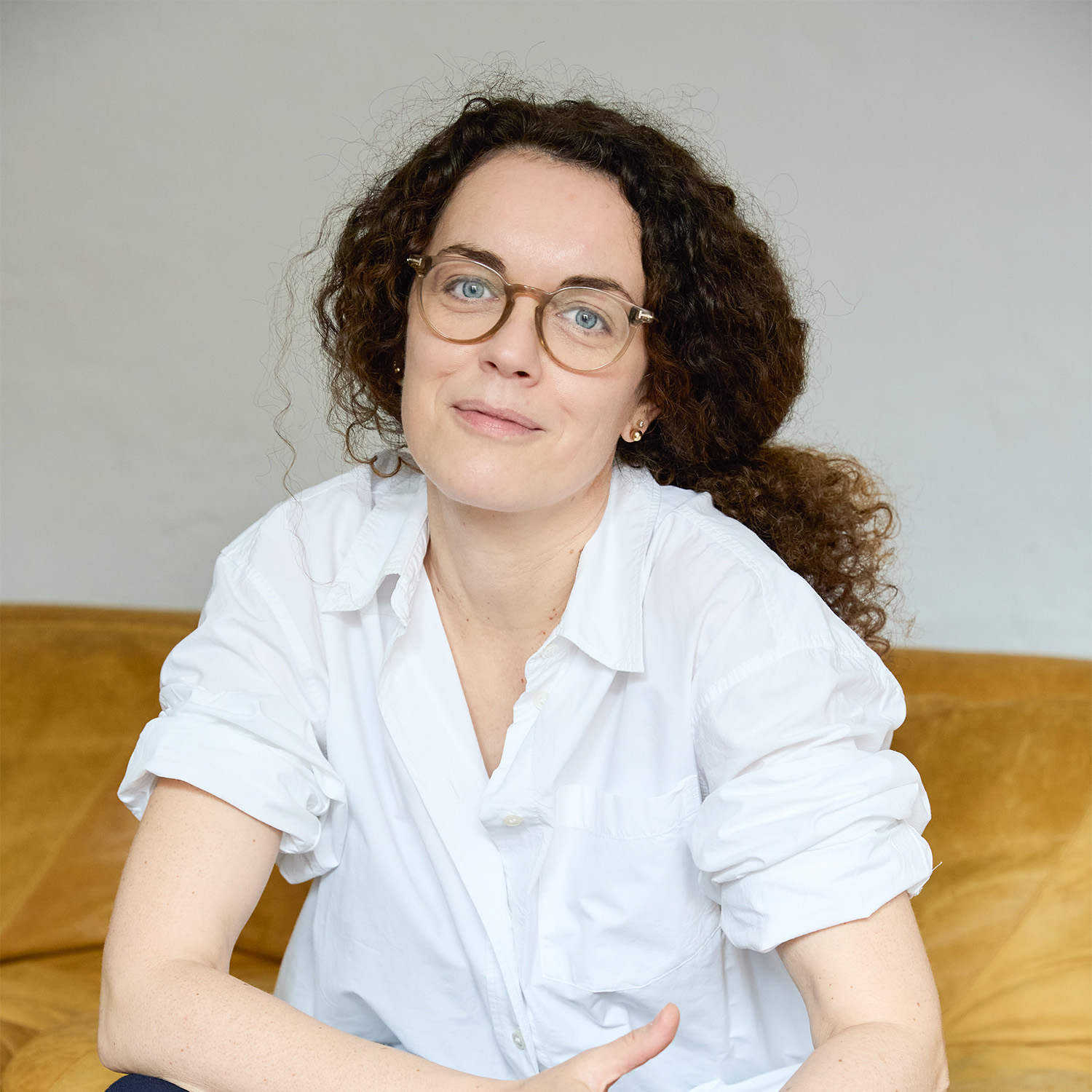
Katrin Schlotterhose’s work sits at the intersection of science and sensuality. Working exclusively with generative AI, she turns extreme macro studies — plants, droplets, biological surfaces into images where a petal becomes a landscape and a bubble becomes a planet. Her visuals serve beauty, biotech and fragrance brands looking for something more honest than stock and more refined than convention, alongside limited fine art editions made for collectors. In everything she creates, the goal is precision in service of feeling, the closer she looks, the more she finds.

© Courtesy of the artist
Which place do you currently call home and where do you work on your projects?
I live with my son Rio in the heart of Berlin, in Tiergarten, close to the park and just off Potsdamer Straße. It is one of those rare pockets of the city where two things meet that usually do not: the urban pulse of Berlin, with traffic, galleries, and constant motion, and a kind of stillness that feels unusual for a city this size.
Within five minutes I can walk into Tiergarten itself — two hundred hectares of trees, water, and quiet, where for an hour you can almost forget that Berlin exists at all.
Potsdamer Straße is a quiet anchor for me. There are galleries, stores, small studios, and a creative density that does not try to perform. Many of the people I respect in Berlin live or work within walking distance, and that proximity shapes the way I think every day. My studio is built into our apartment. Not a separate space, but a room behind a door, part of where Rio and I live. Most mornings I start with coffee at my desk and a couple of hours of quiet before anything else begins. That is when I look at images, practise new techniques, and test ideas. The work I actually like usually comes out of that early window.
Are there any projects that are personally important to you, whether recently completed or currently in progress?
I am in the final stages of an international fragrance campaign right now, and it has been particularly rewarding. Working with markets outside Germany always reminds me how much visual language shifts from culture to culture. What reads as precise to one audience can feel cold to another. What feels luxurious here may feel flat somewhere else. It is a constant calibration, and it sharpens my eye every time.
Next on my desk is the development of a full visual identity for a brand from the ground up. That is the work I love most. It is not a single image or campaign, but an entire visual world that has to hold together over time, across formats and moods. Building that kind of system asks for both intuition and discipline, and it often starts with very small decisions about light, surface, and proportion.
On the personal side, I have just released a new print series. It explores plants through deliberate blur. I wanted to step away from sharpness for once, to let colours melt into one another and let the movement of the image become its subject. When you look at one of these prints, something registers before you can name it. That was the intention: to make work people can lose themselves in for a moment, before language catches up.

© Courtesy of the artist

© Courtesy of the artist

© Courtesy of the artist
Do you have a favorite place in your area where you like to relax and linger?
I go to Tiergarten often. The park is just five minutes from my door, and the green calms me in a way that is hard to explain. Walking under those old trees, with the city humming somewhere in the distance, lets the noise in my head settle.
Inside the park is Café am Neuen See. It is not a new spot, but it is one of those Berlin places that keeps its energy. A beer garden on the edge of a lake, very international, busy in a generous way. I love going there to sit and watch people. Berlin is one of those cities
where you can hear five languages in five minutes, and there is no place where I feel that more than there. It is where my eye relaxes and trains itself at the same time.
There is also a small French wine bar in my neighbourhood called Les Climats. I go there to meet friends, all of them creative in one way or another: a documentary filmmaker, an actress, a curator, an art director. Sharing a glass of wine and listening to what they are
working on is one of the most nourishing parts of my week. It keeps my work honest and my thinking alive.

© Samuel Sven
Are there any urgent political issues or problems in your region?
It is hard to pick only one. Berlin right now sits at the intersection of several issues I think about a lot, and as a creative person living and working here, all of them are connected.
The most immediate one for me is the question of how generative AI will be regulated, credited, taxed, and protected. My practice depends on this technology, and I see firsthand how unresolved the legal and ethical frameworks still are. The conversation in Germany is often polarised, and I would like to see a more measured position — one that protects human artists without smothering what these new tools can do.
Connected to that is the wider question of cultural funding. Public money has been pulled out of independent culture year after year, and the city is slowly losing what made it Berlin in the first place. Artists and small institutions are not luxuries. They are the soft infrastructure that holds a city’s identity together.
Underneath all of this is the housing problem. Rents have pushed many artists, writers, and single parents out of the city. A city that loses its working creatives slowly becomes a museum of itself.
And beyond Berlin, I am concerned about the steady normalisation of far-right developments in Germany. Historically, Berlin has been a city of refuge and openness, and I want it to stay that way.
In your opinion, what has developed well in the last 5 years, and what has not?
What has been most striking is how quickly generative AI has gone from being treated as a novelty, even a gimmick, to becoming a serious artistic medium. I work exclusively with it now, and so do many artists I respect. That shift happened faster than almost any other change in recent visual culture, and I am aware of how rare it is to witness something like that from the beginning.
Closely tied to that is something I notice in the visual culture around me. After years of loud, fast aesthetics dominating advertising and social media, brands and audiences are looking again for images that breathe. There is a real appetite for considered, sensorial work — images that take a moment to read. That gives my kind of work a room it did not have five years ago.
Creative working life itself has also loosened up. Five years ago, the assumption was still that serious work required a separate studio, fixed hours, a particular geography. Today I can do my best work from a room behind a door in my own apartment, with my son nearby and with my own rhythms. For mothers, caregivers, and people who do not fit a traditional studio model, that has been freeing.
What has not developed well is the pace of everything. We are asked to produce, react, and post at a tempo that does not match how good work actually emerges. It is the contradiction of this moment: better conditions, but more brutal expectations. Learning to protect slow time inside that pressure is, for me, the real discipline of working today.

© Thulfiqar Ali

© Café am Neuen See
Do you know a hidden gem when it comes to local manufacturers, whether it’s arts and crafts, sustainable products or food?
Vieri Jewels is a sustainable jewellery label whose pieces I deeply admire. Her Cloud rings have been on my wishlist for years.
Lenas Lovely Vintage is a small second-hand shop in my neighbourhood with beautifully curated pieces. I still wear a dark blue suede trench coat from her shop, years later.
Fabienne Meyer, also known as bings, is a painter whose work I love. Quiet, direct, and full of feeling — the kind of art that stays with you long after you leave the room.
GreenDoor Bar is a tiny bar with some of the best drinks in Berlin. You have to know where to look, which is part of its charm.
Reethaus is where I go when I need to step outside the city for a moment. A genuinely sustainable place, slow and grounded, where you can really exhale.
Zeit Café is another favourite. It is set in a former petrol station, a place that once housed the Grosz Museum, and still carries that quiet sense of Berlin history. I like places where the past is not polished away completely, and Zeit Café has exactly that atmosphere — simple, open, and full of character.

© Clemens Poloczek
Is there anything particularly innovative in your region? Also in comparison to other places you have already visited?
The first thing that strikes me, comparing Berlin to other creative capitals I have spent time in, is how little this city performs. I can ride my bicycle to a meeting in plain clothes and no one blinks. Berlin does not ask me to prove anything externally. I am judged on what I make, not on how I signal status, and that quietly changes everything about how I build a career.
The second is the way history lives on the pavement here. I walk past memorials, pre-war buildings, and traces of the wall almost every day. The past is not tucked away in museums. That changes how I think about time. It keeps me honest about what came
before, and a little less precious about what I make now.
The third is something I have felt my whole working life here: if something does not exist in Berlin, you build it yourself. That is how my old magazine, Metropolitan Circus, came into being. It is how friends of mine have started bakeries, presses, and collectives. There is no waiting for permission.
Do you have a secret restaurant tip that you would like to share with us?
I have three:
The first is Lovis at the Wilmina Hotel in Charlottenburg. The building is a former women’s prison, sensitively converted, and somehow that history feels woven into the experience. The food is precise and seasonal, but what I love most is the atmosphere. You sit down and time slows.
The second is Sticks’n’Sushi. I have a long professional relationship with them and have come to know their philosophy from the inside, which makes me notice how seriously they take everything they do. The Danish-Japanese approach gives the food a particular
discipline, and the rooms themselves are beautifully designed.
The third is April, a small restaurant in Schöneberg that I keep returning to. The wine list is curated with a real point of view, the food is straightforward and excellent, and there is a warmth in the room that is hard to manufacture. It is not a place that tries to impress you, which is precisely why it does.

© Wilmina, Lovis Restaurant

© Wilmina, Lovis Restaurant
Is there a local shop whose products are only available in your region?
Andreas Murkudis, on Potsdamer Straße, just a few minutes from where I live. It is a concept store unlike anything I have seen elsewhere in the world.
The space itself is the first thing that strikes you: vast, almost silent, with high ceilings and pale floors. It feels less like a shop and more like a quiet, slow gallery. Everything inside is curated with a clear point of view — clothing, ceramics, glassware, fragrance, design objects, books. Things that do not sit beside one another anywhere else.
What I love most is that the store does not try to sell you anything. You can walk in just to look, stay for half an hour, and leave with an idea rather than a purchase. For me, living a few streets away, it is part of the neighbourhood I think with. I go there when I need to recalibrate my eye.

© Thomas Meyer Ostkreuz

© Thomas Meyer Ostkreuz
What are your 3 favorite apps that you use every day and couldn’t live without?
– Pinterest
– Midjourney
– Apple Notes
Do you have any favorite newspapers or online magazines? And how do you keep up to date with politics or social and cultural issues?
Die ZEIT is my primary German paper. I go to it for long-form journalism and cultural depth rather than breaking news. When I want to understand a story instead of just hear it, this is where I turn.
brand eins is a German magazine that treats work, entrepreneurship, and design as serious cultural subjects. Every issue gives me at least one piece I keep thinking about for weeks.
I also read a small set of Substack newsletters on art, AI, and culture. One careful essay there usually teaches me more than scrolling ten headlines elsewhere. Slower, but I retain more.

© Deniz Caglayan
Imagine you could be mayor for a year, what would you change?
If I were mayor of Berlin for a year, I would focus on three things.
The first is money for culture. Berlin’s reputation, and a real part of its economy, was built by independent galleries, small publishers, studios, and artist projects. If we keep cutting their funding, they will leave. And once they are gone, you cannot bring them back.
The second is space. The biggest reason artists and writers cannot stay in Berlin anymore is rent. If we want this city to keep attracting interesting people, they have to be able to afford to live and work here. That means long-term protected studios, rent caps in creative neighborhoods, and using empty public buildings for artists instead of selling them.
The third is schools. As a mother, I see every day how much Berlin’s schools need support. Buildings are falling apart, teachers are overworked, and entire systems are held together by goodwill rather than proper investment. A city that cannot take care of its children’s education has no real future. I would put serious money into schools, teachers, and the buildings themselves—not as a political gesture, but as the most basic responsibility a city has.
One last question: If you could choose another place to live, regardless of financial or time constraints, which one would you choose?
Honestly, I would not want to leave Berlin completely. I would always want to keep an apartment here. This is where my work lives, where my friends are, where Rio is growing up.
But I do feel more and more that I need a place outside the city. Not as a permanent move, but as a second rhythm. I could imagine returning to my parents’ farm for stretches of time. A place that feels slower, more physical, and more grounded than Berlin. I have always loved restoring furniture, working with my hands, sanding, repairing, bringing old pieces back to life. It is something I would really like to make space for again.
I could also imagine renovating a house on the Atlantic coast of France with my partner, who is French. An old stone house somewhere near the ocean, with wind, light, and that particular Atlantic atmosphere. Not as an escape from Berlin, but as a counterweight to it. A place to disappear into for a while, work with my hands, and come back with a different kind of clarity.


