

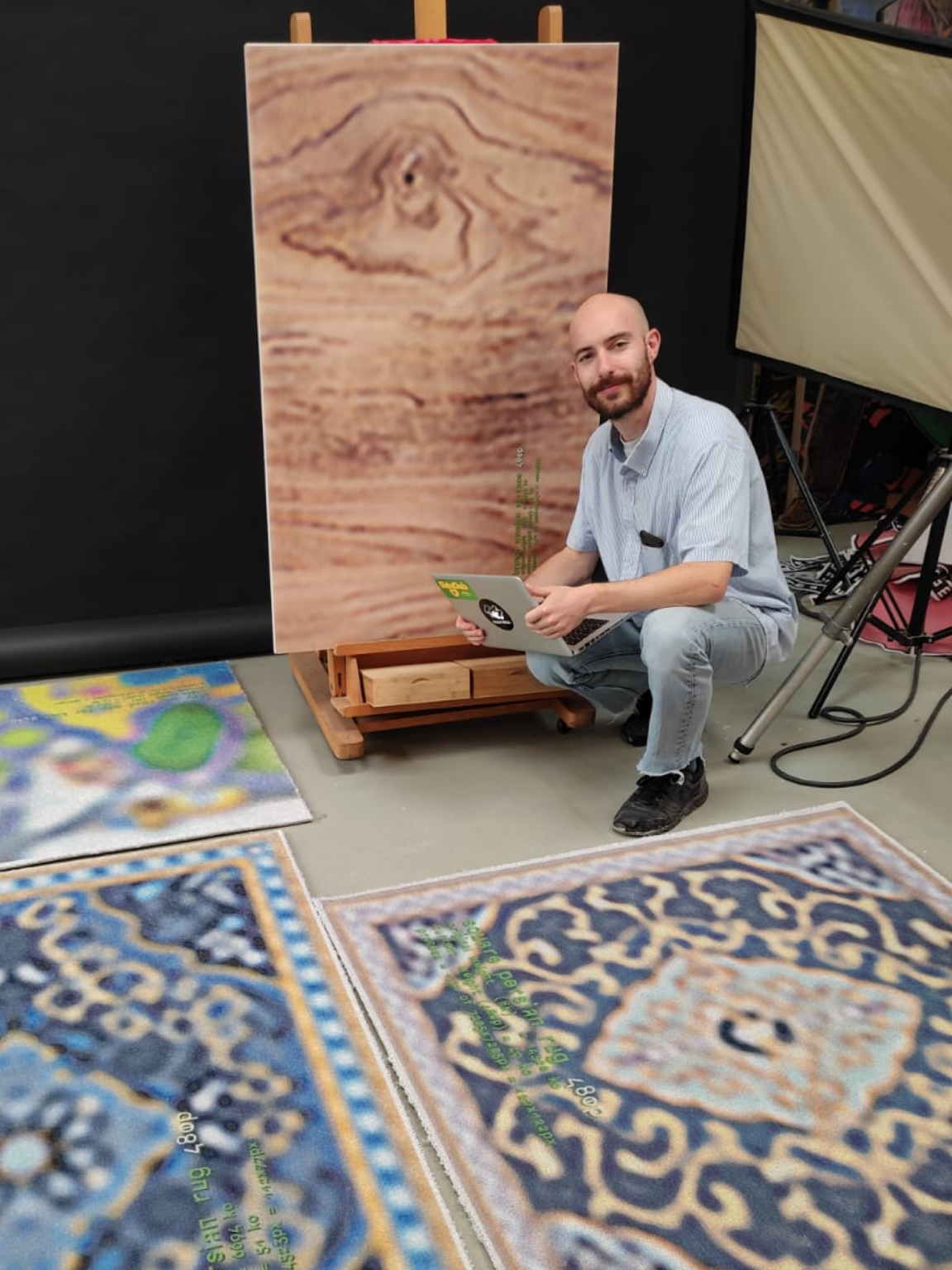
The core of Jonas Hejduk’s work is storytelling. He creates characters, settings, and stories that develop via exhibits, interiors, and installations as opposed to creating items as standalone works. His creations frequently blend a sense of absurdity with meticulous craftsmanship, creating environments that are both familiar and yet otherworldly.
Through speculative scenarios and immersive settings, Hejduk explores contemporary questions around technology, perception and collective imagination. His work encourages viewers to look beyond function alone and engage with design as a tool for reflection, curiosity and play.

© Paskamer
Which place do you currently call home and where do you work on your projects?
After nearly ten years spent in the Netherlands, I recently moved to Brussels, which has become my home base—though “base” might be generous, since I spend my life on the Eurostar going from Brussels to Paris to Rotterdam. I work across several parallel lives: my own personal shows and exhibitions, the exhibition design and scenography studio Paskamer that I co-founded in Rotterdam, my role as design and interior architecture tutor at LISAA in Paris, and the installations and workshops I run with Pauline Rip under the name Dungeon & Design. It’s a fairly nomadic professional life—spread across Europe, but Brussels has caught my heart.
Where is your studio located & how does it look?
As I’ve only just arrived in Brussels, my practice is physically scattered. My studio is still in Rotterdam, where Paskamer—the exhibition design studio I co-founded with Pauline Rip, Alex Foradori and Bianca Schick—is officially based. To get an idea of it, picture one large room in Noord-Rotterdam structured by a floor-to-ceiling funky blue velvet curtain with pink pompoms we designed ourselves (a wink at the Dutch name “paskamer”, meaning “fitting room”), with REC-s (/rex/), our surveillance camera mascot, hanging from a corner of the ceiling—a tiny space that is at once an exhibition room and a production studio. In Brussels, we are currently looking for something bigger: a space that can hold both production and research. In the meantime, I work from a desk at home—a 3D printer and sewing machine within arm’s reach—designing and planning the upcoming shows.

© Paskamer
Are there any projects that are personally important to you—whether recently completed or currently in progress?
Since December 2025, the pace has been relentless. With Paskamer, we designed a window installation in Milan for the tea brand Pompadour, produced in collaboration with Netflix’s Bridgerton—a monumental wig-shaped display unit. We then created the scenography for Greige Fantastic, an exhibition curated by Maia Kenney at De Nederlandsche Bank in Amsterdam—a mystical show drawing from Dutch corporate art collections. From there, a scenography for Milan Design Week for the collaboration between Design Academy Eindhoven and Alcova, and we are now finalising the exhibition design for How Matter Comes to Matter at Onomatopee in Eindhoven, curated by Cecilia Casabona—a dreamcore scenography I’m particularly excited about.
In parallel, with Dungeon & Design, Pauline Rip and I are preparing an installation for the Centre Pompidou as part of the Hors-Pistes / Hors-Champ program—taking place during the Centre’s closure. The piece includes a 4-metre hand-sculpted wooden femur and a 15-metre giant skin hand-felted in flesh-toned wool. It’s hard to take yourself too seriously when you’re sanding a massive femur.
And then there is crash.jpeg—the project closest to my heart. Started in 2021, it imagines a world struck by a meteorite that physically lowers the resolution of reality. A provocation against Silicon Valley’s obsession with ever-higher definition, it has grown into a full collection: Jacquard-woven blurry rugs, an upholstered bench shaped like a low-res tree trunk, bed sheets printed with compressed clouds. Selected pieces are available through Alcova’s shop. The project has been shown at Villa Noailles as a finalist of the Grand Prix Design Parade, at the Venice Design Biennale, Salone del Mobile and Collectible Brussels, and featured in Étapes, Wallpaper and Dezeen.

© Paskamer

© Courtesy of the artist
Do you have a favourite place in your area where you like to relax and linger?
I’m still discovering Brussels, but what I already love is its roughness and authenticity—qualities that contrast enormously with the polished, well-mannered surroundings of the Netherlands I’d grown used to. My Latin and Slavic blood feels more at home here—beautiful art nouveau buildings, terraces always full of people no matter the time, public space being used, slightly trashed and smelling faintly of pee, but alive and generous.
Things that cool me down in Brussels: First, walking through my beautiful neighborhood—the triangle between Bourse, Saint-Catherine and les Riches Claires—with a mix of ambient bangers from the excellent local Kiosk Radio in my ears. Second, music: the underground scene in Brussels is very rich, and the places to dance are numerous—Recyclart, La Halle de Schaerbeek, Horst. Fewer BPMs, equally intense—we recently scored last-minute Ticketswap cheap tickets for Medusa at La Monnaie opera house, and that was overwhelming. Third, cinema. Storytelling is central to my practice, and I’m a very proud Cineville cardholder—Palace, Aventures, Galeries, RITCS—going as often as I can to find inspiration for upcoming projects.

© Royal Institute for Theatre, Cinema & Sound
Are there any urgent political issues or problems in your region?
As soon as we moved in last October, we went straight to a massive protest against Arizona—the Belgian right-wing coalition that strongly focuses on fiscal austerity, planning direct budget cuts and the freezing of subsidies. Fascism is growing, and minorities and the cultural sector are obviously the first ones at risk.
The housing crisis is a nightmare in the Netherlands, and even if we were lucky enough to find an apartment easily here in Brussels—thanks to our dear friend Thomas F.—we know the problem will sooner or later hit just as hard. Prices are already ridiculous, and most independent people in design and art are photoshopping their payslips just to be considered for a viewing, which is not normal at all. (Note to my landlord: I didn’t photoshop anything. 🙂 )
Do you know a hidden gem when it comes to local manufacturers—whether arts and crafts, sustainable products or food?
Maud Paul. A designer, metalworker and drawer based in Molenbeek, Brussels, she cuts and welds her own steel structures by hand and upholsters them in textile to make beautiful seating objects. We collaborated with her for a scenography we designed for a show at Alcova during Salone del Mobile in Milan, where she fabricated tailor-made metal structures that became parts of a series of fake food trolleys we designed. Besides her textile and metal skills, she’s also a remarkably talented drawer, and her work on paper is well worth seeking out.

© Maud Paul

© Maud Paul
Is there anything particularly innovative in your region? Also in comparison to other places you have already visited?
Belgium’s allocation du travail des arts is one of the most genuinely innovative things about this country. Unlike France’s intermittents du spectacle— restricted to performing arts and audiovisual workers—Belgium’s system covers a very broad range of practitioners: performing artists, visual artists, designers, scenographers, and craft workers. It’s not handed out freely either: applicants must demonstrate a substantial body of professional work and pass before a jury—the Commission du travail des arts—which assesses whether their practice qualifies. But once granted, for 5 years it pays a non-degressive monthly allowance of around €1,500 to €2,000, combinable with freelance income. It’s an act of political imagination—and one currently under threat from the Arizona coalition’s austerity agenda.

© Bert Selleslagh on Unsplash

© Hoejin Iwai on Unsplash
Do you have a secret restaurant tip that you would like to share with us?
On Sunday lunchtimes, the ground floor of Bosch—a community space tucked into the Marolles at Rue des Tanneurs 116—opens up as a canteen. It’s the kind of place that doesn’t have a website, doesn’t take reservations, and doesn’t need to. The proceeds go to local associations and humanitarian causes, the crowd is mixed and the food is good.
Do you have any favourite newspapers or online magazines? And how do you keep up to date with politics or social and cultural issues?
Conversations with students—at LISAA, Gerrit Rietveld Academie, EESAB—are genuinely one of the most reliable ways I stay in contact with what’s shifting socially and culturally. Beyond that, I’ve been following closely what Nova Radio has been doing over the past two years: Mathieu Pigasse has been gathering humorists and left-wing figures—Guillaume Meurice among them—to push back against the rise of fascism in French-speaking media, and I find that fight both necessary and inspiring. The guests on La Dernière are usually fascinating; I recently discovered the brilliant sociologist Geoffroy de Lagasnerie through it. In the written press, I still buy Le Monde Diplomatique—though I’ll admit that buying it is considerably easier than reading it cover to cover.

© Trougnouf (Benoit Brummer), Saint-Jacques-sur-Coudenberg during civil twilight (DSCF7448), Adjusted colours, CC BY-SA 4.0
Imagine you could be mayor for a year—what would you change?
I would be terrible at it and get corrupted very easily—but in my naive first days I’d probably start by introducing a basic income for artists, much like Ireland did recently.
One last question: If you could choose another place to live—regardless of financial or time constraints—which one would you choose?
The Silicon Valley, so I could destroy it from the inside.


