

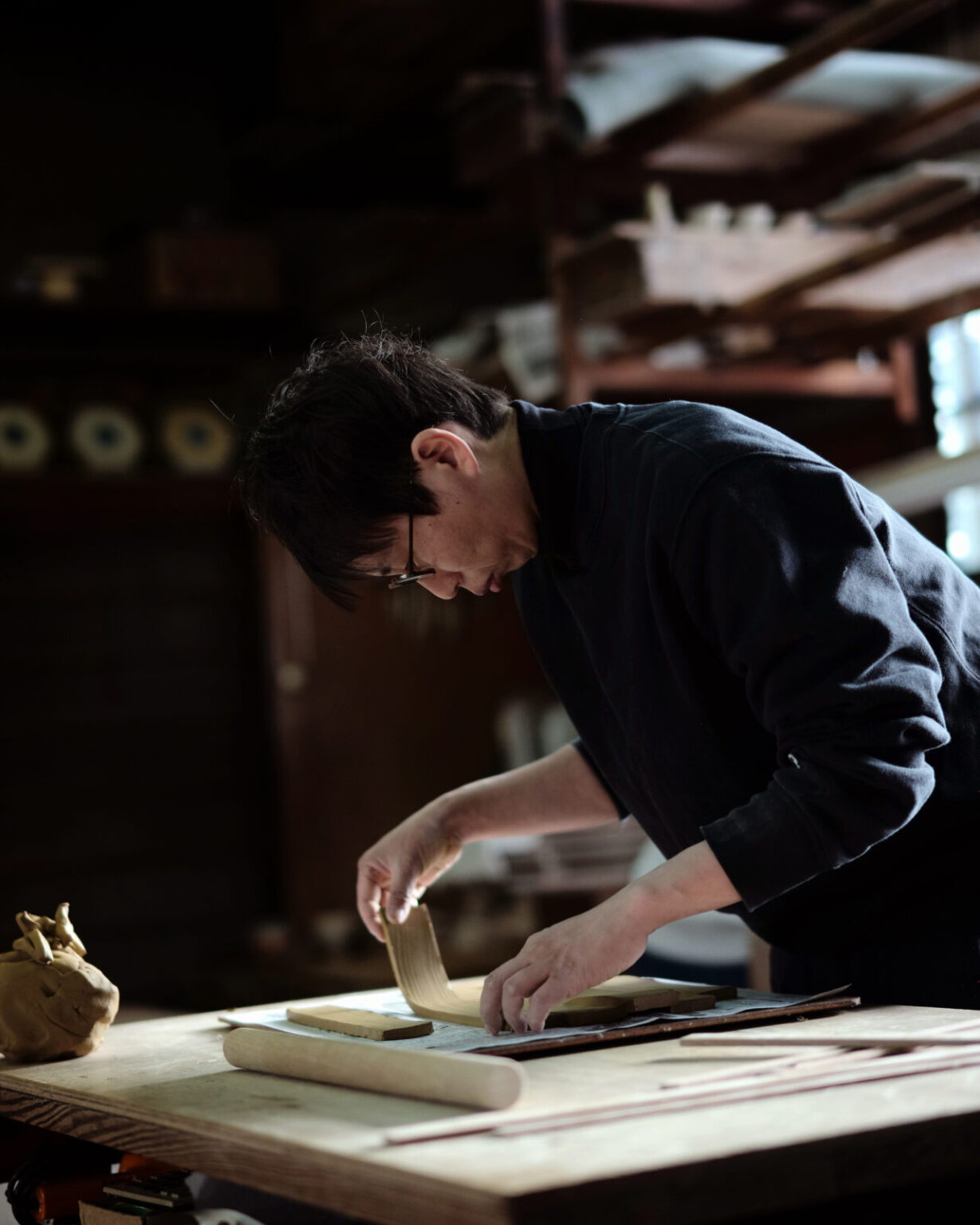
Through a quiet balance of tradition and contemporary form, Hosai Matsubayashi explores the beauty of clay. His tea ceramics reflect Asahikayi’s “Kirei-sabi” aesthetic, embracing the natural character of rough clay, soft blue glazes and pure white slip. Drawing on Uji’s landscape and tea culture, each piece creates a dialogue between maker, nature and user.

© Courtesy of the artist
Which place do you currently call home and where do you work on your projects?
I live and work in Uji, a place located between the ancient capitals of Kyoto and Nara in Japan. Uji has a rich history as a resort area for aristocrats and has been central to tea production and tea culture for centuries.

© Courtesy of the artist

© Courtesy of the artist

© Asahiyaki
Do you have a favourite place in your area where you like to relax and linger?
The area surrounding my workshop is quite delightful, making walks in the vicinity my go-to relaxation activity. The banks of the Uji River, in particular, offer a feast for the eyes with cherry blossoms, lush greenery, and autumn leaves changing with the seasons, accompanied by the pleasant songs of various bird species. Additionally, the area is dotted with historically and architecturally magnificent temples and shrines, such as Uji Shrine, Ujigami Shrine, Koshoji Temple, and Byodo-in Temple, all of which contribute to the deeply historical ambiance of the place.

© Foto von Dmitry Romanoff auf Unsplash
Are there any urgent political issues or problems in your region?
One of the most concerning political issues in my home country or region that particularly stands out to me is the prevalence of cancel culture. In today’s world, mass media and social media platforms frequently highlight various topics, leading to public denunciation of the individuals involved. I see two main problems with this. Firstly, while each issue is undoubtedly significant to those directly involved and there are certainly individuals who deserve accountability, the focus often seems to be more on condemning individuals rather than discussing the underlying social issues. Secondly, it appears that society is losing its capacity for tolerance, becoming increasingly constricted and less forgiving.
In your opinion, what has developed well in the last 5 years—and what has not?
Over the past five years, one positive development I’ve noticed is the growing international interest in Japanese tea culture, as well as its increasingly open and widespread enjoyment within Japan. While the global popularity of matcha-infused sweets has certainly played a role in this, there seems to be a growing appreciation for the nuanced flavors of high-quality, meticulously cultivated teas and the spiritual depth of the traditional Japanese tea ceremony.
On the downside, the foundation for producing and crafting the materials and tools that support traditional arts and culture is eroding. Despite the challenging economic environment, traditional crafts continue to attract new interest, and there are encouraging signs of young successors entering the field. However, the support roles that underpin these crafts are facing increasingly severe challenges.

© Foto von kai muro auf Unsplash

© Foto von Nathan Guan auf Unsplash
Do you know a hidden gem when it comes to local manufacturers—whether it’s arts and crafts, sustainable products or food?
There are many fascinating local artisans, but one particularly noteworthy is Showen Kumihimo, a workshop that uses the traditional Japanese technique of “kumihimo,” originally used for making cords for the obi (belt) of a kimono. They craft a variety of accessories using traditional materials and techniques, adapting this beautiful and intricate cord art for contemporary use. Their products seamlessly blend traditional craftsmanship with modern lifestyle, making them a highly recommended choice for those interested in unique and sustainable craftwork.

© Showen Kumihimo

© Showen Kumihimo
Is there anything particularly innovative in your region? Also in comparison to other places you have already visited?
One aspect of my city that I particularly admire and take pride in is the harmonious coexistence of natural elements like trees and rivers with human-made structures. I believe this balance reflects the intrinsic charm of Uji, nurtured through its history, and it also highlights the local community’s commitment to preserving this harmony.
What strikes me as particularly innovative is the proactive approach taken by Byodo-in Temple in urban planning and landscape preservation. Their efforts are not insular but involve engaging with the community to deepen discussions and collaboratively advance initiatives. This collaborative spirit, where historical sites take an active role in shaping the future while respecting communal values, is something I find unique and commendable compared to other places I know or have visited.
Do you have a secret restaurant tip that you would like to share with us?
In Uji, there has been a recent increase in charming restaurants, including “和旬 Kien” stands out as an exceptional Japanese cuisine establishment. It offers seasonal dishes of remarkable quality, which can be enjoyed alongside delicious sake. Additionally, “Antica Pizzeria L’ASINELLO” is a rare gem in Uji, offering authentic Neapolitan pizza. Both restaurants are excellent but perhaps not as well-known as they deserve to be.

© 和旬 Kien

© Antica Pizzeria L’ASINELLO
Is there a local shop whose products are only available in your region?
In Uji, there are many wonderful tea shops, but Yamamoto Jinjiro Shoten stands out for its unique appeal. This shop, operated by tea farmers, only opens on weekends and offers matcha made using traditional cultivation methods and somewhat old-fashioned equipment, making it a rare find. Another charming aspect of this shop is the opportunity to enjoy tea while listening to stories from the shop owner and tea producer, Mr. Jintaro Yamamoto, adding a personal touch to the experience that is unique to this location.

© Yamamoto Jinjiro Shoten

© Yamamoto Jinjiro Shoten
What are your 3 favourite apps that you use every day and couldn’t live without?
I use three main apps on a daily basis, which aren’t particularly unusual: Instagram, Facebook, and Line.
Do you have any favourite newspapers or online magazines? And how do you keep up to date with politics or social and cultural issues?
I don’t specifically subscribe to any newspapers, but I do enjoy reading online magazines such as OPENERS and AXIS Magazine. For political, social, and cultural information, I often rely on articles shared by friends on social media platforms. This way, I get a diverse range of perspectives and topics directly from my social circle.

© Foto von Lee Thom auf Unsplash
Imagine you could be mayor for a year—what would you change?
If I were to become the mayor of my city for a year, the first change I would implement would be to enhance school education by incorporating more experiential learning about local culture. At the same time, I would create opportunities for students to engage with and appreciate a variety of world cultures, fostering a more globally aware and culturally sensitive upbringing.
One last question: If you could choose another place to live—regardless of financial or time constrains—which one would you choose?
Without a doubt, I take great pride in living in Uji and would choose it as my home. However, if I were to choose a place other than Uji, it would be London. The people I’ve met there have been incredibly fascinating, and I’m interested in London as a gathering place that attracts such diverse and engaging individuals.


