

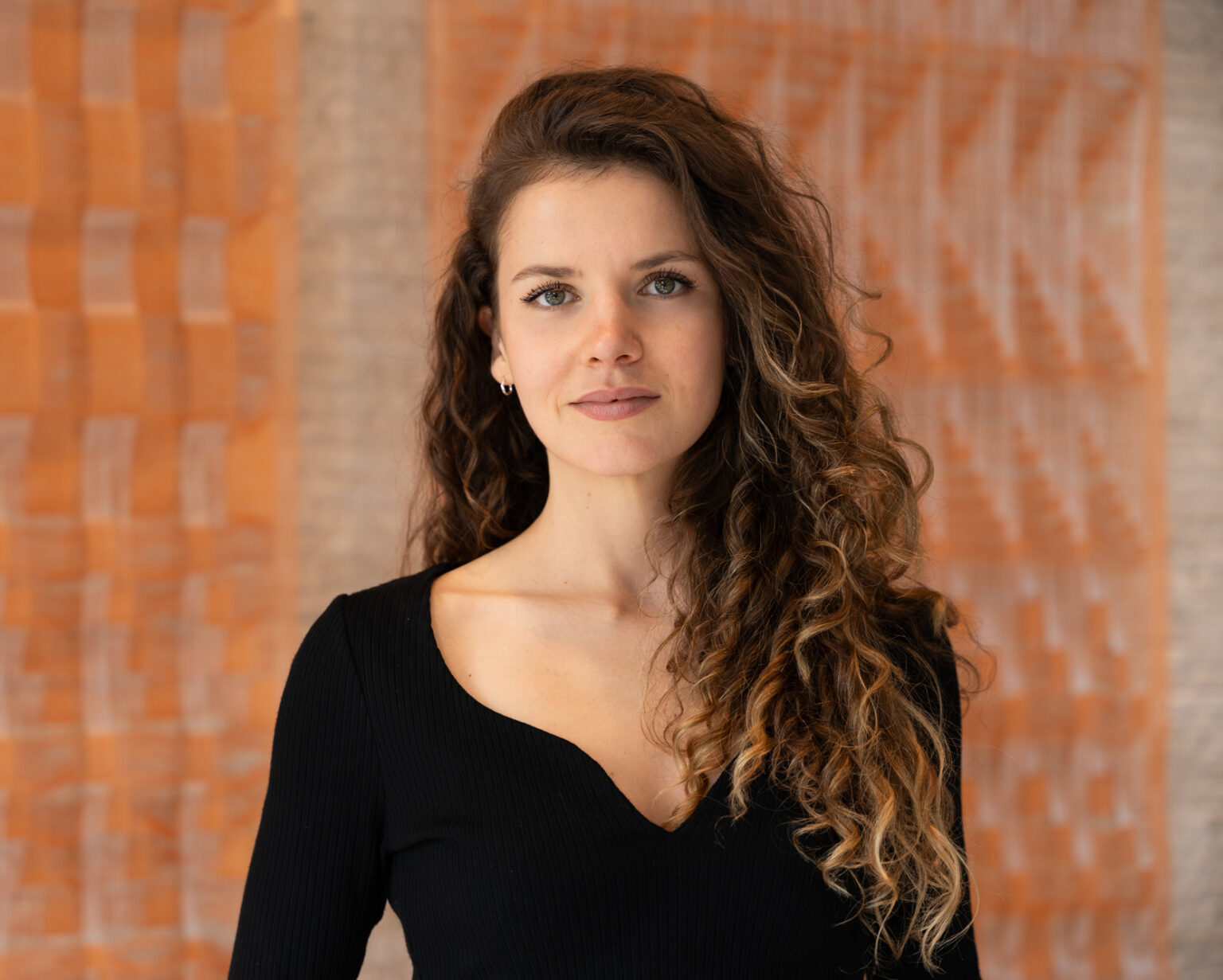
Gimbrère’s work is rooted in a deep fascination for human perception and the often-overlooked dialogue between body and environment. Through research in neuroaesthetics, psychology, and sensory design, she investigates how subtle material qualities can influence emotional states and create a sense of presence. Rather than creating standalone objects, she designs elements that are carefully shaped for their context.
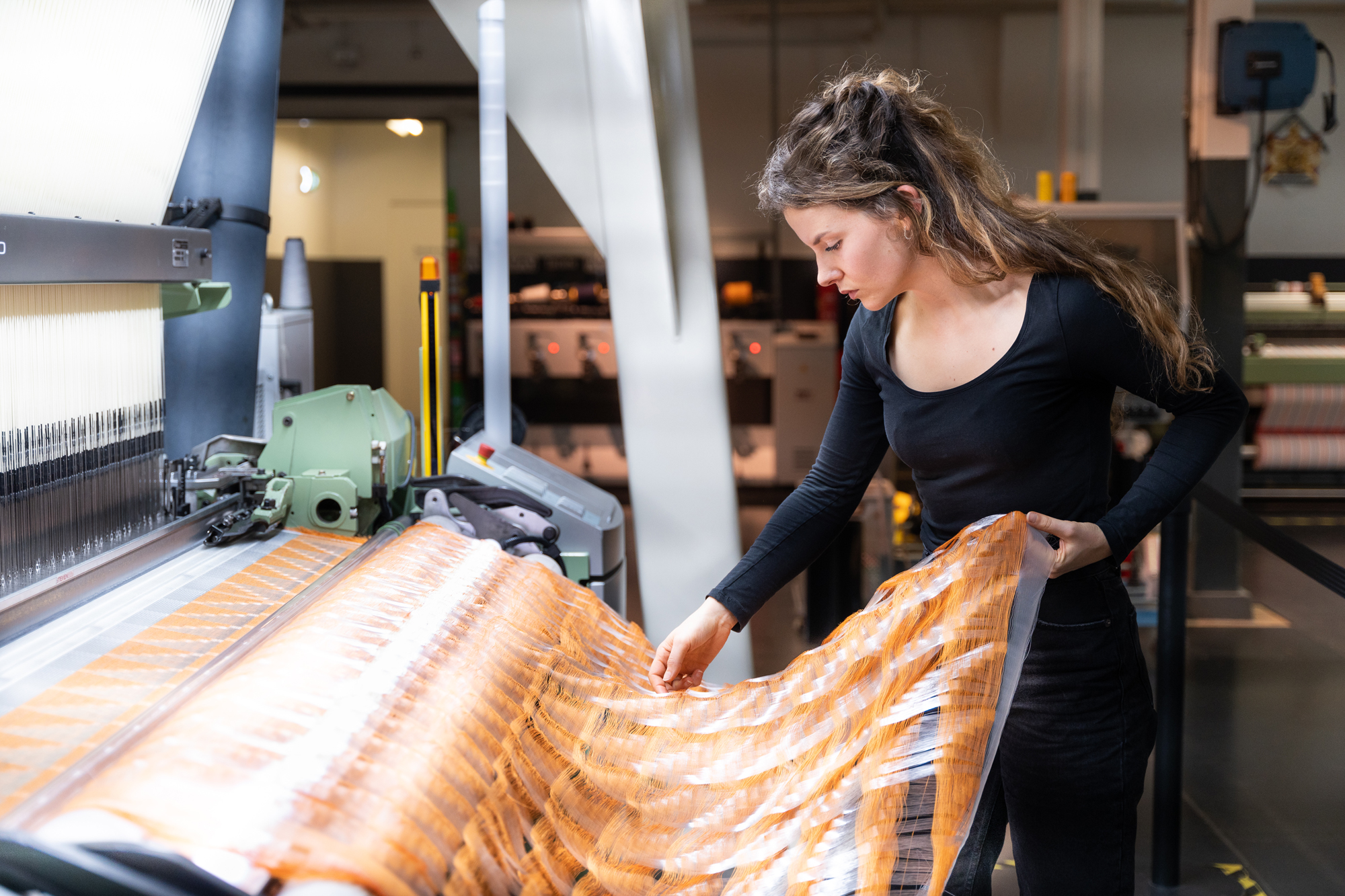
Working intuitively and hands-on with materials and ancient crafts, she has developed a 3D weaving method that reconsiders traditional textile techniques as carriers of knowledge, and as starting points for new spatial and sensory applications. Each project explores how tactile and visual cues can shape atmosphere and perception, while questioning how we value craft, material intelligence, and heritage in a contemporary context.
© Courtesy of the artist
Which place do you currently call home and where do you work on your projects?
I live and work in Eindhoven, in a space with a century of history: the former gymnasium of a boys’ school that is 100+ years old. Now a monument, the building houses nine artists’ households. I live in half of the original gym and use the attic above it as my ‘clean’ workspace—primarily textiles and office tasks.
Since six months ago, I’ve expanded my practice to an external atelier at Sectie-C. Which is a well-known creative ecosystem on the edge of Eindhoven; it’s a sprawling, unpolished hub where designers, artists, and small-scale manufacturers coexist. My space there is a private ‘treehouse’ built inside a large industrial hall, which I share with seven other creatives. It is where I do my rougher, ‘dirty,’ and more experimental work.
I find that I truly flourish when surrounded by others—the daily lunches, the banter, and the ability to ask for a second pair of eyes or a helping hand make the studio feel like a small community.
Where is your studio located & how does it look?
My creative process is split between two distinct environments. My home studio in the old school building is calm and light—perfect for the precision of textile work. In contrast, my space at Sectie-C is freer and more raw. My ‘treehouse’ studio sits elevated within a shared workshop, offering a private vantage point while staying connected to the hustle and bustle in the hall below. It is a space that I am gradually making my own with every new project.
© Courtesy of the artist
Are there any projects that are personally important to you—whether recently completed or currently in progress?
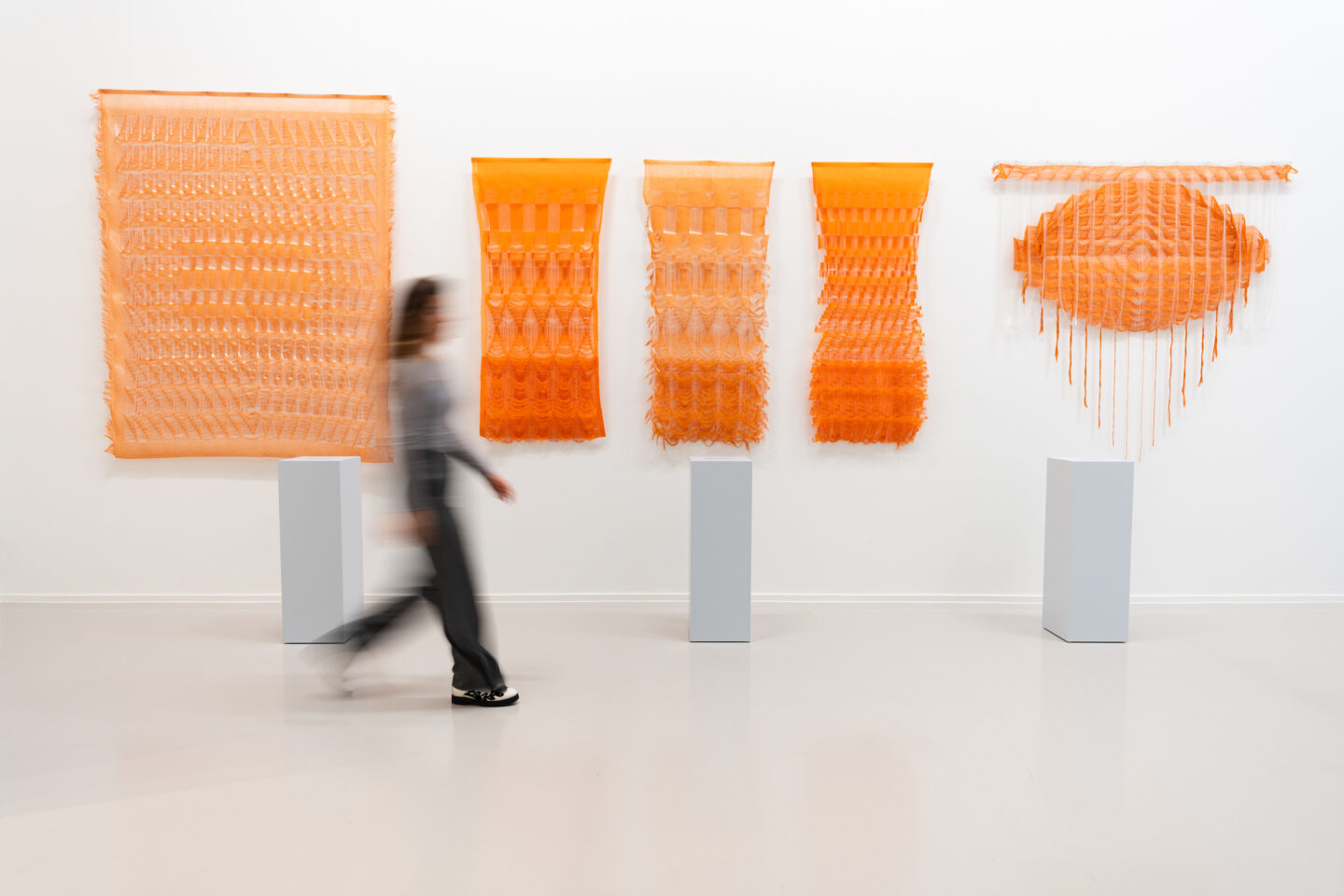
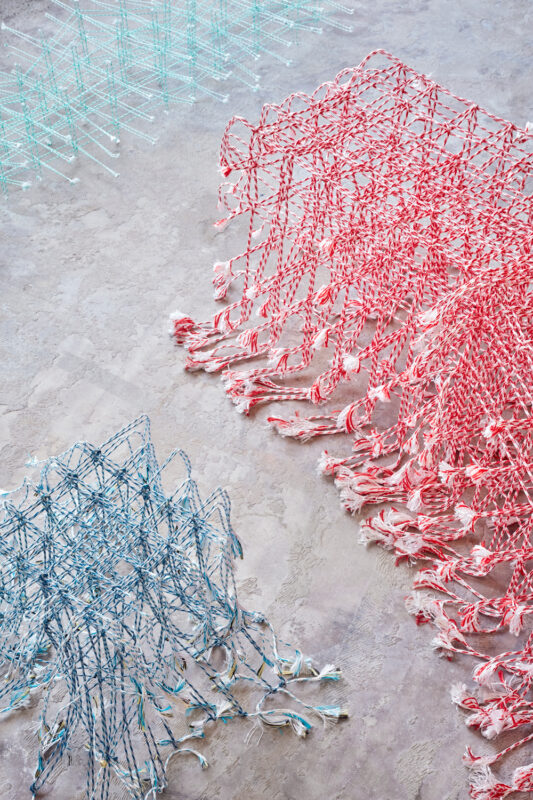
The core ‘red thread’ of my practice is my ever-evolving 3D weaving method. This started with my “Standing Textile(s)” and has since branched out into various specialised explorations like “Cirrus, Linum, Physis, and Acoustic Standing Textile(s)”. By treating weaving not just as a surface but as a structural, three-dimensional form, I’m able to challenge how we perceive textiles and soft materials in space.
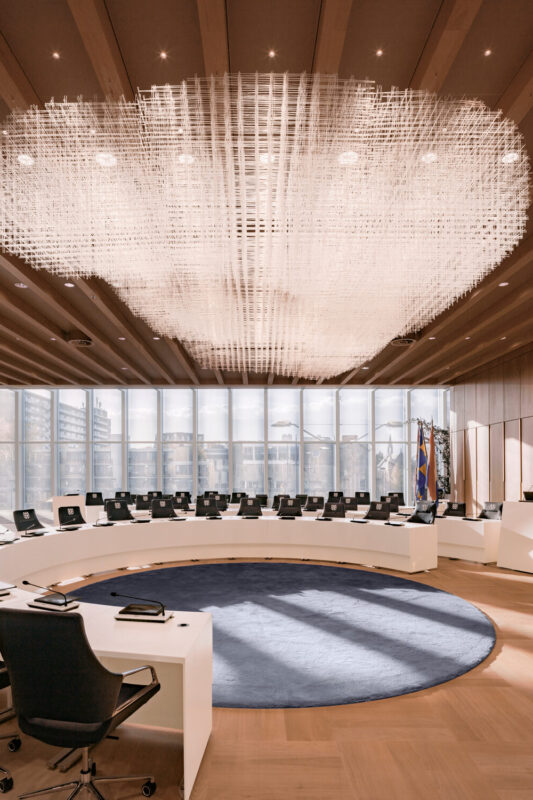
Another project that holds a special place for me is the ‘Crafted Columns’ I created for the Róhe Frames Fashion Week showroom. As a child, I was always fascinated by fashion as a tool for creation of identity and self-expression. Being invited to dive into a brand’s DNA and translate their aesthetic into a physical, handmade installation for a global stage was incredibly rewarding. The process was purely tactile—developing everything by hand—which allowed me to bridge my love for textile craftsmanship with the more fast-paced world of fashion identity.
© Courtesy of the artist
© Courtesy of the artist
Do you have a favourite place in your area where you like to relax and linger?
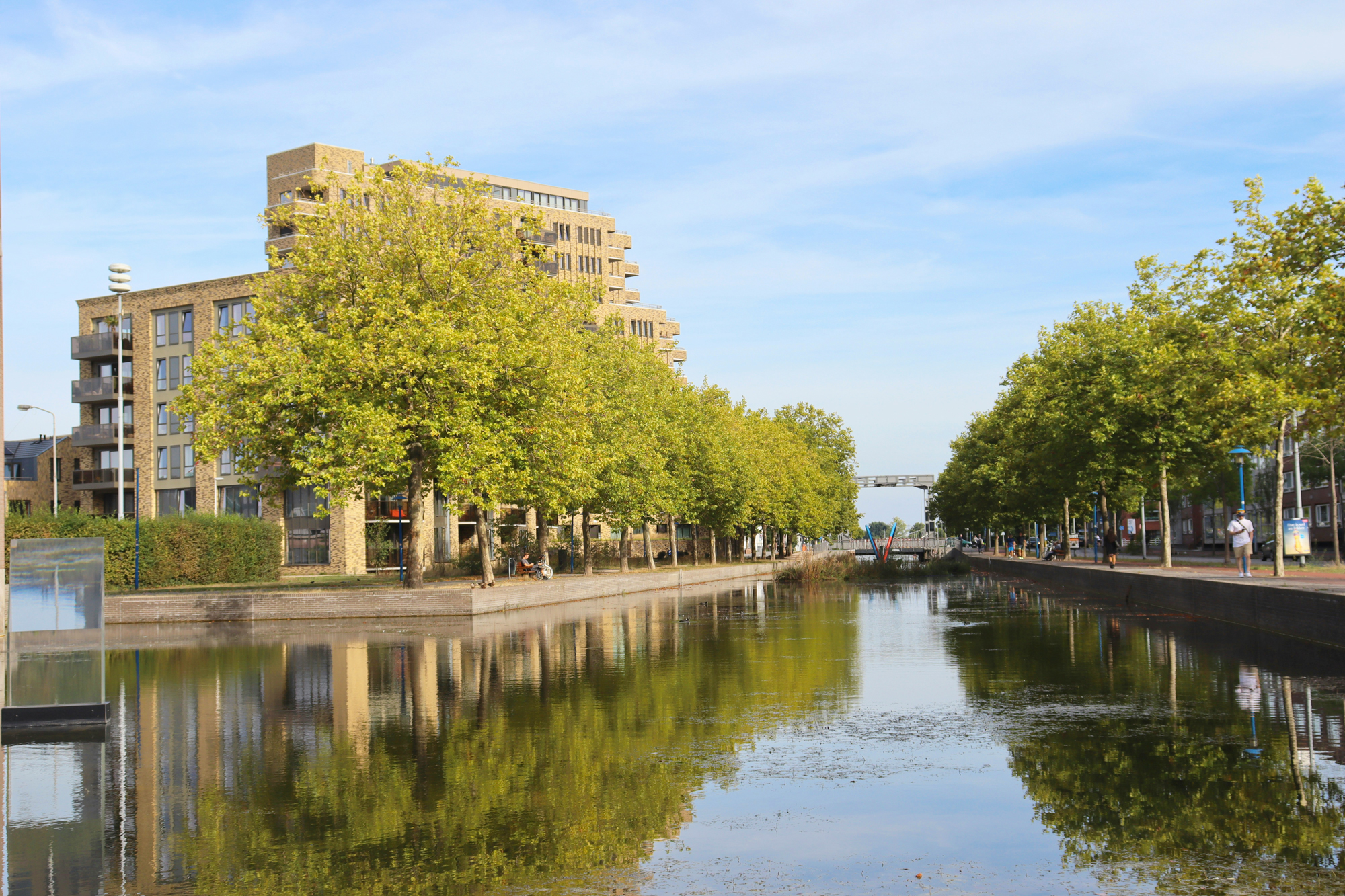
Movement and light are essential to my well-being, so I spend the first half of my day chasing fresh air and natural brightness. I’ve realized I am very sensitive to my environment; I need that morning ‘reset’ to function well.
In the afternoons, my relaxation takes a more social, observational form. I love to take my laptop to a terrace or a café in the city center. There, I can sit in my own ‘work bubble’ while remaining immersed in the energy of the city. I find it endlessly inspiring to simply observe human behavior and sense the flow of people around me. As the day fades, I naturally draw back into my own sanctuary—retreating to the quiet of my home or the familiar walls of my atelier to process the day’s impressions.
© Photo: Alicja Ziaj,Unsplash
Are there any urgent political issues or problems in your region?
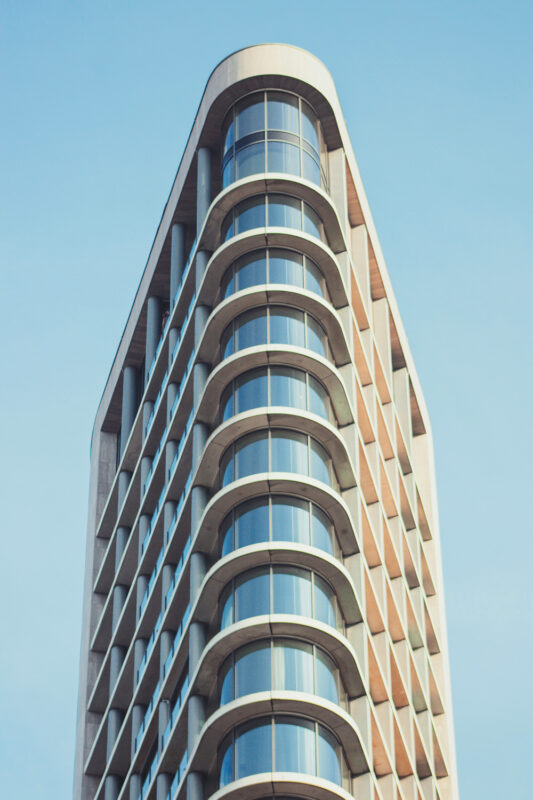
The political and social landscape in Eindhoven is currently defined by a ‘double-edged’ success. Locally, we are navigating the rapid expansion of the Brainport region. In the last five years, the city has become a global tech powerhouse, which has brought immense investment but also created a sort of ‘Monaco effect’—making it increasingly difficult for the very people who give the city its identity (artists, students, and makers) to find affordable space.
In your opinion, what has developed well in the last 5 years—and what has not?
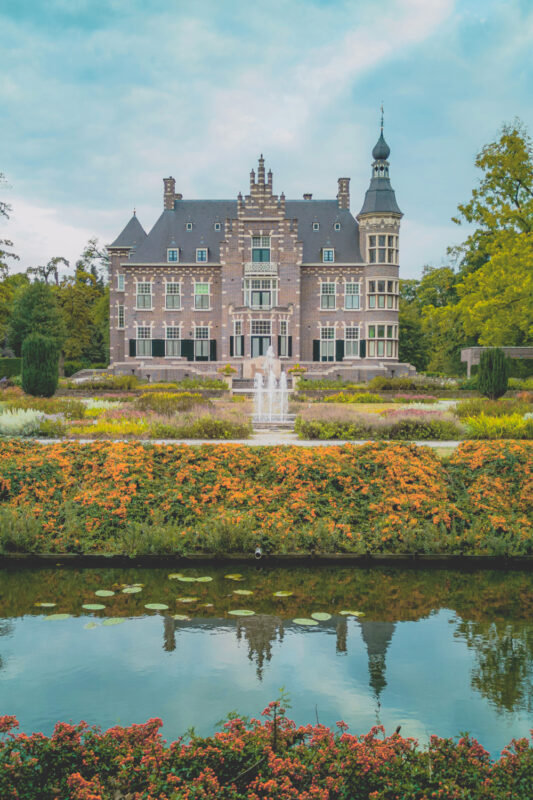
At Sectie-C, where my studio is located, we live under a bit of a ‘Sword of Damocles’ as the area is slated for residential redevelopment. However, there is a powerful silver lining: the resilience of our creative community.
We recently saw a massive win when the Municipality decided to buy the 19.000 m2 of Sectie-c, taking control of the development of the site into a mixed residential and commercial area, where the creative ecosystem will hopefully be preserved and housing is added. Which is a second win after Design Academy Eindhoven was able to stay in Eindhoven after nearly being pushed out by rising costs. It took an incredible amount of collective effort from the creative community to make the point that a ‘Tech City’ without a ‘Design Soul’ is just an office park.
While we celebrated these victories, the work isn’t over. The challenge now is practical and urgent: we still need to find ways to house the students, ensure creatives can afford their ateliers, and manage the logistics of for example move vital faculty and resources to further away locations. It’s a transition period where the sector is working harder than ever to prove that our presence isn’t just ‘nice to have’—it’s essential to Eindhoven’s future.
© Photo: Remco Mariën,Unsplash
© Photo: B NW,Unsplash
Do you know a hidden gem when it comes to local manufacturers—whether it’s arts and crafts, sustainable products or food?
A true hidden gem is Make Eindhoven. It’s a place where traditional craftsmanship—like bronze casting and glass blowing—meets modern experimentation. It’s less of a factory and more of a sanctuary for local manufacturing.
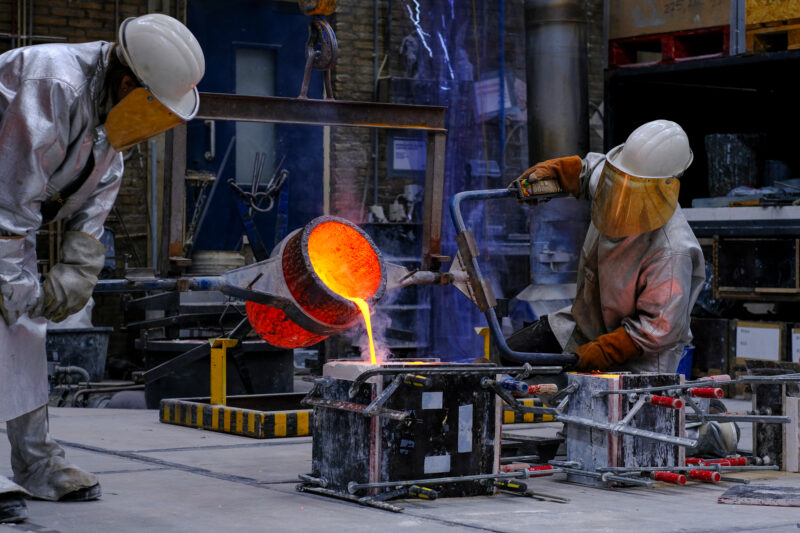
© Ruud Hermans at Make Eindhoven
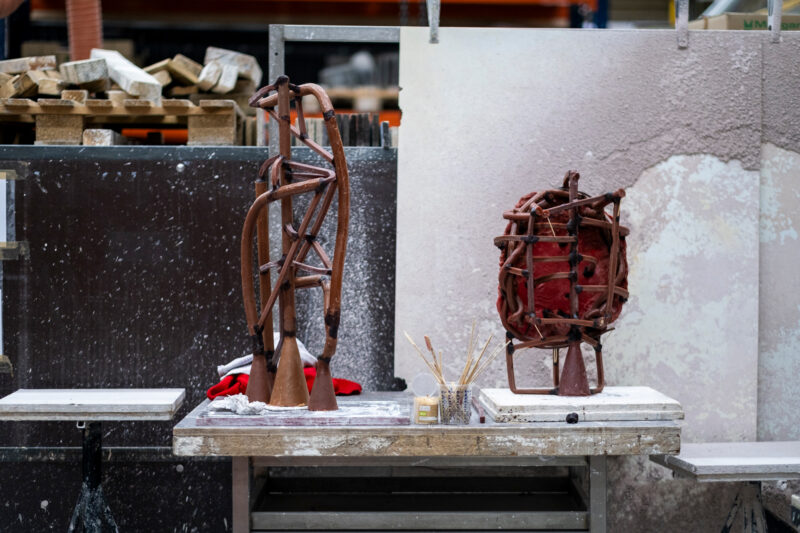
© Ruud Hermans at Make Eindhoven
Is there anything particularly innovative in your region? Also in comparison to other places you have already visited?
Regarding innovation, what’s special here isn’t just the high-tech chips and the Brainport Region; it’s the Social and Material Advocacy. In my role on the board of the Culture Fund, I see firsthand how innovation in Brabant is often a tool for community-building. We are incredibly strong at launching creative initiatives that bring arts, culture and nature directly into neighbourhoods, making it an integrated part of daily life rather than something kept behind gallery walls.
There is also a unique concentration of Material Heritage Labs that you won’t find anywhere else. We have the TextielLab in Tilburg, which is a global pilgrimage site for innovation and has a special place in my heart; the Schoenenkwartier in Waalwijk, which keeps the leather and shoe-making legacy alive through modern design; and specialised companies like Vlisco (wax-print) or Ecco (leather).
What’s innovative here is that we don’t treat our industrial history (textiles, wool, leather) as a closed chapter. Instead, we use it as a foundation for future-proofing materials. Whether it’s circular textiles or social projects that reconnect people through craft, the innovation here is human-scale. In comparison to other places I’ve visited, Brabant doesn’t just innovate for the sake of ‘newness’—we innovate to create meaning and resilience within our social landscape.
Do you have a secret restaurant tip that you would like to share with us?
Because of food allergies, I rarely eat out, but Gezana is a rare exception. It’s an Eritrean restaurant that feels like a home rather than a ‘concept.’ It’s welcoming, unpretentious, and serves delicious and nourishing food to share.
Is there a local shop whose products are only available in your region?
A perfect example of our local ecosystem is the Wasven. It’s more than just a farm or a shop; it’s a green ‘citadel’ in the middle of a residential area where social impact and ecology meet. They have their own traditional bakery and a guesthouse where people with a distance to the labor market work with incredible pride.
Along with the Genneper Hoeve, which is a biodynamic farm just a short walk from the city center, these places represent a ‘closed-loop’ philosophy. You can buy cheese or bread made right there on the land. In a city that is rapidly ‘concrete-izing’ and scaling up, these spots are lovely green anchors to seek solace—they remind us of the value of slow production and the importance of preserving ‘green lungs’ for the community to breathe and connect.
What are your 3 favourite apps that you use every day and couldn’t live without?
1. My Notes App: Between running my own business, managing a household, leading the pre-bachelor program at the Design Academy Eindhoven, and sitting on several advisory boards, my brain is often working at maximum capacity. My Notes app is my essential safety valve. It’s where I perform my ‘mental downloads’—jotting down everything from sudden creative sparks to urgent to-do lists. I simply couldn’t stay on top of my daily life without a dedicated space to offload those thoughts and turn back to when I forgot what needs my attention.
2. YouTube / Substack / Instagram: I rely on these platforms to keep a finger on the pulse of what’s happening globally; they are my windows into knowledge about health, politics, philosophy, astrology, and culture. However, I have a complicated relationship with Instagram in particular. I’m increasingly tired of content permeated with the ‘Instagram and TikTok way’ of creation—the hyper-focus on marketing tricks and ‘hacking’ the algorithm. I’ve recently been exploring Substack as a space to write my own work and find more depth, though even there, you see the struggle between ‘hits’ and meaningful content. At my core, I am always searching for actual, inspiring, and valuable substance, trying to stay away from the brain-rotting and demoralizing content.”
3. Direct Communication (Mail / Signal / WhatsApp / Text): Finally, any messaging app that allows for direct, unfiltered contact with my inner circle (and, honestly, a lot of GIFs). In a busy life, meeting up with friends in person isn’t always possible, as many also live far away. As platforms like Instagram have changed, we don’t really share our lives there anymore; it’s become nearly impossible to reach above the algorithm’s suggestions just to stay connected with friends. Because of that, I deeply value the ability to connect directly with the people who matter most via a simple text.
Do you have any favourite newspapers or online magazines? And how do you keep up to date with politics or social and cultural issues?
I tend to keep some distance from the daily ‘noise’ of the news cycle, checking in sporadically to stay aware of the general public and national discourse. Lately, I find myself gravitating toward keeping an eye on the US political and social climate—not because it is a direct reflection of the Netherlands, but because of its undeniable cultural proximity and influence on Europe. My engagement increased with the rise of women’s rights violations there—of which we do see a reflection in the Netherlands as well, with the rise of sexism and rising femicide rates—and I have since been closely monitoring the increase of human rights violations, the effects of individualism on the social landscape, and growing polarization.
Given how accessible the US media is, the shifts occurring there around politics, identity, and culture often act as a precursor to global conversations, eventually rippling out to the rest of the world. The Netherlands has always been susceptible to this, and now, with access to everything through online channels, it is no different.
To navigate these complex topics, and to give my nervous system a necessary break, I prefer ‘slow’ and longer-form journalism over breaking news. I value De Correspondent, for example, for their focus on structural trends rather than daily sensations. I also have a soft spot for independent creators who explore the intersections of culture, identity, and spirituality or philosophy. I find these fields often reveal more about the current ‘mood’ of society than a traditional political headline might.
I also find great value in the perspectives of independent travel essayists, such as a solo female traveller in a less-documented and less-accessible regions. Their first-hand accounts offer a human-scale view of global climates that feels more honest and less filtered than mainstream reporting. I try to gather information from multiple, varied sources to avoid a one-sided view, always searching for nuance in a world that often prefers simple answers.
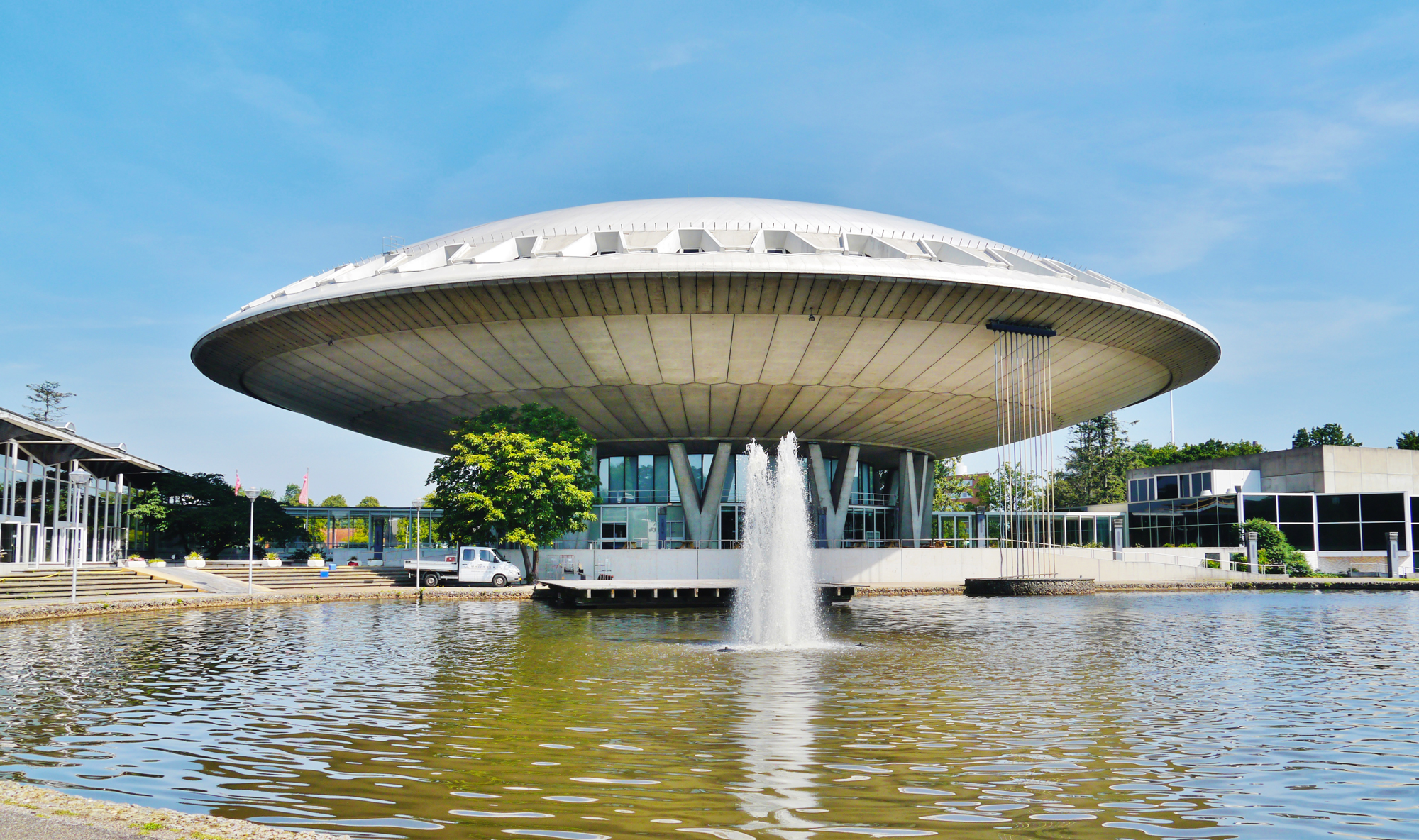
© Zairon, Eindhoven Evoluon 04, Adjusted Colour, CC BY-SA 4.0
Imagine you could be mayor for a year—what would you change?
If I were Mayor for a year, my priority would be to reposition arts and culture as a fundamental pillar of our collective well-being rather than a ‘luxury’ or an afterthought. I believe we need these creative spaces to reflect, to open our views, and to find a place where we can safely process our emotions and gain understanding of one another.
In a city that is growing as fast as Eindhoven, it’s easy to focus only on the digital and the economic, but we need the ‘analog’ stimulation that art provides. It is a space for questioning and for connection. My goal would be to make these experiences radically more accessible—ensuring that creative hubs aren’t just isolated pockets for the elite, but integrated parts of the city where every resident can find a mirror to their own experience or a window into someone else’s. I’d protect the ‘unpolished’ spaces where artists can experiment without the pressure of commercial success, because that is where the real social healing happens.
One last question: If you could choose another place to live—regardless of financial or time constrains—which one would you choose?
If constraints were no object, I would gravitate toward a city that offers a high-density creative network and constant cultural friction. In the Netherlands, Amsterdam would be the natural choice for me, for its exhibitions, events, and professional opportunities. However, I’ve always held a deep, enduring love for London. Having lived there and visited frequently, it will always have a place in my heart; I find its specific energy and cultural layers endlessly comforting and energizing.
After a recent visit, Paris has been on my mind as well. I found myself drawn to its wealth of galleries and access to healthy lifestyle options; it feels like a city where I could truly immerse myself in both art and a high quality of daily life.
The challenge, of course, is the ‘maker’s paradox.’ Being a single artist and designer, moving to these major hubs often means sacrificing the physical space—the large atelier—that my work requires to grow. While I dream of the connectivity of a global capital, I am also deeply aware of how rare and vital my current setup in Eindhoven is. Choosing a new home would be a delicate balancing act, weighing the need for a world-class cultural network against the space and freedom to keep creating at scale.


