

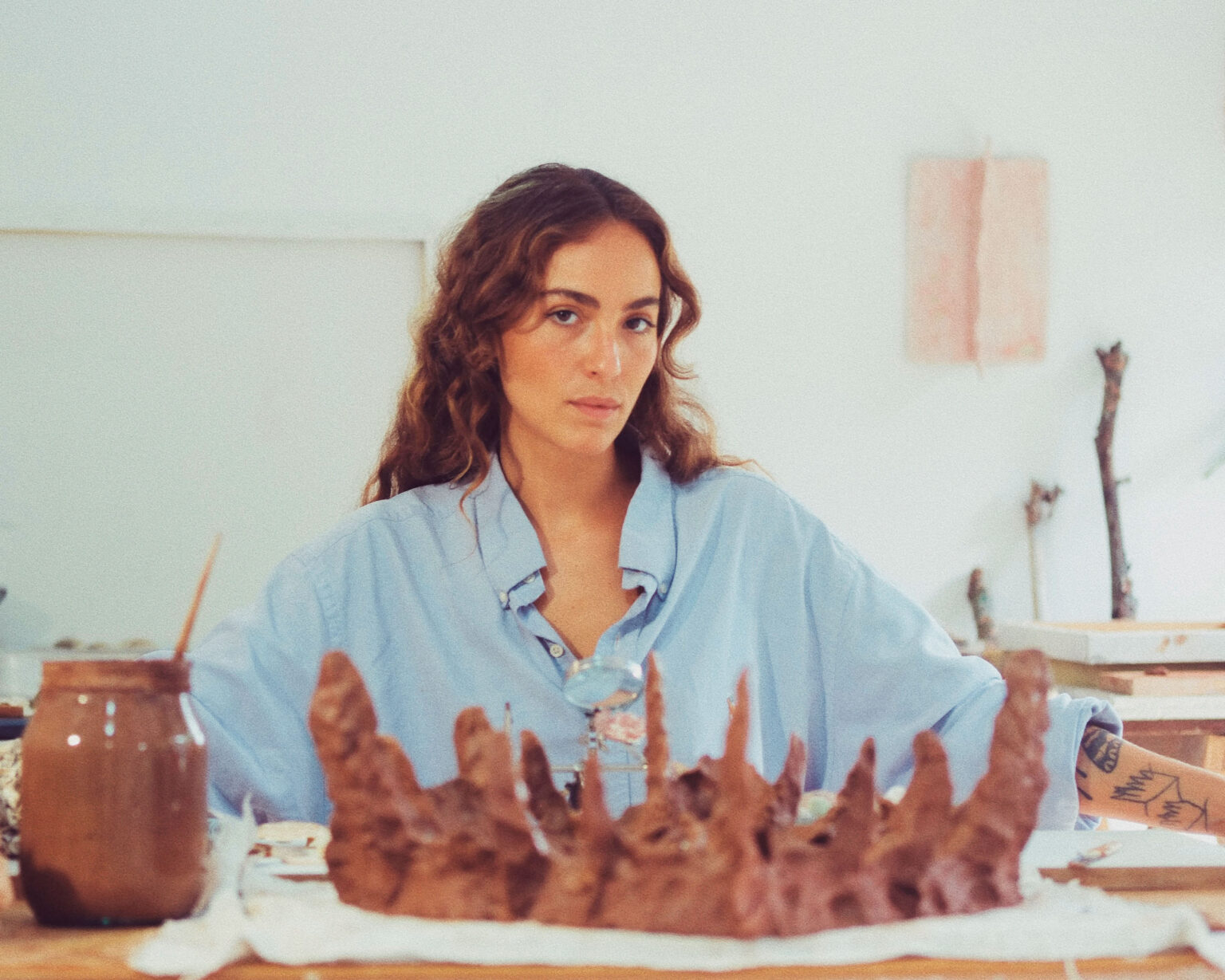
Anália Moraes’s practice stems from a process of listening : to the material, to living things, and to time. In her studio-laboratory, clay is not a passive medium but collaborator into which she incorporates recycled glass silica, charred oyster shells and local soil, allowing the material to assert its own identity. Her biomorphic forms draw inspiration from organic structures observed under a microscope or captured in the field, translated into tactile sculptures that blur the line between the organic and the artificial.

© Courtesy of the artist
Which place do you currently call home and where do you work on your projects?
I’ve been living and working in Ilhabela, in southeast of Brazil, for the past five years. The island possesses a powerful, fluid energy, being constantly surrounded by saltwater while also home to an abundance of inland waterfalls. It is mainly a vast natural reserve where the Atlantic Forest meets the sea and this environment is more than just my home, it is a foundational element of my life shaping both my artistic process and my personal philosophy.
Where is your studio located & how does it look?
Last year, I achieved a long-time goal of integrating my home with more studio space. My studio is located in a little house at the back of my garden, just a few steps away from my house. To get there, I cross a small orchard filled with mulberry, pomegranate, acerola, and pitanga trees.
The studio itself is a semi-open space, which allows me to work while looking out at the greenery, often in the company of my senior heartthrob cat, Opie. It is a deeply rewarding and practical setup. Ceramic work involves stages that are highly sensitive to time and humidity, so having my kiln and workspace just steps away allows me to stay fully connected to the rhythms of my materials.

© Courtesy of the artist
Are there any projects that are personally important to you—whether recently completed or currently in progress?
In August, I will be opening my first solo exhibition at the local town museum. It is housed in a traditional caiçara house, a historical structure that is a very significant to the local heritage, located facing the sea on the main street of the historical center. To be able to share a body of work that has been so profoundly shaped by my life here and to celebrate this milestone with the local community, is incredibly meaningful.
Alongside this, I am honored to be featured in the second edition of Piscina, which launches on June 27th.
I follow and support this project since its inception 10 years ago, and have always admired their dedication to art. It is a community built on immense affection and connection, and the first art magazine in Brazil entirely dedicated to showcasing the work of people who identify as women and/or non-binary people. Being part of this dialogue is a project I hold very close to my heart.
Other project very exciting for me is a recent gastro-performance I hosted in my backyard, where my sculptural practice literally met the table. The highlight was cooking potatoes in clay over an open fire and serving drinks in ceramic chalices that I had fired in a pit-fire right alongside it. Beyond the technique, the experience was deeply rooted in the land, featuring cacao from agroforestry and other organic produce sourced locally. What made this work even more significant was that most of these ingredients came from local ecological initiatives led by women. It wasn’t just a shared meal, it was a ritual of connection between ancestral cooking and art techniques and community.

© Courtesy of the artist

© Courtesy of the artist
Do you have a favourite place in your area where you like to relax and linger?
Besides relaxing in my hammock on the balcony at home and sunbathing in the garden, my routine usually involves cycling along the coast towards the historical center. One of my favorite spots to stop and read is Santa Tereza beach; it’s tucked away from the main road and offers a quiet atmosphere. On my way back home I usually stop to browse the shelves at Canoa Bookshop or enjoying a zabaione gelato at Tradizionale Gelateria.
When I have more time to spare on the weekends, I head north to Pacuíba beach. You have to take a short trail to reach it, but it’s a small paradise that is worth the journey.

© Photo by Christian Felix Möller Somers, Unsplash
Are there any urgent political issues or problems in your region?
First is the critical state of our sanitation infrastructure. Despite Ilhabela’s significant revenue from oil royalties, a substantial portion of our sewage is still not properly collected or treated, which directly impacts the health of our marine life and our community.
The second is the pressure from real estate speculation. As tourism grows, housing costs have surged, making it increasingly difficult for local families and the workers who sustain the island’s economy to find secure, affordable places to live.
Organizations like the Instituto Ilhabela Sustentável and various local civil society networks have been consistently raising awareness about how the issues that threatens not only our landscape but the very culture of the traditional communities. I strongly believe, however, that Ilhabela has the potential to be a model for ecological and sustainable urban management. Given our resources and our unique position as an island sanctuary.
In your opinion, what has developed well in the last 5 years—and what has not?
Over the last five years, I have seen a shift in how tourism affects the island. Unfortunately, there is a growing trend of ‘extractive’ tourism that lacks a balanced connection with nature. A clear example is the surge in whale-watching tourism. Ilhabela is a vital part of the migration route for Humpback whales which visit our waters between June and August. Sadly, the rise in unregulated boat and jet-ski traffic has become a serious threat, often distressing these animals during such a critical period of their cycle. Organizations like the Instituto Baleia Jubarte have been working hard to educate the public.
On the positive side, I am truly inspired by the local cultural scene. While we still have a long way to go, events like Citronela Doc, a documentary film festival focused on contemporary Brazilian cinema, is a highlight. Seeing the effort to promote accessible, cultural and ecological tourism proves that the island can foster a deeper engagement with art, offering a space for meaningful storytelling that goes far beyond the typical tourism narrative.

© Photo by Renato Trentin, Unsplash

© Photo by Paulo Freitas, Unsplash
Do you know a hidden gem when it comes to local manufacturers—whether it’s arts and crafts, sustainable products or food?
The Instituto Baía dos Vermelhos, located in the far south of Ilhabela, tucked away in the heart of the Atlantic Forest. It is an extraordinary complex, featuring an arena type concert hall with amazing acoustics, an open-air amphitheater, and a dedicated art pavilion for exhibitions. The way the architecture respects and integrates with the surrounding forest is breathtaking. They host a diverse program of dance, music, and orchestral performances throughout the year, including an annual festival. While it is quite a distance from the historical center, the journey south is part of the experience. It stands as a testament to how art and nature can coexist, offering a space that elevates the island’s cultural life far beyond the usual beach experience.
Is there anything particularly innovative in your region? Also in comparison to other places you have already visited?
What I find most innovative is the work being done to bridge ancestral knowledge with contemporary demands with ecological responsibility.
A good example is the A.MAR Project (Projeto A.MAR), which works directly with local caiçara fishing communities. They support sustainable fishing practices, essential to empower local acctivities so they can be at the center of the local economy.
I am also inspired by the movement towards ‘Zero Waste’ in our local businesses. Thanks to the work of consultancies like Flow Sustentável, many establishments are now implementing robust composting systems and waste-reduction protocols.
Do you have a secret restaurant tip that you would like to share with us?
Ilhabela has such a vibrant culinary scene, but I have a few go-to spots that I love!
For a special dinner where you truly want to treat yourself, Alento is the best choice. Right next to it, also overlooking the sea, you’ll find Auga, which is my recommendation for an exceptional lunch. Both are wonderful because they embrace seasonality and are deeply committed to sourcing fresh, local fish.
If you are looking for a casual spot for a post-beach drink and appetizers, Equador is the best place. It is a family-run, local favorite that perfectly captures the relaxed island’s energy.
If you’re in the south of the island, Ben’s Comidaria is a place with spectacular sunset views and with access to a secluded beach, the owner has Swedish roots and the cuisine reflects a wonderful fusion.
For those with a sweet tooth, I highly recommend visiting Le Blé D’or and Chez Martin, both offer absolutely wonderful desserts.

© Alento

© Auga
Is there a local shop whose products are only available in your region?
For unique, locally crafted products, I always recommend Projeto A.MAR. They specialize in artisanal preservation techniques, such as smoking and curing, that highlight the quality of our local fish. Their selection of bottarga, preserved oysters, and smoked fish is exceptional.
While they operate an intimate restaurant that functions by reservation, you can also find their products at select spots on the island. I suggest visiting Enfim Ostras, where you can enjoy fresh oysters and pick up a few of A.MAR’s preserved goods.
What are your 3 favourite apps that you use every day and couldn’t live without?
Spotify is my constant companion for music and podcasts, whether I’m in the studio or on my bike. WhatsApp is more essential than I would like to admit and finally, I have a tie between Gmail and Duolingo for third place. But to be honest, if I could, I would live solely on weather forecast apps.
Do you have any favourite newspapers or online magazines? And how do you keep up to date with politics or social and cultural issues?
For deep, investigative journalism, I always turn to Revista Piauí. Their reporting is excellent, and their weekly podcast, Foro de Teresina, helps me to navigate the constant frenzy of the news cycle. For broader daily updates, I check El País, and to stay connected with the art world I sometimes read CLOT Magazine and The Art Newspaper.

© Photo by Christian Felix Möller Somers, Unsplash
Imagine you could be mayor for a year—what would you change?
I wouldn’t try to solve everything with quick fixes; I would focus on restructuring how the city manages its most acute tensions: social inequality and environmental preservation.
My priority would be to formally bridge the gap between the municipal government, the State Park management, and local environmental organizations. Currently, these entities often operate in silos, but the island’s future depends on a unified ecological strategy. We need to move beyond reactionary policies and treat environmental protection as the core of our economic planning. Simultaneously, I would implement policies for affordable, sustainable social housing, decentralizing development to ensure that Ilhabela remains a place for its residents, not just a seasonal destination. It’s complex, but integrating our land-use policies with our ecological reality is the only way to ensure the island remains viable for the next generations.
One last question: If you could choose another place to live—regardless of financial or time constrains—which one would you choose?
My family comes from the heart of Minas Gerais, a landlocked state in Brazil, so living by the sea was a lifelong dream of mine. Reaching a point where I can live more consciously, close to nature’s rhythms and silence, is an achievement that already brings me immense fulfillment.
If I had unlimited resources and time, I wouldn’t trade this place for another. I would use that freedom to deepen my dedication to ensure that this island remains as vibrant and resilient as the life I’ve been able to build here.


