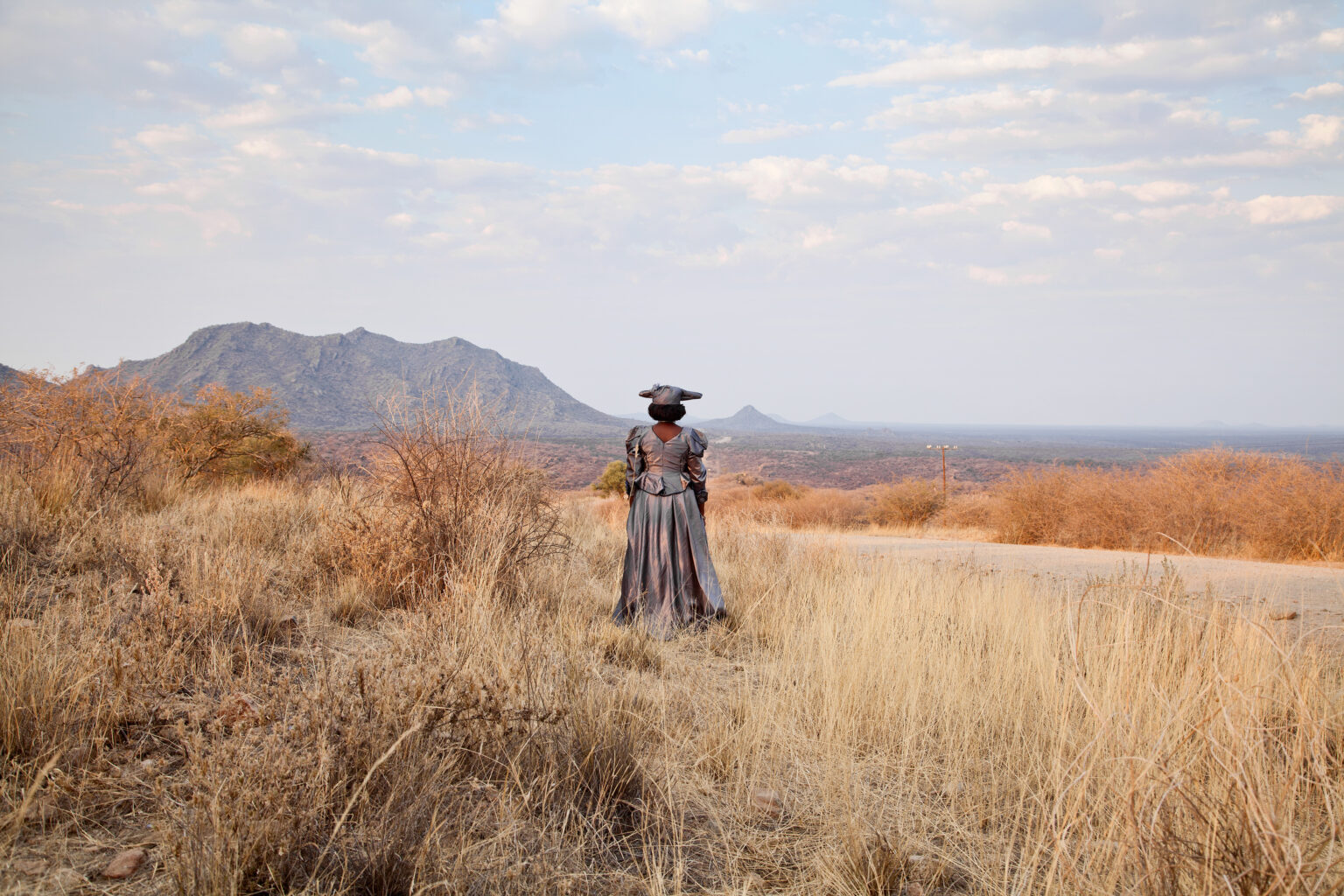

The dress is not in a museum. It is worn in the streets of Windhoek, on the railway tracks of Swakopmund, on the slopes of the mountains of the Namib Desert. Its shape comes from an imposition: in the 19th century, German missionaries required Ovaherero women to cover their bodies according to European codes of Christian modesty. What Ovaherero women did with that constraint is one of the most singular responses colonial history has ever received. They did not reject it. They absorbed it, transformed it, made it into something that belongs to them so completely that its origin has become almost unrecognisable.
The Herero dress is now a hybrid garment in the literal sense of the word: its seams contain a lining cut from hospital sheets from the apartheid regime, embroidery that evokes Germany in the 1920s, fabric bought in a contemporary shop. It carries the history of three successive imperialisms and has made itself into a living monument. A monument that cannot be moved or toppled, because it walks.
Namibia is a country where objects take account of what history has done to them. Graves are unmarked. Land has not been returned. The first genocide of the 20th century, officially recognised by Germany only in 2021, has left traces in every corner of the territory: in the mass graves beneath the beaches of Swakopmund, in the poisoned wells of the Omaheke Desert, in the names of streets in colonial towns, renamed or not. What some Namibians do with these traces is what is at stake here.

© 2024 Nicola Brandt
What the ground retains
There are countries where history lies behind you, archived, accessible through dates and treaties. Namibia is not one of them.
On 2 October 1904, the German general Lothar von Trotha issued an extermination order against the Ovaherero, as his colonial troops repressed their armed resistance against the German occupation of South West Africa. The fleeing Ovaherero were driven eastwards into the Omaheke Desert, an arid extension of the Kalahari. Wells were poisoned along their path. Tens of thousands of people died of thirst, hunger and exhaustion. Concentration camps were established in Swakopmund, in what was then called Lüderitzbucht, and in Okahandja. Mortality in the coastal camps was particularly high: populations from the interior could not withstand the damp climate of the Atlantic coast. This genocide, which continued until 1908 and also affected the Nama, was officially recognised by Germany in 2021. The proposed reparations agreement remains contested by representatives of the communities concerned.
What this period did to Namibian territory is inscribed in land ownership and in bodies. Land seized through conquest was sold to settlers, mostly German, under conditions that left dispossessed populations in communal areas with limited resources. Katuvangua Maendo, born in 1971 in the communal area of Ovitoto, in the Otjozondjupa region, describes the situation with cadastral frankness: her area is surrounded by farms owned by white people, on land where the Ovaherero originally lived. Cattle, which represented the wealth, status and identity of families, were exported to Germany through the port of Walvis Bay during the war. On land that has become too narrow, grazing is no longer sufficient.

© 2024 Nicola Brandt
There is also what cadastral maps do not record. The sacred fire, okuruuo, is the cosmological link between the living and their ancestors. It is passed down within family homesteads. The forced dispersal of Ovaherero families during and after the war broke this transmission. Entire families found themselves denied access to the graves of their ancestors, located on private properties owned by descendants of settlers. For Maendo, her people cannot visit the dead. This is not a metaphor. It is a land reality.
At Voigtsgrund, a karakul farm created in 1906 by the Voigts family and sold to the government in 1984 as resettlement land, the Swartbooi family and their Nama ancestors have lived and worked since 1906. Without capital. Without security of tenure. The difference between owning and inhabiting may be the central fault line of this territory.

© 2024 Nicola Brandt
Living monument, wandering monument
It is in this space, between dispossession and retrieval, that the work of Namibian photographer Nicola Brandt finds its ground of inquiry. Brandt was born in Namibia and is of European colonial descent. Her great-grandfather arrived in German South West Africa in 1910 as a supply agent for a mining company. Her grandmother lived in a house adjoining unmarked mass graves of Ovaherero, Nama and San people, without grasping their proximity. Brandt calls this condition “the distance within”: being born from inside a territory while carrying, in one’s family inheritance, the legacy of those who colonised it.
Her book “The Distance Within” (Steidl, 2025) brings together more than a decade of photographs, combining her images with colonial archives and the testimonies of two Ovaherero women with whom she travelled: Uakondjisa Kakuekuee Mbari and Katuvangua Maendo. Her method is deliberately anti-documentary: she seeks to create “non-landscapes”, images that refuse to offer the gaze what it expects from Namibian territory.
What the book documents, among other things, are two objects and what they do to memory. The first is the Herero dress. Mbari wears it on Rössing Mountain, a uranium extraction site, and on the railway tracks of Swakopmund, built with the forced labour of Ovaherero and Nama prisoners during the genocide. She consciously sells her image in this dress to tourists: an act of economic autonomy and a culturally ambiguous act, which Brandt photographs without resolving. Mbari is one of the first women in Swakopmund to have deliberately turned this practice into a source of income, aware of what photography does to the bodies it represents. The dress carries simultaneous layers: a lining cut from hospital sheets from apartheid, embroidery that evokes Germany in the 1920s, fabric bought in a contemporary shop. Brandt describes it as a “living monument”: an object that has absorbed what was imposed upon it in order to become something irreducibly other.

© 2024 Nicola Brandt
The second object is the Reiterdenkmal. The bronze equestrian statue erected in Windhoek in 1912 commemorates the German soldiers who died during the Herero-German wars of 1904 to 1908. Its inscription honours them in what is described, without irony, as a “Herero rebellion.” It does not mention the tens of thousands of Ovaherero and Nama killed in the same conflict. In 2009, the statue was lowered from its perch overlooking the Christuskirche and moved to Robert Mugabe Avenue. Then to the Alte Feste, the former German fort, out of sight of passers-by. Then inside the fort’s walls, near the ruin, in a refuge that became both its shelter and its prison. The art critic James E. Young, whose essay appears in the book, notes that unlike the Reichstag wrapped by Christo in Berlin in 1995, an act of reconsecration, the Reiterdenkmal is undergoing a gradual desacralisation: transformed, through its successive displacements, from conqueror into conquered.
During the final relocation, in November 2022, the young Ovaherero artist Gift Uzera prepared herself in front of the statue. She put on the undergarment of the Ovaherero dress. She laid white flowers at the soldier’s feet. She danced as the crane lifted the statue, swaddled in bubble wrap. She wrote: the experience was one of immediate liberation. And yet, as one sleeping giant was put to rest, another, living one, came to life among them: a man in the crowd shook the ladder on which her friend was standing, demanding that she come down, that the dress be removed. Symbolic reappropriation does not extinguish the concrete resistance to which it responds.

© 2024 Nicola Brandt
What joy does not resolve
The land question is not resolved by a performance. The reparations agreement proposed by the German and Namibian governments in May 2021, which officially recognises the genocide, remains contested by representatives of the Ovaherero and Nama communities, particularly over the amounts involved and the mechanisms of distribution. Maendo formulates this persistence without nuance: the demands will never cease, the claims will never stop.
The commodification of identity raises its own questions. On safari websites, Namibia is presented as “a land where one can look from one horizon to the other without seeing any sign of human intervention.” This language of erasure, which Brandt analyses in her book, is the verbal counterpart of what colonial landscape photography did visually for decades: present the land as empty, innocent, available. The genocide and the concentration camps of Swakopmund have no place in the tourist image of Namibia. They have a place in the ground. Mbari, who sells her image to tourists in the very dress that embodies a century of cultural resistance, operates within that same economy. The tension is not resolved. It is assumed.
Gift Uzera and Muningandu Hoveka, two young Ovaherero artists, call their generation the “hinge generation”: the one for whom the Otjiherero language itself seems to be at stake, for whom queer Herero identities are entering public space as never before, for whom reappropriation is not the restoration of a before but the invention of an after. They write: we sharpen our gaze on the world again, we create new stories while wishing to nourish our ancestral mythologies and traditions. There is joy in the plural, in the hybrid.

© 2024 Nicola Brandt
This joy does not return the land. It does not repair the unmarked graves. It does not fill the absence of the sacred fire in dispersed families. It does something else: it names the possibility of a future that is not entirely defined by the terms of dispossession.
The dress does not wait to be interpreted. It walks. It is worn on a mining site, on tracks of forced labour, before a statue being moved towards its own symbolic disappearance. It carries histories it was not designed to carry, and which have become its own.
The Reiterdenkmal is inside a fort. Its last position may not be final. Namibia is a country where the question of what occupies public space has not been settled, where graves lie beneath the sand, where land is disputed through property deeds signed during an occupation that those who signed them considered legitimate.
To cross this territory without seeing what it carries is to reproduce the gesture that Brandt spends a decade undoing: looking at a landscape and seeing only emptiness, where there is presence.