
In Key West, at the southernmost point of a continent fond of imagining itself boundless, a concrete post topped with a buoy marks mile zero of U.S. Route 1. A souvenir shop beside it, a queue of tourists in front. From here to Fort Kent, a small town on the Canadian border, it’s roughly 2,300 miles, through thirteen of the original colonies, subtropical swamp, industrial wasteland and pine forest that vanishes under snow each winter. Only in the 1920s did a federal board for interstate highways stitch dozens of older routes, postal roads and trade paths into one continuous number. At the Norton Museum of Art in West Palm Beach, which sits directly on the road, it is still known locally by its old name: the Dixie Highway.
The road barely follows the coastline itself. Mostly it tracks the fall line, the transition zone where the Appalachian foothills meet the coastal plain, where mills, trading posts and later factory towns settled from the eighteenth century onward, because that was as far upriver as boats could travel. It follows the seams where America was stitched together more than it follows the coast.
And yet it has no image of its own. No Route 66 with its neon-sign nostalgia, no ready stock of pictures to summon the moment the name comes up. Every exit delivers its own associations: broken mill towns in Massachusetts, candy colours in South Carolina, marshland that barely qualifies as land.
Travel it, and you move along the edge of the cinematic America you already know from home. Often only a few miles from the interstate, but in a different time zone of decline: main streets abandoned fifty years ago, when the freeways siphoned off the traffic and left motels, diners and drive-ins behind like shells after the tide. You drive this road to see what has been left lying between the exits.

The Trap of Nostalgia
America has developed a weakness for its own past – not necessarily the actual one. Along the Atlantic coast, town by town, a kind of nostalgia infrastructure has taken hold: restored main streets, costumed performers, shops conjuring up a time when everything was supposedly simpler.
These stagings are almost never innocent. To settle into an idealised past is to opt out of the lessons an honest memory actually offers, and to grow numb to what the present actually requires. The most uncomfortable insight of this journey might be this: the past itself is usually not the problem. It gets invoked, mostly, so as not to have to look at the present.
The German photographer August Sander pursued a related impulse when he began, in the 1920s, cataloguing his country in portraits, across trades and origins, during a period he himself experienced as politically turbulent. Sander called his archive a mirror of his time. What is mirrored on this coast is a wish: to find refuge in a past that never existed in this form.

A Photographer who knows about leaving
The compass for this journey belongs to a woman who knows what it means to leave a country and never quite arrive in a new one. Anastasia Samoylova was born in Moscow in 1984 and was still a child when she witnessed the collapse of the Soviet Union. She studied environmental design in Moscow, moved to the United States in 2008 and later completed an art degree in Illinois, before settling in Miami in 2016. There, her first major series took shape: FloodZone, a Florida whose property boom races against a sea level that is literally rising, photographed in the same pastel tones the real-estate industry uses to sell that same Florida.
Her perspective is doubly refracted: that of the immigrant, to whom nothing feels self-evident, and that of the naturalised American, already part of what she photographs. This doubling let her shift, for Atlantic Coast, between observer and participant, sometimes within the same day.
The starting point was an exhibition Samoylova saw in Miami Beach: photographs by Berenice Abbott, who travelled the same highway in 1954, setting out from New York with two companions and a giant schnauzer in the station wagon. Abbott, born in 1898, learned her craft under Man Ray in Paris and made her name there with portraits of the avant-garde, before producing a decade-long project on New York. Her Route 1 journey, the largest single body of work of her career, remained strangely overlooked in her lifetime.
Seventy years later, Samoylova took up mainly Abbott’s openness. She followed the exact route more loosely, over several stages between 2020 and 2024, sometimes for a single day, sometimes a whole week in one place. The resulting book, Atlantic Coast, appeared in 2025 from Aperture and the Norton Museum of Art.
What she observes in America, Samoylova also recognises from home. In the early 2000s, she experienced what she herself calls “the thaw”: a moment when something like democracy seemed to be on the horizon in Russia. That possibility has since all but gone out. Her home country has since moved backwards: the rise of oligarchs, authoritarianism, war in Ukraine, economic decline – orchestrated, she says, not least by nostalgia: the glorification of the Russian Empire, the revival of Stalin’s cult of personality, the longing for the Soviet Union. The book answers, seventy years late, a question Abbott left open: what becomes of this road, if you follow it long enough.

Traces by the Roadside
Abbott set out from New York in 1954 and drove south; Samoylova reversed the direction and began in Florida, at what she herself calls the most vulnerable point on the route: where climate change shows up in every building code and every insurance policy.
Her images return to certain motifs: fences, scaffolding, floodlines. The book’s cover image, Reflection in Black Thunderbird, shows a palm tree mirrored in the paintwork of a black land yacht, taken in Palm Beach in 2024; another holds fireworks on the dark surface of the water off Fort Knox, a historic fort in tiny Prospect, Maine.

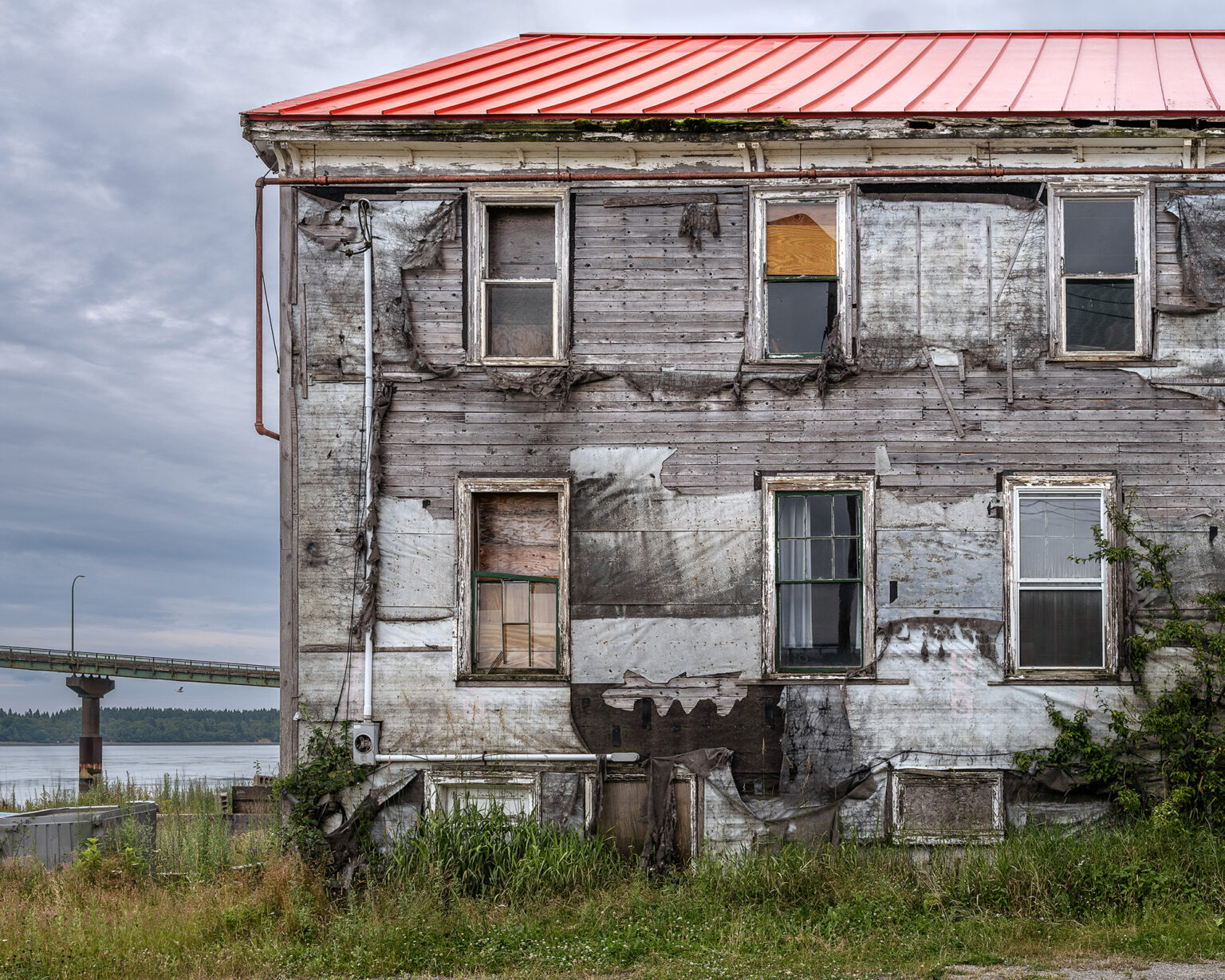
Samoylova’s images are beautiful, in the old-fashioned sense of the word: composed, colour-balanced. That decline can be photographed so attractively is not a new observation, but it remains uncomfortable. Her answer to it is precision rather than accusation. Her image of a car shrouded in pale blue fabric and weighed down with a brick, parked in front of a crumbling house in Waycross, Georgia, shows exactly this duality: decay behind, care in front – taken almost seventy years after an almost identical scene Abbott photographed a few miles away.

The further north you travel, the narrower the landscape becomes. The people seem more reserved too. In Georgia and South Carolina, identity often expresses itself through faith, visible in a shop sign reading Jesus Saves outside a historic house in Charleston. Further north, in North Carolina, memory takes the place of faith: a fifth-generation farmer poses in front of a mural of his own farm in Garysburg, a cotton branch in hand. In Maine, what counts most is self-reliance, the distance to the next neighbour.

At several points on the journey, Samoylova felt like an outsider, particularly where the past is staged as heritage: a woman in period costume behind the glass case of an old-fashioned sweet shop in Portsmouth, New Hampshire, of the kind almost any American small town can produce once it has turned itself into a heritage attraction. In the mirror behind her, barely visible, a modern cash register gives the game away – the only moment the illusion briefly slips. A tent-like structure in the backyard of a house in Mars Hill, Maine, belongs to the same category. Anyone who has lived through how quickly a country can rewrite its own past recognises the machinery behind the set faster than someone who grew up inside it.

Historically, this road has never been innocent. In 1954, in Jacksonville, Abbott photographed a drinking fountain with separate access for Black and white people, as the Jim Crow segregation laws of the American South required: two men drink, a third waits and looks straight into the camera – an offhand image of an inequality that was, at the time, written into law and unremarkable in daily life. Seventy years later, without setting out to, Samoylova returned to the same place. Her image of a crumbling tabby ruin, built of oyster shell and lime, was also made in Jacksonville – only without the people who once stood in front of it. The signposted drinking fountain is gone; the law that mandated it was repealed with the civil rights legislation of the 1960s. The inequality it made visible shows up today in a different form: in insurance premiums and property prices that still correlate with old, long since officially abolished city boundaries, in neighbourhoods that receive little public investment. Less visible, but measurable.
What stayed constant across the drive were small human continuities: a conversation at a diner, a hairdresser working on through a snowstorm while the traffic outside comes to a standstill. The most fitting lineage for this book is Robert Frank’s The Americans, from 1958. Frank, too, arrived in the country as an immigrant, at twenty-three, exactly as Samoylova would, seventy years later.

At the end of the road
Fort Kent has only the Canadian border, a few degrees colder than three hundred miles south, a car park, a border sign, a few houses. The last mile looks like any other.
What remains of the drive is a collection of edges: coastal erosion in Florida, a mural in North Carolina, a ruin in Jacksonville, a tent in a backyard in Maine. America likes to sell itself as an idea. Along its edges, it shows up in smaller units: as repair, as a church, a family business, a plot of land someone is holding on to.
Hope, if that’s even the right word for it, lies in the small continuities Samoylova keeps returning to: the conversation that happens anyway, the work that gets done anyway. Modest, but observable. And observable hope counts for more in a travel account than prescribed optimism.
Route 1 ends at a border. What it reveals does not end there.