

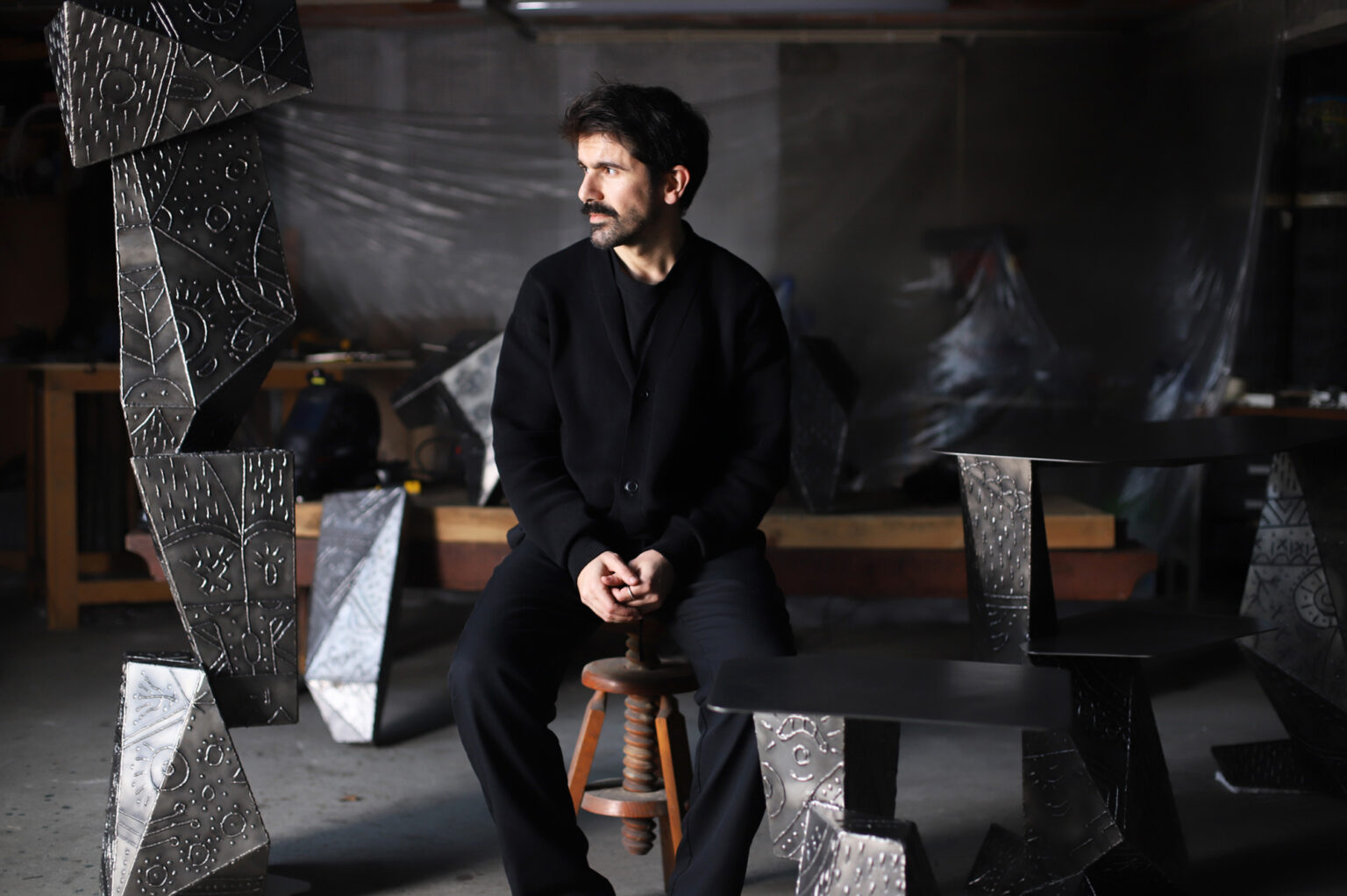
Welding is more than a necessity of an industrial society, but a centuries-old technique used to create art and beauty. On dark slabs of metal melted together in geometric shapes, André Teoman adds seemingly painted ornamental details with rods and fire. The symbols and themes etched together into patterns tell a story of Portuguese culture and legend.
His workplace in his birthplace of Viana do Castelo in Northern Portugal seeps into every aspect of his art: from the history that manifests in the formations of the metalwork to the spirit of crafting and tradition that fuels Teoman. He uses his designs to show that the world should not abandon manual processes and physical materials.

© Courtesy of the artist
Which place do you currently call home and where do you work on your projects?
I live and work in Viana do Castelo, on the north coast of Portugal. Although my projects often take me across Portugal, this city remains the centre of my practice. Being surrounded by a strong network of craftspeople in a slow city constantly reminds me why I chose to stay. I enjoy being close to the people, materials and workshops that shape my work so normally I prefer local sourcing.
Where is your studio located & how does it look?
My studio and workshop are located in Viana do Castelo. I have the studio on the city center and the workshop on the outer part of the city, but both, on their own way, are evolving workspaces where sketches, prototypes, material samples, and unfinished ideas live side by side. Over the past few years I’ve deliberately brought more making into the studio, allowing experimentation to become part of the design process. It’s a place where digital tools meet craftsmanship, and where ideas are constantly tested through materials rather than remaining purely conceptual.

© Courtesy of the artist
Are there any projects that are personally important to you —whether recently completed or currently in progress?
I’m increasingly interested in developing my workshop further since I believe digital services will change a lot; materiality and objects will still have their own space. I’m looking for new ways of combining traditional craftsmanship with contemporary production methods. Every collection becomes an opportunity to experiment with this dialogue like I do on Soldita but projects such as Re-De and Gir Gir are examples of this ongoing exploration too, where discarded materials, local manufacturing and digital processes come together to create new narratives and new objects. More than individual collections, it’s this continuous process of experimentation that feels most important to me.

© Courtesy of the artist

© Courtesy of the artist

© Courtesy of the artist
Do you have a favourite place in your area where you like to relax and linger?
I would say my hometown is a very good city to live with plenty of such places. One of my favourite places is the Santa Luzia mountain. From there you can overlook the city, the Lima River and the Atlantic Ocean all at once. It is a place that you can either have fun with your kid, have a family picnic, just go there to relax and think about a project or simply enjoy the landscape.

© Photo: Jürgen Wenig, Pixabay
Are there any urgent political issues or problems in your region?
Like many parts of Europe, one of the biggest challenges is making it possible for younger generations to remain in the cities. Housing prices have risen significantly, while many traditional workshops struggle to find successors. Preserving craftsmanship is not simply about protecting heritage, it is also about creating conditions that make these professions economically viable for future generations.
In your opinion, what has developed well in the last 5 years—and what has not?
It’s hard to say. When COVID came, I was thinking that digital was the future, that everyone should focus on how to showcase on the world wide web. Now with AI, I think no one will believe in digital in a couple of years, and creatives and brands will have to have a physical presence. It’s unbelievable, but in 5 years now, the world changes a lot, and I think changes will happen faster and faster. The downside is that digital is always cheaper to invest in while physical requires affordable housing and workspaces that have become increasingly difficult to access, making it harder for younger creatives and artisans to establish themselves locally.
Do you know a hidden gem when it comes to local manufacturers—whether it’s arts and crafts, sustainable products or food?
Rather than highlighting a single manufacturer, I would point to the network of small family-run workshops across northern Portugal. Many of them quietly produce extraordinary work in wood, metal, textiles and ceramics, combining decades of expertise with an openness to experimentation. These collaborations are one of the region’s greatest strengths.

© Photo: Miguel Mota Sousa, Unsplash

© Photo: Krzysztof Golik creator QS:P170,Q51955005, Souls Chapel in Viana do Castelo 04, CC BY-SA 4.0
Is there anything particularly innovative in your region? Also in comparison to other places you have already visited?
Northern Portugal has an exceptional balance between industry and craftsmanship. Within a relatively small area, you can find highly specialised manufacturers alongside family-run workshops that preserve generations of knowledge. This proximity creates a unique environment where ideas can move quickly from sketch to prototype and there is openness to small productions and testing. Compared to many other places I’ve visited, collaboration here feels remarkably direct and accessible.
Do you have a secret restaurant tip that you would like to share with us?
Tasquinha da Linda in Viana do Castelo. It serves some of the best seafood in the region, staying true to Portuguese cuisine without overcomplicating it.

© Tasquinha da Linda

© Tasquinha da Linda
Is there a local shop whose products are only available in your region?
Rather than a store, I would recommend visiting the craft fairs during summer where you can find unique products and talent.
What are your 3 favourite apps that you use every day and couldn’t live without?
– Spotify
– X
– Kobo (not really an app, but you get it… digital books)
Do you have any favourite newspapers or online magazines? And how do you keep up to date with politics or social and cultural issues?
For design and architecture, I regularly follow Dezeen, Designboom and physical publications of AD, and Wallpaper. For current affairs, I just check some websites and see the news.

© Photo: Pedro Quintão, Pixabay
Imagine you could be mayor for a year—what would you change?
Mayor of my hometown? Keeping in mind my field of work, I would focus on making the city more attractive for young creatives and skilled craftspeople. That would include creating affordable workspaces, supporting traditional workshops that collaborate with contemporary designers, and strengthening the connection between education, industry, and local makers. I would make that a proud part ot the tourism too. I believe smaller cities can become centres of innovation by investing in what already makes them unique. Maybe that would make me more the culture councillor rather than the mayor.
One last question: If you could choose another place to live—regardless of financial or time constrains —which one would you choose?
Tokyo. I’ve always been fascinated by the coexistence of tradition and innovation that defines the city. It’s a place where centuries-old craftsmanship exists alongside cutting-edge technology without one diminishing the other. That balance resonates strongly with my own approach to design, and I feel it would be an endlessly inspiring place to live. But I’m sure I wouldn’t trade it for my beautiful city.


