

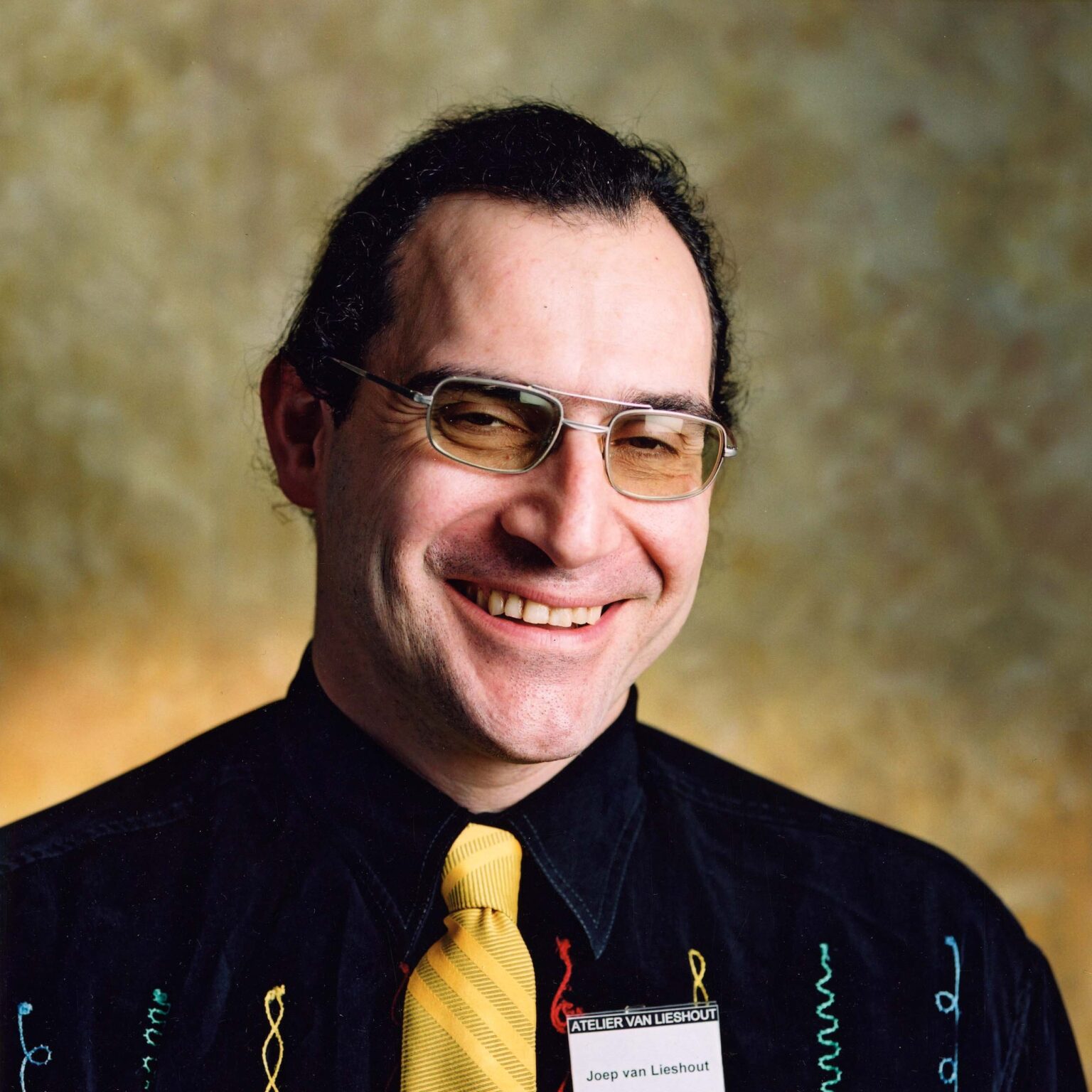
Obsessed with systems and freedom, Joep van Lieshout has spent four decades building utopias from the ground up. From biogas installations and floating clinics to nomadic habitats and zero-footprint cities mapped in meticulous spreadsheets, every object the studio makes is at once a sculpture and a proposition, an exercise in survival dressed as art.

© Courtesy of the artist
Which place do you currently call home and where do you work on your projects?
Rotterdam has been my home for more than forty years. I live and work in the harbour area, in what is now called M4H. When I first arrived in the early 1980s it was a complete no-go area. That was exactly what I liked about it. There was space, freedom and the possibility to build almost anything. I’ve never really separated living and working. For me they’re the same thing—home.
I have had the studios here, and each one changed the scale of my work. My first studio was on the Keileweg. Then I moved into Katoenveem, a monumental warehouse right on the water. It was there that I founded AVL-Ville, a fully operational free state, where we experimented with living independently and sustainably, building everything from our own canteen and workshops to biogas systems, to compost toilets and our own currency.
When that chapter ended, we realized the building was unsafe and needed close to 100 million to restore, but we got lucky and moved only a few streets away into an abandoned hamster food factory. Together with my team we transformed it into my dream studio. Soon afterwards, an old shipping office and architectural gem ‘The Villa’ became available, where I founded AVL Mundo as an artist residency and experimental art platform. Then a former shisha bar and a neighbouring garage became available. With some help we were able to acquire both. We connected everything together—using shipping containers left over from AVL-Ville and whatever else we could build ourselves—it’s a unique architectural collage. So we now share the complex with my studio and storage with BRUTUS, which is now one of the largest contemporary art spaces in the Netherlands and an independent organisation dedicated to exhibitions, performances, festivals and ambitious projects that don’t fit easily inside traditional museums.
What makes this neighbourhood so special today is that it has transformed alongside us. M4H has become an extraordinary community of artists, designers, architects and makers. There are so many artist-run spaces, galleries, music venues, restaurants, workshops and incredible museums nearby. BRUTUS and AVL share a Sculpture Garden that backs onto with Voedseltuin, a community food garden that feeds and employs local people, so I can walk outside and see sculpture, architecture, vegetables and people working together in the same landscape. Twenty years ago I was excited when we finally got a local grocery store. Today, everything is here.
For me, this place is paradise. I love my home.
Where is your studio located & how does it look?
My atelier is located on the Keileweg in Rotterdam’s M4H harbour district, where my studio and BRUTUS occupy a group of interconnected industrial buildings dating from the 1920s to the 1980s. From the outside they have, they’re mostly original. We kept much of their rough industrial character, adding only what was necessary—including a black timber façade, solar panels and a large neon art work that reads The Right to Do Wrong, The Wrong to Do Right by Libia Castro and Ólafur Ólafsson. The buildings remain connected by shipping containers and improvised structures, so the whole complex is a collage of buildings that has grown organically over decades, anchored by the 1914 monumental ‘Villa ‘designed by architect Jan van Teeffelen in the middle.
The heart of the studio is a former hamster food factory. When we first entered it, it was filthy, derelict and covered in bird droppings, but together with my team we transformed it into the workshop I had always dreamed of. Today everything happens here: woodworking, welding, fibreglass, mould making, painting and assembly. We can build almost anything under one roof.
My favourite space is what we call the Kathedraal, a vast hall created from the old silos. It rises almost 15 metres high and gives me enough room to install monumental sculptures while they’re still being made. It’s where I can live with the work for a while—walking around it, looking at it from different angles and figuring out where it’s taking me next.
Outside, the studio continues into a sculpture garden where large works can be tested in the open air before travelling into the world. It’s a working studio with cranes, forklifts, welding sparks, half-finished sculptures, prototypes and materials everywhere. It’s noisy and constantly changing—which is exactly how I like it.

© Andre Smits
Are there any projects that are personally important to you—whether recently completed or currently in progress?
That is an interesting question because my work never really seems to end—each work informs the next, I see the last 40 years as one giant ongoing work I refer to as “The Saga”. For me AVL and all we do is a living Gesamtkunstwerk that has been unfolding throughout my life. Each project becomes the foundation for the next.
Science, ecology and systems have inspired my work since the beginning, which is the reason I founded Atelier Van Lieshout in the first place. I have never seen art as something separate from everyday life, but as a way to rethink how we live, build, work and care for one another.
If I look back, one of the first pivotal moments was the giant bar-toilet-stair -commission for Rem Koolhaas in Lille. The project forced me to scale my practice. To meet the deadline, I expanded from JVL into Atelier Van Lieshout, building the team that allowed the studio to tackle increasingly ambitious architectural and public projects.
Another major turning point came in 2001 when we shut down AVL-Ville. Rather than seeing it as an ending, it became the catalyst for SlaveCity, a project that occupied me for almost a decade. It was an urban blueprint for a zero-footprint city of the future, exploring architecture, economics, ecology and labour through everything from detailed Excel spreadsheets calculating environmental impact and productivity, to architectural models of power plants, shopping centres, call centres and complete urban infrastructures. Looking back, I see SlaveCity as the conceptual prequel to BRUTUS and my ongoing ambition to build a living biotope.
During the pandemic another chapter began with The Voyage—a body of work about humanity’s ongoing journey—a search for another place, another world, at a moment when none of us was free to travel. That journey soon expanded beyond migration and utopia into questions of care, resilience and survival. Works celebrating frontline healthcare workers, re-ignited my everlasting fascination with science and future of healthcare EHBO—The Iron Lung and Dream Machines were designed to sustain life. Other projects such as Disco Inferno reflect my obsession with recycling and systems of renewal.
The Voyage eventually grew into the largest installation ever presented at Art Basel’s 2025 edition of Unlimited, comprising 186 sculptures stretching across the entire hall. That universe continues to evolve today through Sanitas Futurum and Agricola Narco Geneticus, projects exploring biotechnology, genetics, future agriculture and the role pharmaceuticals may play in caring for both people and the planet. These relate to the first works that I created at the start of my career, such as Operation Table and The Boat—my lust for invention and science is the impetus for all my efforts.
All of these ideas ultimately culminate in BRUTUS, which is the realization of a lifelong ambition: to create a living biotope a self-sustaining ecosystem where artists have the time and freedom to experiment, where different generations can live and work together, and where art, architecture, design, technology, science and wellness in everyday life, will intersect.
My hope is that BRUTUS sets a new standard for how we can live together—with greater freedom, greater responsibility and greater imagination.
Everything I have made has been an experiment that feeds the next benchmark. BRUTUS is where more than four decades of research, thinking and building converge. There will be more to share about this soon.

© Jannes Linders

© Courtesy of the artist

© Courtesy of the artist
Do you have a favourite place in your area where you like to relax and linger?
I don’t really separate work from relaxation, when I’m sculpting is actually the time that I feel the most at ease and the most relaxed. Plus, the studio is my happy place.
When I want a change of scenery, I like to drive through the harbor area between my studio and the North Sea. It’s a surreal industrial landscape of enormous ships, quays, refineries, cranes, industrial complexes, and vast stretches of artificial land. It’s totally inspiring. Driving through it is one of the few ways I shut off—partially, I’m always dreaming.

© Julienne Van Kempen, Unsplash
Are there any urgent political issues or problems in your region?
Like any city, it has its challenges. There has been a severe housing shortage for as long as I can remember. It has become incredibly difficult for young people, families, artists and older people to find affordable places to live.
Those challenges are one of the reasons I’m so committed to BRUTUS. For me, it has never been just about building a museum or housing. It’s about creating a community where culture remains part of the city instead of being pushed out. Artists are often the first to move into neglected neighbourhoods because they can find affordable places to live and work. They help transform those areas, but as property values rise, they’re often the first people forced to leave. We’ve seen this happen in cities around the world. With BRUTUS, I’m trying to create a different future.
My hope is that BRUTUS can help keep artists in the neighbourhoods they helped pioneer while also creating affordable homes for a much broader community. If culture disappears from our cities, they lose part of their soul. My ambition is for BRUTUS to set a new standard—one where housing, culture and community don’t compete with one another, but strengthen each other. If we can make that work, perhaps it can become a model for cities everywhere.
In your opinion, what has developed well in the last 5 years, and what has not?
One of the most encouraging developments has been the growth of several bottom-up initiatives that have strengthened the creative community. Kunst and Complex is the home to the pioneers of the area, the first settlers where some of us have been working since the 80’s. It’s a family really, we have been close friends for decades. More recent projects such as Keilepand have created an ecosystem of affordable studios, workshops, exhibitions, lectures and the Food Union, a professional kitchen shared by local businesses and community organisations. Katoenhuis is a home for technology and immersive media, while the Food Garden Voedseltuin combines urban agriculture with social inclusion, growing fresh produce with people who face barriers to employment and supplying the local food bank.
Organisations regularly work together to shape the future of the neighbourhood, and the resilience shown by Keilewerf after a devastating fire is a perfect example of that spirit.
More broadly, what continues to impress me about Rotterdam and the Netherlands in general is the relationship between agriculture, technology and design. Dutch innovation has always been driven by necessity, and that way of thinking has deeply influenced my own output. Examples are projects such as Agricola Narco Geneticus—Farmer, Cow of the Future, The Insect Farm explore possible futures for healthcare, food, ecology and technology.
Other works such as—Franchise Unit and Pioneer Set—a nomadic utopian habitat The Voyage—which all look back at self-sufficiency and development . For me, innovation isn’t only about inventing something new; it’s also about rediscovering old ideas and imagining how they might shape the future.
This area has inspired and offered me the freedom to combine art, architecture, engineering, ecology and agriculture has defined my work from the beginning—from AVL-Ville to BRUTUS. If we need something, we build it ourselves. It’s one of the reasons I’ve continued to live and work here for more than forty years.

© Boudewijn Bollmann

© Boudewijn Bollmann
Do you know a hidden gem when it comes to local manufacturers—whether arts and crafts, sustainable products or food?
One of my favorites is Keilewerf, a community of makers where craftspeople, designers and artists share workshops. One maker there creates beautiful bags from recycled fire hoses. I just admire the craftsmanship and the ingenuity behind them.
I also love the local market near my studio. Because Rotterdam is one of the world’s largest ports and sits beside one of Europe’s biggest greenhouse regions, there’s an incredible abundance of fresh fruit, vegetables and fish. The quality is excellent, the prices are surprisingly affordable, and it’s a wonderful reflection of the city’s unique relationship between the harbour, agriculture and everyday life in Rotterdam.
The neighbourhood itself is equally distinctive. It’s incredibly diverse—around 80% of the residents have a non-Dutch background—which makes it a vibrant mix of cultures, ideas and cuisines. That diversity is one of the things I enjoy most about living and working here.
Is there anything particularly innovative in your region? Also in comparison to other places you have already visited?
One of the things that makes Rotterdam distinctive is its willingness to experiment. It is a very hands-on city—if you have a good idea, there’s a real chance you can make it happen.
The harbor itself is a place of constant innovation. Across the river, the former shipyards have become home to advanced technological industries while still reflecting Rotterdam’s industrial heritage.
The landscape is also remarkable. The Maasvlakte, for example, is an enormous expanse of artificial land created to extend the port into the North Sea. It has a surreal, almost science fiction-like atmosphere and demonstrates the Netherlands’ expertise in land reclamation and water management.
Closer to my studio, a recently created Tidal park shows another innovative approach to urban design. Built along the river, it creates space for both people and nature. Because the river’s water level rises and falls by nearly two meters with the tides, the park has been carefully designed to support habitats that are alternately submerged and exposed, creating a unique landscape at the boundary between the harbor and the city.
Another inspiring initiative is the Food Garden—Voedsteltuin, a social project that grows fresh produce together with people who face barriers to employment. The harvest supplies the local food bank, helping provide healthy, fresh food to people who struggle to afford nutritious meals. The project not only improves access to good food but also creates opportunities for people to develop skills, gain confidence, and participate in the community.
What I find most innovative is not a single project but the way Rotterdam continuously reinvents itself while finding new relationships between industry, nature, technology, art and urban life.
There are so many artists, makers, designers, architects and landscape architects that are dominating the world stage, who are all based here.

© Mike van den Bos, Unsplash

© micheile henderson, Unsplash
Do you have a secret restaurant tip that you would like to share with us?
One of my favorite places to eat is a restaurant set in the former office of an old factory in the harbor. It offers refined dining in a uniquely industrial setting, which perfectly reflects the character of the neighborhood—Eaux Posse. Marseilles, is an amazing restaurant run by one of my favorite chefs, DJ, with whom I created the infamous ‘Crypto-Dinner’, he’s also the only person I know of to turn Ye down for a full-time-gig. He is a passionate artist, character and one of my favorite chefs anywhere in the world. I’m also excited by Roodkapje which is much more than a restaurant—it’s a multidisciplinary space where art, music, performance, and food come together. For something more every day, I love getting fries in the city center and baked Chinese oysters.
Is there a local shop whose products are only available in your region?
There isn’t really a traditional product that is exclusive to Rotterdam. What makes this region special is not a single local specialty, but its innovation, its extraordinary ability to get things done.
Although Jenever, the origin of Gin, was born in our neighboring area Schiedam, which is the absolute capital of the production of this very nice drink For me, Rotterdam’s unique product is Art—it’s enormous omnipresence or our creative output. Dutch art, design, architecture and landscape architecture have an influence far beyond the Netherlands, and I would say our most valuable commodity is the production of art—especially functional art.
The concentration of talent—and the work that comes out of it—is astounding.
Rotterdam is also one of the world’s great cities for public art, with more than 1000 artworks woven into the urban landscape. You encounter sculptures, murals and installations on street corners, rooftops, in parks and public squares. Wherever you go, there is something to discover.
What makes this possible is that Rotterdam continues to make space for artists. Being able to live and work in the city centre, with room to experiment and create, is increasingly rare, and it’s something I care deeply about. Much of my own work today, including BRUTUS, is focused on ensuring artists can continue to remain part of the city rather than being pushed out by development.
One initiative I particularly admire is Tramhuis, the information centre for Rotterdam’s public sculpture collection. Operated by Droom en Daad, its mission is to encourage both Rotterdammers and visitors to discover the city through its public art, including a five-kilometre sculpture route, audio guides, walking tours and collaborations with local organisations. I’ve hosted one of the walking tours myself, and the audio guide is still available.
I’ve also had the privilege of serving on the committee that helped secure the permanent installation of Paul McCarthy’s sculpture in the city centre, something I’m very proud of.
The Tramhuis itself is an architectural gem and a wonderful example of Rotterdam’s commitment to culture. Originally built in 1914 as a waiting room for the Rotterdam Electric Tramway Company on the Blaak, it survived the bombing of May 1940 before moving through several locations around the city. Since 1970 it has stood on Eendrachtsplein, where many Rotterdammers remember it as everything from a café to a kebab shop. Beautifully restored by Droom en Daad, it has found a new life as the gateway to Rotterdam’s remarkable public art collection.
What are your 3 favourite apps that you use every day and couldn’t live without?
Youtube, I love it, it’s an invaluable learning tooland a great source of entertainment. It’s really amazing. I also love Gemini and Sketchup
Do you have any favourite newspapers or online magazines? And how do you keep up to date with politics or social and cultural issues?
– NRC
I read the news daily.

© Mike van den Bos, Unsplash
Imagine you could be mayor for a year—what would you change?
I would preach for one day and I would talk about how we can do things together to be free to help each other—take care of needy and greedy and how we can motivate people to be good, to make a beautiful society, a perfect city where everyone is happy everyone has a chance and nobody is left alone.
One last question: If you could choose another place to live—regardless of financial or time constraints—which one would you choose?
There is no place like home no place i’d rather be then my hometown, Rotterdam is my city!
