You come to Pigalle, past neon signs and the red sails of the Moulin Rouge, and stand before an address every Parisian knows. Inside, a dim light receives you, red velvet banquettes, a breath of the sixties. Where Gainsbourg once sang and Dalí led a panther on a leash, you now sleep. The music still lies in the walls.

The Location
The Bus Palladium sits on Rue Pierre Fontaine, a steep lane in Pigalle, in the 9th arrondissement between Place Pigalle and Saint-Georges. All around lies the old pleasure quarter, with the neon of Rue Frochot, the theatres and the Moulin Rouge a few minutes away. The Métro stops at Pigalle, and Montmartre climbs the hill just behind. From outside, a façade over five storeys, added to the building in the renovation, bearing the name that has stood for Parisian nights for decades. An address you don’t search for but know, in the heart of once-seedy, now-fashionable Pigalle.

Backstory
The Bus Palladium was opened in 1965 by the twenty-two-year-old bebop dancer James Arch with James Thibault, in a former dance hall on Rue Fontaine. The idea: shuttle buses brought young people from the suburbs into the city, hence the name. Salvador Dalí ennobled the place with a party, and soon Jagger, Gainsbourg, Hallyday and Gloria Gaynor sang or danced here.

© CDSE

© Matthieu Salvaing
In 2022 the club closed, weakened by Covid and high costs. Now the group Chapitre Six brings it back, led by the hotelier Fabrice Saltiel, who knows the Bus from his own years there and wanted a house in the spirit of New York’s Chelsea Hotel, far from the classic five-star model. The club is curated by the nightlife impresario Lionel Bensemoun, known from Le Baron.
Interior & Architecture
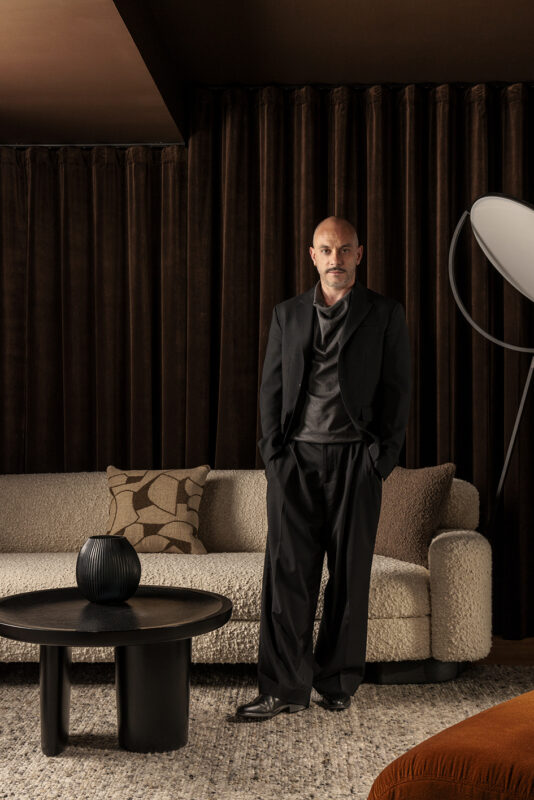
The overhaul is the work of Studio KO, the Paris and Marrakech practice of Karl Fournier and Olivier Marty, known for the Yves Saint Laurent Museum in Marrakech. Their design breathes the sixties, sensual and hedonistic, at once raw and radical as it once was. In the restaurant, red velvet banquettes meet brutalist concrete panels, bare black tables instead of tablecloths, plus skylights and a built-in terrarium of plants behind glass.

The rooms are spread over five new storeys, with a concert hall in the basement, its ceilings bare and its walls clad in cork. The art programme was created with the gallery L’Œil de KO and the collector Antoine Billore. Sustainability reaches the bar too, whose tonics, syrups and cordials are all made in-house. The spaces feel at once out of time and entirely of today.


A Look Inside
The house counts 35 rooms and suites over five storeys, plus, on the ground floor, the 90-seat restaurant, a bar and the lobby, and in the basement the concert hall for two hundred guests. The largest is the Dalí Suite, also called “Magic Rock”, at eighty square metres.

The rooms are kept in sixties retro-chic, sensual and dim, with high-end sound systems guests rave about, smart TVs and box-spring beds. At reception, earplugs and sleep masks stand ready around the clock, and those seeking quiet get a room facing the courtyard; a house with a club in its belly calls for such foresight. Two Superior rooms are adapted for wheelchair access, two pairs of rooms connect. Baby cots are available on request, though the Bus is more for grown-ups.


Culinary
The in-house restaurant is open from early to late and led by head chef Valentin Raffali, known as co-owner of the bistro Livingston in Marseille, whose style he brings here: inventive French plates from seasonal produce, such as smoked leg of lamb with kumquat gremolata or langoustines with XO glaze.

You eat among red velvet banquettes and concrete panels, at bare black tables, beside the glass terrarium. Thursday to Saturday, DJs spin in the restaurant, the soundtrack drawn from a formidable record collection, half from founder James Arch, half from Jean-Charles Dupuy, the “king” of Parisian nightlife.

© Eva Lopez

© Eva Lopez
At the bar wait six signature cocktails, all the classics and a well-considered alcohol-free list; the Chaussan, named after a legendary host of the old Bus, is bubblegum pink, made of olive-oil syrup, lemon, tomato liquor and basil-infused vodka. Plus a silver tower of pommes frites to start the evening. Some rates include breakfast, otherwise it costs thirty-five euros, served beside the terrarium where daylight falls through the skylights.


Wellness & Relaxation
There is no spa or pool; the Bus Palladium is not a place of stillness but of the night. Rest here means something else: a late morning in the darkened retro room, a breakfast that stretches into noon, a cocktail at the bar before the music starts below.

© Matthieu Salvaing
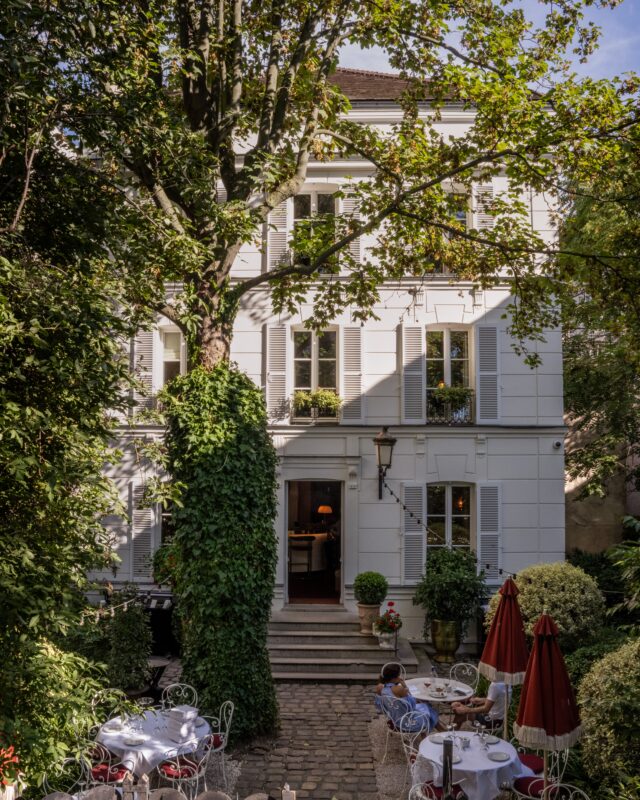
Those who still want calm retreat to a room facing the courtyard, with earplugs from reception and a heavy curtain against the Paris light. A small rooftop is planned, one day to open the view over the roofs of Pigalle up to the Sacré-Cœur. The real relaxation of the house, though, is the letting go, the dancing, the night.


Surrounding Area
Pigalle has been the heart of Parisian nightlife since the nineteenth century, a former red-light district whose main drag is still lined with neon and where the Moulin Rouge turns its sails. Around Rue Fontaine lies concentrated cultural history: Edgar Degas had his studio here, André Breton and Louis Aragon conceived Surrealism in the cafés, Django Reinhardt played in the dance hall next door. The once-seedy quarter has turned into “SoPi”, South Pigalle, with natural-wine bars, concept stores and late bars.

© Nikita Pishchugin on Unsplash

© Nhi D on Unsplash
The Musée de la Vie Romantique, a quiet artist’s house with a garden at the foot of Montmartre, is worth a detour, as is the museum of Gustave Moreau. For records, the shops of Rue des Martyrs reward, the street that draws the southern border with its delis and cafés. Those after sweets head to the famous pâtisserie on Rue des Martyrs; those who love books, to the small bookshops around. Behind the hotel, Montmartre climbs the hill to the Sacré-Cœur, the vineyards and the studios. In the evening the way leads to the bars of SoPi or straight down into the hotel’s own club.
Activities
For night owls: The in-house concert basement with its changing programme under the disco ball, the bars of South Pigalle, the Moulin Rouge and its clubs La Machine and Bar à Bulles with a view of the windmill.
For music lovers: The record collection in the restaurant, the DJ nights Thursday to Saturday, the concert halls around and the traces of the rock history Gainsbourg once sang about.
For art lovers: The Musée de la Vie Romantique at the foot of Montmartre with its garden café, the studio house of Gustave Moreau, the galleries and the house’s own art programme.
For the appetite: The restaurant with the cooking of Valentin Raffali, the natural-wine bars of SoPi, the delis and cafés of Rue des Martyrs.
For walkers: The climb to Montmartre, to the Sacré-Cœur, the vineyards and the Place du Tertre, the quiet lanes around Avenue Frochot.


© Matthieu Salvaing
For history travellers: The traces of the Surrealists around Breton and Aragon, the studio of Degas, the dance halls and music halls of old Pigalle.
For shoppers: The concept stores and record shops of South Pigalle, the boutiques of Rue des Martyrs, the vintage dealers around Place Saint-Georges.
For romantics: A drink at the bar in pink light, an evening in the darkened retro room, the view from the planned rooftop over the roofs of Pigalle.
For city explorers: The Palais Garnier and the Galeries Lafayette within walking distance, the covered passages of the 9th arrondissement, the neoclassical quarter of the Nouvelle Athènes around Place Saint-Georges.
Details
- 35 rooms and suites over five floors; the largest: Dalí Suite alias “Magic Rock” (80 m²); two Superior rooms wheelchair-accessible, two pairs of rooms connecting.
- Restaurant (90 seats, head chef Valentin Raffali), bar with house-made syrups, concert basement (200 seats), planned rooftop.
- No spa, no pool; earplugs and sleep masks at reception, courtyard-facing rooms on request.
- Breakfast for a surcharge (€35); air conditioning, smart TV, sound system in the rooms.
- Children welcome, baby cot on request; parking (€45/day).
- Located at 6 rue Pierre Fontaine, Pigalle, 9th arrondissement; Métro Pigalle.
- Website: buspalladium.com