

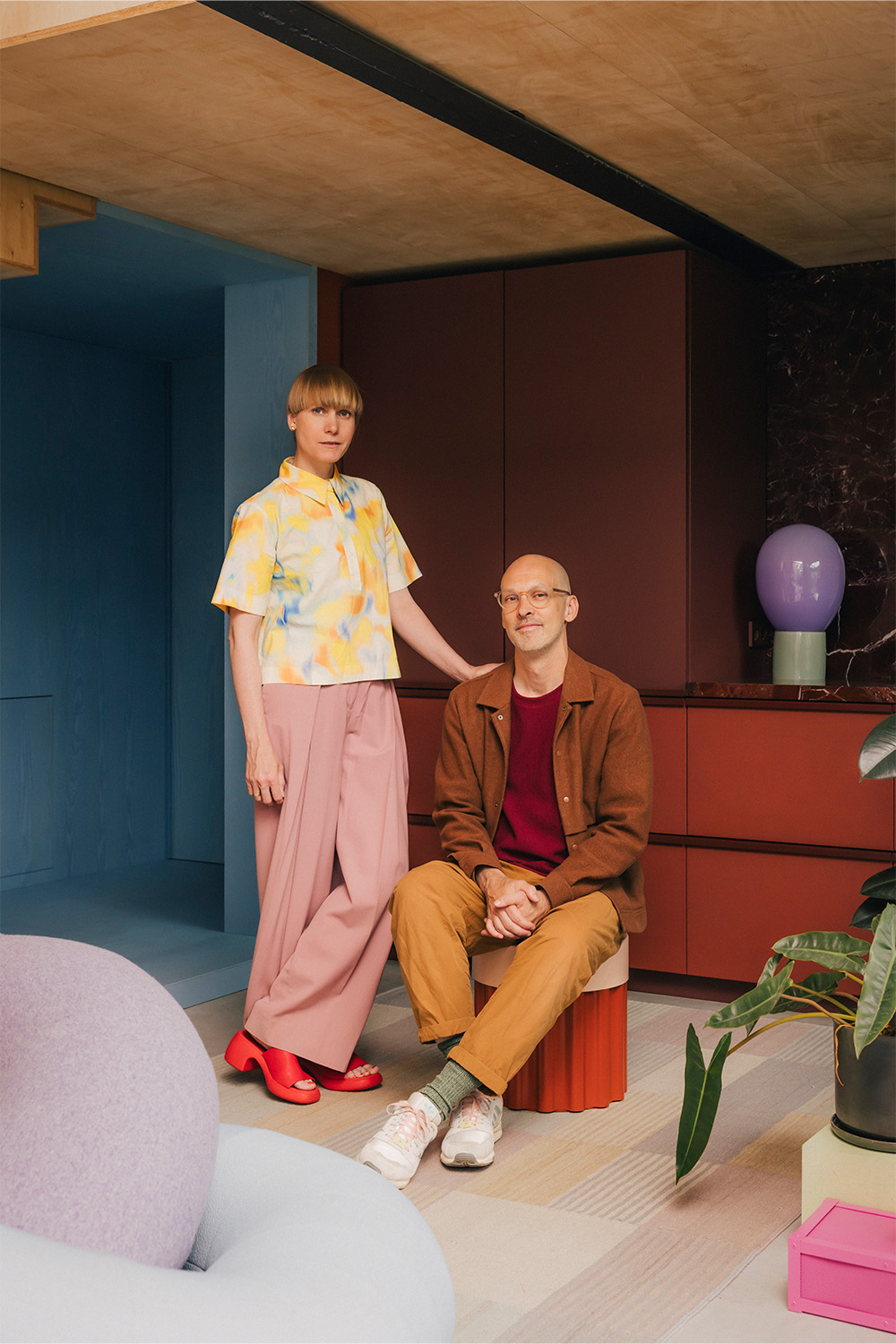
Colour is both the method and the message in the work of Raw Color. Across textiles, photography and graphic design, Daniera ter Haar and Christoph Brach strip each project down to its essentials, letting hue, tone and saturation carry the weight. Their process is precise yet playful, seeking simplicity without coldness. They treat colour not as decoration but as structure itself, breathing life and vibrancy into every surface, object and image they touch.

© Courtesy of the artist
Which place do you currently call home and where do you work on your projects?
We live and work in the same building, a former Philips factory from the 1950s. Founded in Eindhoven, Philips relocated most of its production to other countries in the 1990s, leading to the abandonment or demolition of many buildings. We were fortunate that this building was saved and redeveloped by Piet Hein Eek and Iggie Dekkers (Eek & Dekkers). Renovated between 2012 and 2014, it is transformed into a beautiful, spacious architecture that retains its industrial character, evident in the steel beams and concrete grid ceiling, typical elements of Philips’ corporate architecture from that era.
Where is your studio located & how does it look?
The studio is located in Eindhoven, a former industrial city that transitioned into a high-tech economy and creative hub. After our study at the renowned Design Academy Eindhoven, we stayed in the city. The studio is situated in the former industrial area Strijp-R, established by Philips, which has since transformed into a residential neighbourhood. In walking distance is Strijp-S, another former industrial area that has become Eindhoven’s vibrant alternative heart. It’s a lively mix of gastronomy, event spaces, and residential areas, housed in former industrial buildings and complemented by newly developed high-rise architecture. Strijp-S is an inspiring place to visit, especially on weekends, when it’s buzzing with activity and offers a fun atmosphere for exploring and enjoying a drink.

© Courtesy of the artist
Are there any projects that are personally important to you—whether recently completed or currently in progress?
We work on multiple projects simultaneously with our team. Our compact studio of five people allows us to handle larger commissions while maintaining direct communication with all team members. We actively participate in each project.
A recent project involved designing the scenography for Van Gogh Museum’s exhibition “Yellow,” which focussed on the artist’s work and his contemporaries. We also recently finalised the set design for the windows of Hèrmès in Switzerland. This project is unique because the studio actively designed and produced the objects for the windows, starting from the concept and building up to the setup of the first windows.
Another special collaboration was designing the 100-year anniversary colour fan deck of RAL Classics, a system we use regularly. We delved into their archive to explore the heritage and functional aspects of individual colours within their industrial applications.
Additionally, we will be collaborating with several brands to develop several products next year.

© Courtesy of the artist

© Courtesy of the artist

© Courtesy of the artist
Do you have a favourite place in your area where you like to relax and linger?
We prefer to stay close to home in our area of town. As mentioned before, there’s a lot to discover. We have two sons around the age of 10 who still need some attention. They love playing basketball, so we join them at Urban Sports Park. It’s a great initiative that offers a variety of sports, including skating and free running.
Piet Hein Eek has his empire of a workshop, a shop, a hotel, and a restaurant just around the corner. It’s an inspiring place that we love to visit, browse through, and grab a coffee and a cake.
However, it’s also important to spend time with friends, which can be challenging with a busy studio and young kids. So, we often enjoy hanging out at home, having a drink, and relaxing on our terrace and enjoying our plants.

© Photo: Alicja Ziaj, Unsplash
Are there any urgent political issues or problems in your region?
The region and city are experiencing rapid growth, particularly driven by the high-tech sector. ASML, the world leading chip machine producer, is headquartered in Veldhoven, just a short drive from Eindhoven. This growth has brought significant economic benefits, creating numerous job opportunities and attracting talent to the city. However, the rapid expansion has put immense pressure on the housing market and the existing infrastructure of Eindhoven.
From our perspective, the creative industry is being pushed out of the city due to a decrease of space availability and rising costs of living. We have been connected as tutors at Design Academy Eindhoven for over 15 years and are witnessing the struggle of students to find housing. Within the creative industry itself, we have noticed that former students are less likely to establish businesses or existing businesses are forced to relocate. As a result, the city may increasingly adopt a monocultural profile, becoming more tech-driven.
Despite these challenges, the city still boasts a vibrant creative scene. Beyond traditional design practices, it is evident in the unique bars and gastronomy establishments run by creative individuals. These places have become integral to everyday life, contributing to a diverse and energetic atmosphere of the city.
In your opinion, what has developed well in the last 5 years—and what has not?
From our perspective, we see a shift towards an increasingly individualist society. People are taking less effort to understand each other and respect differing opinions. We also notice a shift towards a more passive attitude. Social media could be seen as a potential driver of these developments, as people tend to get more stuck in a reflection mode, manifesting in more thinking and less doing, or consumption instead of creation. While we have experienced that shifting into an active mode delivers a lot of well-being, as it gives us energy and redirects thoughts in a positive direction, this is relevant for our profession as designers. You can’t come to a successful project by thinking alone. Intellect can help you define starting points, but intuition is a catalyst that drives a project into unexpected and unthinkable solutions. The same applies to simple every day tasks, such as cleaning the house or working on the terrace, which are great ways to be useful.
On the other hand, we see that there is growing availability of knowledge. AI can be an impressive tool that helps us find information even faster or accelerate some tasks. We use these tools, especially when researching or rewriting a piece of text like this.

© Tayla Kohler on Unsplash

© Remco Mariën on Unsplash
Do you know a hidden gem when it comes to local manufacturers—whether it’s arts and crafts, sustainable products or food?
There’s a fantastic bakery in Eindhoven called Broodt. Founded by a former designer named Dido, after years of working as an industrial designer, Dido self-taught himself baking. He started by making bread at home for friends and eventually opened a bakery in the centre of Eindhoven. Sourdough bread is hard to find in the Netherlands, but Dido’s bread is one of the best we’ve ever had. We’re especially fans of his Pain Galicia, which he discovered during a bread field trip to Spain.
Another great place to visit is Vaderland, a farm taken over by a former co-student at Design Academy Eindhoven. She inherited the farm from her father and now, along with her husband and team, grows local vegetables. Her husband is a chef who makes the most delicious dishes using the fresh ingredients. You can book a table at their small restaurant or visit their farm shop. This place is situated just outside Eindhoven and can be reached by car or by combining a bike ride through nature.
Is there anything particularly innovative in your region? Also in comparison to other places you have already visited?
The local design scene is what comes to mind first. It emerged from the Design Academy Eindhoven and gained significant recognition through the former students that established their studios in the city. The most prominent manifestation of this creative scene is Dutch Design Week, which has been running for over 25 years. It was started by a small group of designers and attracts over 300,000 visitors each October, surpassing the city’s population. The event fills the city with energy, and visitors can explore over 120 locations, including many design studios. We have been participating in Dutch Design Week for many years and have opened our studio to the public in the past years. We have shared relevant projects from each year, such as our sofas for Sancal and the collection for Ikea.
Do you have a secret restaurant tip that you would like to share with us?
We absolutely love visiting Radio Royaal. The restaurant is housed in a former factory, and the unique space of 8m high allows guests to sit next to the former machines. The dedicated team has been collaborating for years, creating innovative yet balanced dishes that consistently maintain the highest quality. Radio Royaal embodies everything we cherish about Eindhoven – an inspring blend of industrial heritage and creativity.

© Radio Royaal

© Radio Royaal
Is there a local shop whose products are only available in your region?
Piet Hein Eek’s showroom is a unique experience. The products on display are all made in the same building, and visitors can literally see the production through the large glass walls of the airy and light-filled factory. Piet Hein Eek is known for his innovative approach to design, reusing materials like used wood from demolished buildings. The showroom primarily showcases furniture, lighting, and larger-scale interior accessories from his collection. There’s also a shop that sells smaller products from Piet’s collection, as well as other local designers and international brands. The showroom is complemented by an art gallery and restaurant, making it a complete destination for a day out.

© Piet Hein Eek

© Piet Hein Eek
What are your 3 favourite apps that you use every day and couldn’t live without?
— De Volkskrant, a Dutch newspaper, combines great journalism with well-designed visual content.
— Instagram is a relevant app for sharing studio activity, connecting with our audience, and staying informed about the global creative community.
—NBA, the app of the world’s most famous basketball competition, serves as a great neutraliser, allowing us to follow the latest matches alongside our creative work.
Do you have any favourite newspapers or online magazines? And how do you keep up to date with politics or social and cultural issues?
As mentioned in the app answer, we digitally read De Volkskrant every day. It’s the national Dutch newspaper, known for its progressive voice and humanistic view on the world and politics.

© Alex vd Slikke on Unsplash
Imagine you could be mayor for a year—what would you change?
We would then try to improve the housing situation. It’s incredibly difficult to find affordable housing for people who are just starting out. This shouldn’t be the case. It seems like politics needs to control the free market more. Many aspects of life have been left to the economy and market mechanisms, which has brought us to our current situation. Money shouldn’t be the main driver, as it is now. It’s supposed to solve problems, but money has also created many.
For example, there’s evidence of benefits when it comes to implementing creative spaces in newly developed residential areas. Alexander Ramselaar has done some great work together with creatives and municipalities, in realising these kinds of projects into the future city structures across The Netherlands. These creative places may cost money initially, but they improve the quality of life in these areas on long term. They can offer innovative gastronomy, local gardening, or other activities like workshops or sports. This fosters social cohesion, stimulates exchange, and makes the areas desirable to visit or live in. This is a great example of cultural diversification versus monocultural areas.
Unfortunately, these cultivated areas need to be protected. When an area becomes desirable, prices rise, and those who pioneered it are often pushed away because they can’t afford to stay anymore.
One last question: If you could choose another place to live—regardless of financial or time constrains—which one would you choose?
We’ve visited Berlin and Barcelona many times and genuinely fell in love with both cities. Barcelona has been primarily a professional destination for us. We needed to be there for our studio to collaborate with local brands like Santa & Cole or Nanimarquina, as well as local design education institutions like Elisava. However, we’re hesitant to mention the city here. We know many local creatives and witness their struggles when it comes to finding affordable studio space or housing. It’s basically become impossible to buy a house within Barcelona. Large-scale tourism has become a significant problem here, unfortunately driven by money again.

