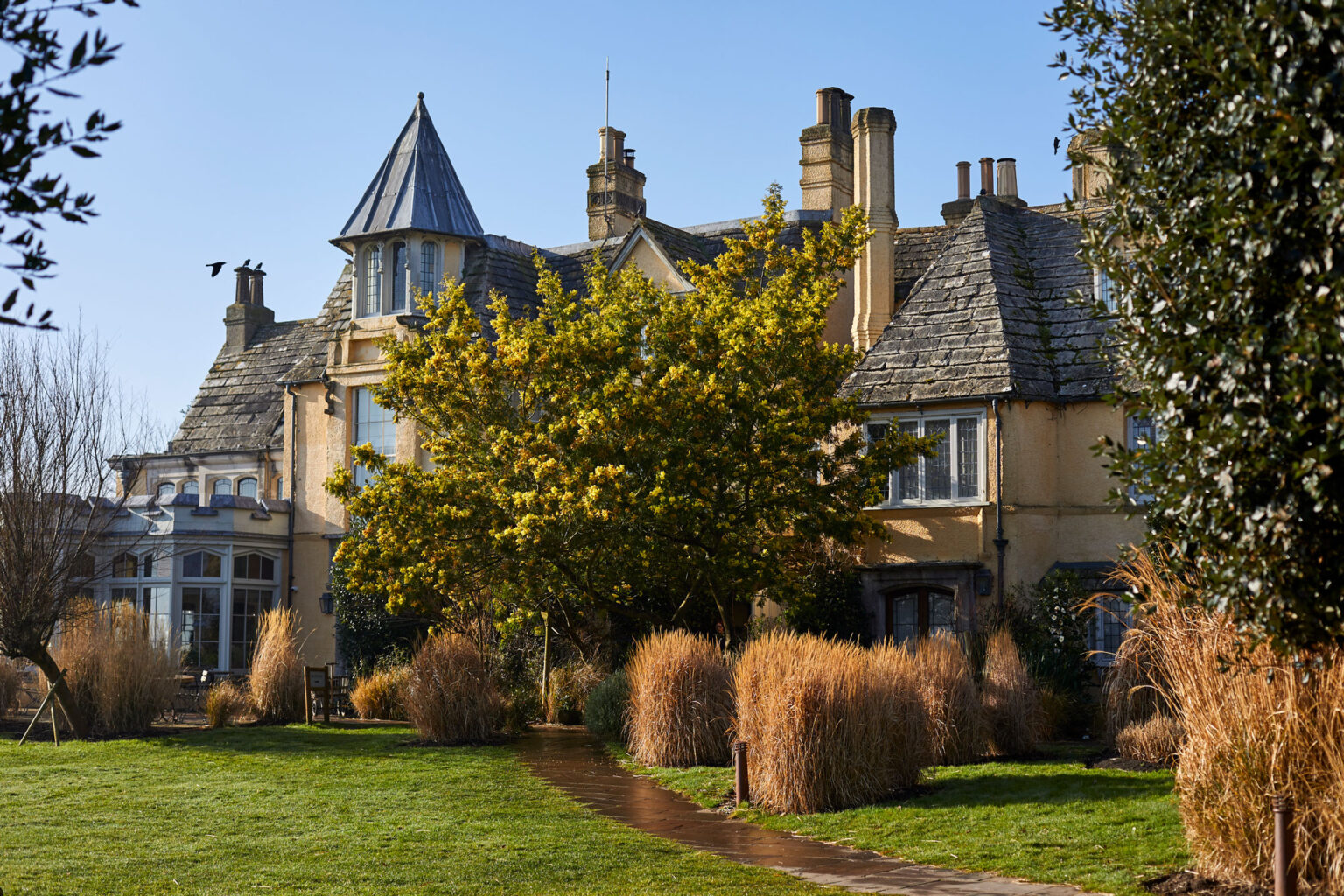

The road to Studland runs through heath and narrow villages, then a yellow house appears among the trees, looking as if a child had designed it and insisted on a turret. Nobody rushes to take your bags. Inside, chandeliers over worn-in sofas, a dog, an open fire; the bay lies beyond the windows. You are a guest before you are a customer.

The location
Studland sits on the Isle of Purbeck, a peninsula of chalk and heath at the start of the Jurassic Coast. The land drops to the bay at the door; on the horizon stand the white stacks of Old Harry Rocks, and on clear days the Isle of Wight behind them.

The house is a neo-gothic manor of the nineteenth century, butter-yellow, with bays, battlements and a shingled roof that means to look like a sandcastle; built for the Bankes family as a summer seat. The National Trust owns it today, THE PIG leases it. Outside, a stage set; inside, a sitting room.


Backstory
The PIG idea comes from Robin Hutson, who had built up Hotel du Vin before opening a deliberately un-ironed country house in the New Forest in 2011: the kitchen garden at the centre, second-hand furniture, no gloss. The Studland house joined in 2014, fourth in the line, in a building owned by the National Trust. The Bankes family had it built as a summer house in the nineteenth century, the story goes, in the wish that it should resemble a sandcastle. The interiors follow the hand of Judy Hutson, who supplied the group’s vintage vocabulary: found objects, curios, nothing new allowed to look new. The Hutsons stepped back at the end of 2024; Home Grown Hotels carries the concept on. What remains is the old house rule: the garden first, then the kitchen.

Interior & architecture
The manor is a Victorian fantasy with gargoyles, bays and a turret that nobody needs and everybody likes. Inside, the peculiar floor plan survives, rooms at odd angles, each cut differently. Judy Hutson’s interiors work with patina rather than polish: reworked floorboards, antiques and bric-a-brac, chandeliers, in one room Portuguese carving, in another a four-poster.


The conservatory restaurant is bright and full of plants, half greenhouse. For the growing house a new wing was added, gently enough that the seam barely shows. In the garden stand two thatched dovecotes against the wall and, further out, shepherd’s huts with sea views.


The colours stay muted, earthy, borrowed from the coast. Sustainability shows here as reuse: much of it is second-hand, repaired, lived on.
A look inside
The house is small and rambling: a reception without pomp, sitting rooms with fireplaces, the conservatory as restaurant, the Round House in the garden for private tables of eight to twelve. Twenty-three rooms, all different, from Snug through Comfy to the Generous Rooms with the best views: number 14 with a four-poster, 15 with a bath at the foot of the bed, 16 with the largest bathroom and a sea view.

Add two thatched dovecotes by the kitchen garden and the shepherd’s huts Harry’s Hut and The Pig Hut, freestanding bath and bay at the door.


Each room uses every nook of the old building, with reworked floorboards and antiques; ground-floor Comfy Luxe rooms in the new wing are step-free. Roberts radios throughout, good beds, a well-stocked larder shelf. Comfort without stiffness.


Culinary
The reason to come here, again, is the food. It’s served in the glazed conservatory, with a view across the bay to Old Harry Rocks, on the 25-mile menu: what doesn’t grow in the walled garden comes from twenty-five miles at most, here above all from the sea. The menu changes daily with the harvest and the catch, Poole Bay crab, mussels and hand-dived scallops, fish off the coast, vegetables cut that morning, and the meat of the pigs that earn their name in the garden.

The cooking is British garden food, seasonal, without flourish; heartier in winter, with braises and root vegetables, lighter and greener in summer. You eat among potted plants and candlelight, the bay in the window.


Outside, the Garden Oven bakes wood-fired pizza, no booking. The wine cellar is seriously stocked, an inheritance from Hutson’s Hotel du Vin days. Book a kitchen-garden tour and watch dinner grow.


Wellness & Relaxation
There is no conventional spa, and no pool. Treatments happen in the Sheep Huts, small cabins on the slope, with a view of Old Harry Rocks and products by Bamford. You need no more when a beach lies at the door.

Five minutes on foot and you stand on the sand of Studland Bay, one of the finest beaches on the south coast; behind it the heath of the nature reserve, before it the open sea. Rest here means a deckchair on the lawn, a walk on the coast path, a swim in the bay when the water allows. The wind takes the to-do list off your hands.


Surrounding area
The Isle of Purbeck is a cultural landscape of chalk, smuggling stories and literature. The South West Coast Path begins at the door; a circuit of barely six kilometres leads to Old Harry Rocks, the start of the Jurassic Coast. Studland is said to have inspired Enid Blyton’s Toytown, and her Famous Five are at home around nearby Corfe Castle, whose ruin was left by the English Civil War and which once belonged to the Bankes family.

An old steam railway runs at Swanage, and in the harbour Gee Whites serves oysters and lobster, cash only. A chain ferry crosses to Sandbanks over the narrow mouth of Poole Harbour; out beyond lies Brownsea Island, home to red squirrels and birthplace of the Scouts. Deeper into Purbeck the Square and Compass at Worth Matravers is worth it, a seventeenth-century pub with its own cider and a small fossil room.


On the coast at Kimmeridge the Etches Collection shows the Jurassic Coast as a dinosaur hoard. For houses, head to the Kingston Lacy estate, Bankes again, now National Trust. And for the first pint, the walk to the sixteenth century is enough: the Bankes Arms stands five minutes away.
Activities
For walkers. The South West Coast Path to Old Harry Rocks, on along the Purbeck Way to Swanage, plus Dancing Ledge and Durlston park with its cliffs; on clear days the view reaches the Isle of Wight.
For beach people. The long pale sand of Studland Bay just below the house, dunes behind it and the heath of the nature reserve, calm shallow water in front.
For history and literature lovers. Corfe Castle as a ruin to climb, Victorian Swanage, the Kingston Lacy estate, plus Enid Blyton’s Toytown and the Famous Five, who are at home here.
For nature lovers. By boat to Brownsea Island for red squirrels and seabirds, reptiles on Studland heath, the geology at Old Harry Rocks.
For the appetite. The house 25-mile menu and wood-fired pizza, an ale at the Bankes Arms, the cider at the Square and Compass, seafood at Gee Whites in Swanage.


For families. The pigs and chickens in the garden, the beach, the Swanage steam railway and the chain ferry to Sandbanks.
For garden and design lovers. The kitchen-garden tour, the gardens of Kingston Lacy, and the eccentric Victorian architecture all around.
For watersports people. Kayak out to the chalk stacks, swimming and sailing in the sheltered bay, wind- and kitesurfing off Studland, plus boat trips along the Jurassic Coast.
For the quiet-seeking. A treatment in the Sheep Hut with a view of Old Harry Rocks, a deckchair on the lawn, a book by the open fire when the wind roughens the bay.
Details
- Twenty-three rooms, all individual: categories from Snug and Comfy to the Generous Rooms; the finest are number 14 (four-poster), 15 (bath at the foot of the bed) and 16 (largest bathroom, sea view).
- Plus two thatched dovecotes by the kitchen garden and two shepherd’s huts (Harry’s Hut, The Pig Hut) with sea views.
- Conservatory restaurant (25-mile menu), Garden Oven for wood-fired pizza, Round House for private dining, own wine cellar.
- No spa, no pool; treatments in the Sheep Huts with Bamford products.
- Walled kitchen garden, free-roaming animals; dogs welcome.
- Above Studland Bay, Dorset; building owned by the National Trust.