

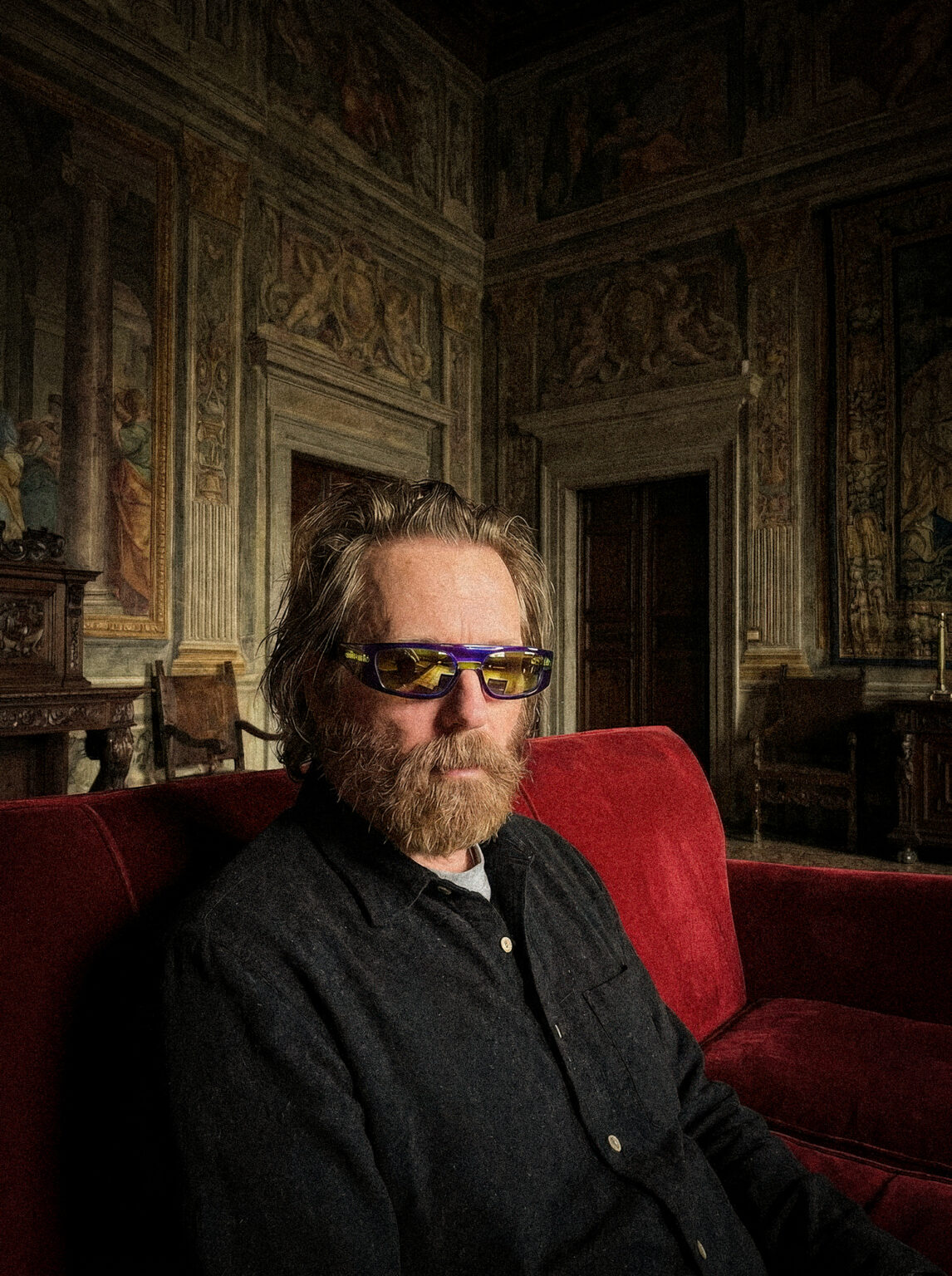
Diango Hernández’s work balances structural clarity with conceptual openness. Precision and design logic meet interruption and reinterpretation, so each piece feels both constructed and uncertain. Rooted in industrial thinking yet expanded into memory, space, and narrative, his practice turns familiar forms into quiet reflections on how we build and understand the world around us.

© Courtesy of the artist
Which place do you currently call home and where do you work on your projects?
I currently live and work in Düsseldorf, Germany, although Havana remains an essential emotional and imaginative point of reference in my life and work. Over the years, I have come to understand home less as a fixed geographic location and more as a mental and poetic space.
My projects are developed primarily in my studio in Düsseldorf, where painting, architecture, design, and fiction come together. After many years of working between Düsseldorf and Milan, I am now in the process of developing a larger studio in Milan, a city that has become increasingly important to my practice. Many of the spaces I create—whether paintings, installations, or swimming pools—begin in these studios as imagined environments.
Where is your studio located & how does it look?
I have several studios, but over the last five years—since my son was born—the idea of the studio has changed profoundly for me. The studio is no longer a single, fixed place; it has become wherever I am able to paint, think, and concentrate. Becoming a father transformed the way I work in the best possible way.
Working is no longer a solitary or purely self-centered activity. It has become a carefully measured use of time, shaped by the presence of another person whose needs and rhythms are deeply intertwined with my own. In that sense, the studio has become both more flexible and more meaningful. Whether in Düsseldorf, Milan, Havana, or at the kitchen table at home, what matters most is the mental space to imagine and create.
Are there any projects that are personally important to you—whether recently completed or currently in progress?
One of the projects that is most important to me at the moment is Olaismo. What began as a painterly exploration of waves and the instability of perception has evolved into a much broader artistic language. Today, Olaismo extends beyond painting into ceramics, swimming pools, interiors, and architectural interventions. At its core is the idea that reality is never fixed; it is fluid, emotional, and constantly reshaped by memory and desire.
A concept that deeply occupies me right now is construction in the broadest and most profound sense of the word. I am increasingly interested in infiltrating art—and artistic thinking—into living spaces and cities. My goal is to create works that are fully functional, yet conceived and developed with the same rigor, sensitivity, and conceptual depth as a work of art.
Whether it is a tiled swimming pool, a room, or an architectural element, I want these projects to be useful and inhabitable while also carrying the emotional and intellectual resonance of sculpture or painting. In this sense, Olaismo is becoming a way of building: a method for transforming everyday spaces into places of imagination, beauty, and reflection.

© Courtesy of the artist

© Courtesy of the artist

© Courtesy of the artist
Do you have a favourite place in your area where you like to relax and linger?
One of my favorite places to relax is our potager, the vegetable and flower garden we care for as a family. Spending time there with my wife and son is one of the most grounding and rewarding parts of my daily life. Gardening has a rhythm that is very different from the studio: it teaches patience, attention, and trust in time.

© Photo: Nicolas Peyrol on Unsplash
Are there any urgent political issues or problems in your region?
As we all know, the world is going through a profound political transformation. Many of the structures and certainties that shaped recent decades are being questioned, and that process is creating both instability and new possibilities. The place I remain particularly concerned about is Cuba.
I would like to see Cubans able to excel freely—to create without limits, to think without ideological restrictions, and to fully develop their talents and aspirations. Cuba has extraordinary human potential, and I hope to see a future in which imagination, initiative, and individual freedom can flourish without constraint.
In your opinion, what has developed well in the last 5 years—and what has not?
Over the last five years, one of the most remarkable developments has been the acceleration of technology, particularly artificial intelligence. These tools are transforming the way we communicate, imagine, and create. For artists, designers, and architects, they open up extraordinary possibilities to visualize ideas and to work across disciplines in ways that were difficult to imagine only a few years ago.
At the same time, many political and social tensions have intensified. In numerous parts of the world, ideological polarization has become more pronounced, and meaningful dialogue often feels more difficult. I remain especially attentive to Cuba and hope to see a future in which creativity, entrepreneurship, and free thought can flourish without restriction.
On a personal level, the most positive development in my life has been becoming a father. It has changed my understanding of time, responsibility, and what truly matters. It has made me more focused and more aware of the importance of building—not only artworks, but also a meaningful life and a hopeful future.

© Photo: nis on Unsplash

© Photo: Nicolas Peyrol on Unsplash
Do you know a hidden gem when it comes to local manufacturers—whether it’s arts and crafts, sustainable products or food?
One of my favorite local gems is Café Heinemann, a family-owned confectionery that has been an institution in Düsseldorf since the 1960s. It is a place I return to often, both for its exceptional pralines and for its wonderful selection of cakes.
What I admire about Heinemann is the consistency and care that go into everything they make. There is a sense of tradition and craftsmanship that feels increasingly rare. In a world that moves very quickly, places like this remind us of the enduring value of doing something well, generation after generation.
Is there anything particularly innovative in your region? Also in comparison to other places you have already visited?
What has always struck me about the Rhineland is the extraordinary space that has been given to contemporary art since the postwar period. Few regions in Europe have invested so consistently in artists, museums, collectors, and experimental institutions. Cities such as Düsseldorf and Cologne helped create an environment in which contemporary art was not treated as something marginal, but as an essential part of public and cultural life.
This ecosystem shaped generations of artists and made the region one of the most influential centers for contemporary art in the world. What I found particularly inspiring was the conviction that art mattered—that it was worth supporting, collecting, discussing, and integrating into everyday life. Compared to many other places I have visited, this level of long-term commitment to contemporary art has been truly exceptional.
At the same time, I believe this legacy should not be taken for granted. Today, I see a real danger that some of this remarkable cultural infrastructure and spirit could gradually fade. Economic pressures, shifting priorities, and a reduced willingness to take risks can weaken the conditions that once made the Rhineland so vital. Preserving that openness to experimentation and maintaining strong support for artists will be essential if the region is to continue playing the important role it has held for decades.
Do you have a secret restaurant tip that you would like to share with us?
One of my favorite restaurants in Düsseldorf is G. Saitta in Oberkassel. It is one of those places that combines excellent Italian cuisine with a warm, family-run atmosphere that makes you feel immediately at home. I have a particular weakness for their antipasti, fresh pasta, and exceptional wine selection, but what I appreciate most is the sense of continuity and authenticity that the Saitta family has preserved over the years.
Restaurants like this are much more than places to eat—they become part of the cultural fabric of a city. Whenever friends visit Düsseldorf, this is one of the first places I like to take them.

© G. Saitta Restaurant

© G. Saitta Restaurant
Is there a local shop whose products are only available in your region?
Again I have to mention is Café Heinemann. Although some of their products can occasionally be found elsewhere, the full experience—and many of their specialties—are very much tied to Düsseldorf and the surrounding region.
What are your 3 favourite apps that you use every day and couldn’t live without?
Three apps I use every day and would not want to be without are Instagram, ChatGPT, and Apple Music.
Do you have any favourite newspapers or online magazines? And how do you keep up to date with politics or social and cultural issues?
I do not rely on a single newspaper or magazine. I prefer to consult a wide range of sources and to read as many different perspectives as possible. That approach feels increasingly important today, when information often arrives filtered through very specific political or ideological lenses.
I regularly read newspapers, online magazines, and cultural publications from different countries and with differing viewpoints. This helps me form a more nuanced understanding of political, social, and cultural developments. I believe that staying informed requires a certain degree of curiosity and skepticism—a willingness to compare narratives rather than accept any single account as definitive.
In the arts, I continue to follow a broad spectrum of publications, but I also consider conversations, books, exhibitions, and even social media to be essential sources of information. Some of the most interesting insights often emerge when very different perspectives are placed in dialogue with one another.

© Photo: Artem Zasypalov on Unsplash
Imagine you could be mayor for a year—what would you change?
If I were mayor for a year, one of my priorities would be to create more opportunities for young people with strong ideas. I would devote significant resources to supporting entrepreneurial initiatives of all kinds—from business ventures and technological innovations to cultural and community-oriented projects.
Young people often have the energy, imagination, and willingness to take risks that are essential for keeping a city dynamic and forward-looking. What they frequently need is not more bureaucracy, but trust, practical support, and access to funding. I would like to see cities invest more decisively in emerging talent and in projects that have the potential to generate both economic and cultural value.
I believe that some of the most meaningful transformations begin with relatively small initiatives led by motivated individuals. By giving young people the tools to realize their ideas, a city not only supports innovation but also strengthens its sense of optimism and possibility.
One last question: If you could choose another place to live—regardless of financial or time constrains—which one would you choose?
If I could choose another place to live, regardless of practical constraints, I would choose New York City. From the very first time I visited, I felt an immediate connection to the city. There was an energy and intensity that was difficult to explain at the time, but it stayed with me.
What fascinates me most about New York is its extraordinary sense of enthusiasm and its contagious culture of exchange. It is a city where people connect through ideas, projects, and a shared ambition to create something meaningful. There is a remarkable openness to new possibilities and a constant willingness to engage.
Life in New York seems to demand the best from everyone. It challenges you to think bigger, work harder, and remain fully present. That spirit of ambition and creative urgency is deeply inspiring to me, and it is one of the reasons the city has always held a very special place in my imagination.


