

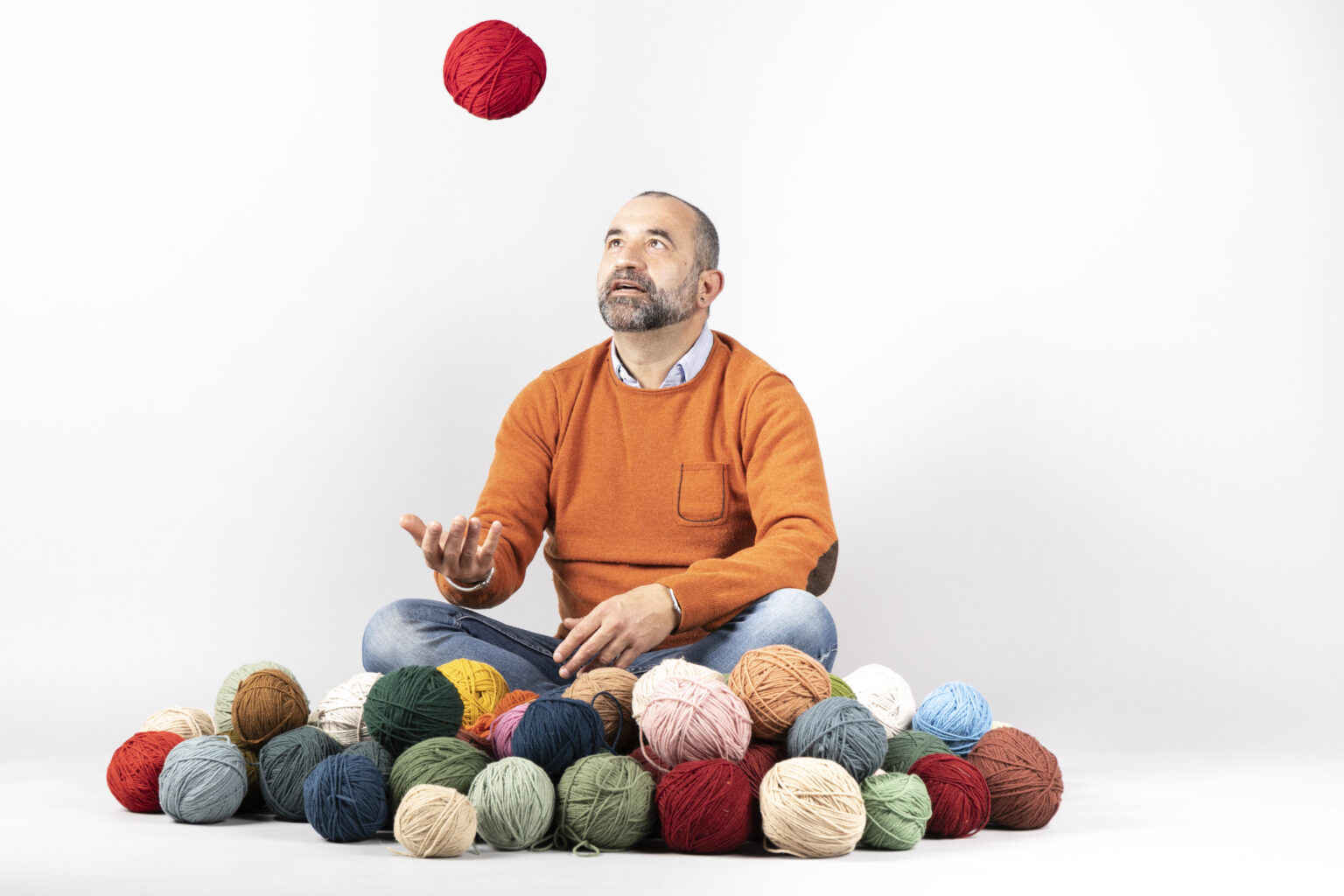
String by string, João Bruno weaves together the same material his mother used to make traditional Arraiolos rugs to form his own creations. Each design is made with the guiding thread of this uniquely Portuguese wool in the slow, rhythmic pace created in Bruno’s studio in his birth city of Tomar, taking on new shapes that transcend conventional use of the material.
Bruno takes long-standing heritage and turns it into unconventional pieces with a modern spin. For him, “handmade in Portugal is more than just a label; it’s a seal of authenticity, an ode to the history and tradition of a country that values the richness of manual work.” Resisting optimization, he takes pride in the patience and personalization used to make each piece.

© Courtesy of the artist
Which place do you currently call home and where do you work on your projects?
I was born in Tomar, one of the most beautiful cities in Portugal (right in the center of the country). I work in the city. My studio is located in an old factory, but I live outside Tomar, in the countryside where I feel more quiet.
Where is your studio located & how does it look?
My studio is in Tomar, Portugal, inside A MOAGEM-FÁBRICA DAS ARTES, an old flour factory that has been reborn as a cultural center. It is a space where past and present coexist: the raw industrial walls contrast with the softness of wool, and the echoes of machinery have given way to the quiet rhythm of weaving. This unique atmosphere allows me to explore both tradition and innovation in my practice. It’s a place filled with history and memory, which I find very inspiring and allows me to create textile sculptures on a significant scale, while also maintaining the intimate, handcrafted rhythm that defines my work.

© Courtesy of the artist
Are there any projects that are important to you personally, that you have recently completed or that you are still working on?
There are several projects that resonate deeply with me. A Natureza da Lã is a forthcoming solo exhibition where wool becomes a metaphor for the fragile dialogue between humanity and nature. In Madrid, at the 7 Islas Hotel, I will soon present another exhibition that feels like opening a new window for my work beyond Portugal.
This September, showing DODECAEDRO at Paris Design Week will be a special moment, as it connected my practice to an international stage through the language of geometry and lightness. At the same time, I am creating A DANÇA DAS MÃOS, a videographic piece that intertwines craft and dance, revealing the silent choreography of making by hand.
Each of these projects carries a part of me— rooted in tradition, yet always seeking transformation and new encounters.

© Courtesy of the artist

© Courtesy of the artist
Do you have a favourite place in your area where you like to relax and linger?
I consider myself very fortunate to live in a region where nature is very present. That is what makes me feel relaxed: nature. Either in Tomar or in my region, I have several spots where I usually go to relax my mind, such as: Mata Nacional dos 7 Montes, a big forest inside the city with many trails and big trees; Aqueduto dos Pegões, also in Tomar, one of my favourite places in Tomar that combines nature and history; Convento de Cristo in Tomar, the UNESCO World Heritage site is a live lesson of art history. Every time I can, I go there and it’s surprising how you can discover new things every single time; At Castelo de Almourol, a couple of kilometers from Tomar, you can find one of the most beautiful and unique medieval castles in Portugal built on the top of an island inside the river Tagus.

© Photo: Berthold Werner, Tomar BW 2018-10-08 09-51-05, modified, CC BY-SA 4.0
Are there any urgent political issues or problems in your region?
What concerns me the most these days is the rising of the extreme right wing in Portugal. And that can be very problematic and complex socially speaking. I mean in terms of xenophobia, racism and all kinds of intolerance. Unfortunately, this is not just a local problem, it’s worlwide. We’re facing dark times, I’m afraid.
In your opinion, what has developed well in the last 5 years—and what has not?
Technologically we have seen so many improvements in the last years, but at the same time it looks like we are creating a parallel reality because many structural issues are not yet accomplished, such as education and health. I think we still have a long road ahead of us in Portugal when it comes to social and cultural politics. It’s all about choices and education, mostly.

© Photo: Miguel Silva from Pixabay

© Photo: Steve Matthews auf Unsplash
Do you know a hidden gem when it comes to local manufacturers—whether it’s arts and crafts, sustainable products or food?
I would like to highlight a very specific and unique kind of work that you can find in Tomar. Tinsmith works. There’s only one artisan left that works with this material, which is mainly used for two different purposes. One of the objects used in the main festivity of Tomar called Festa dos Tabuleiros (Trays Festival or parade) that happens every four years is made of tinsmith. It’s a crown. The crown of the holy spirit.
Is there anything particularly innovative in your region? Also in comparison to other places you have already visited?
Not so much in terms of innovation, but more in terms of singularity. The cultural heritage of this city is very unique since Tomar was the headquarter for the Templar Knights in the XII century, and actually they “created” the basis for the city as we know today.
Do you have a secret restaurant tip that you would like to share with us?
My favourite restaurant in Tomar is a very small place that used to be an old tavern in the beginning of the XX century. It’s called ‘Casa das Ratas‘, and it’s definitely the best food in town.
Is there a local shop whose products are only available in your region?
For those who appreciate sweets, Tomar has also some particular things to offer and taste. Convent sweets are a good example. On one special mastery is called ‘Estrelas de Tomar‘ You can find all the traditional sweets from Tomar like ‘beija-me depressa’ and ‘fatias de Tomar’.

© Estrelas de Tomar

© Estrelas de Tomar
What are your 3 favourite apps that you use every day and couldn’t live without?
Whatsapp, Instagram, and Apple Music.
Do you have any favourite newspapers or online magazines? And how do you keep up to date with politics or social and cultural issues?
Le Monde Diplomatique (Portuguese version); Monocle magazine. And I often listen to a Portuguese radio with a focus on the news, which is TSF.

© Photo: Freysteinn G. Jonsson auf Unsplash
Imagine you could be mayor for a year—what would you change?
More green spaces, definitely (although Tomar has a lot of gardens and also a forest inside the city), and to limit even more the presence of cars on the city center. Also, I would work with all the cultural agents in order to have a wide variety of cultural events happening during the year.
One last question: If you could choose another place to live—regardless of financial or time constrains—which one would you choose?
In Portugal, I would be living in the Alentejo in the middle of nowhere (Alentejo is the biggest region of Portugal located in the south of the country and has the lowest population…so it’s nature, nature and more nature!). Outside of Portugal, I would probably choose Sardegna in Italy.


