

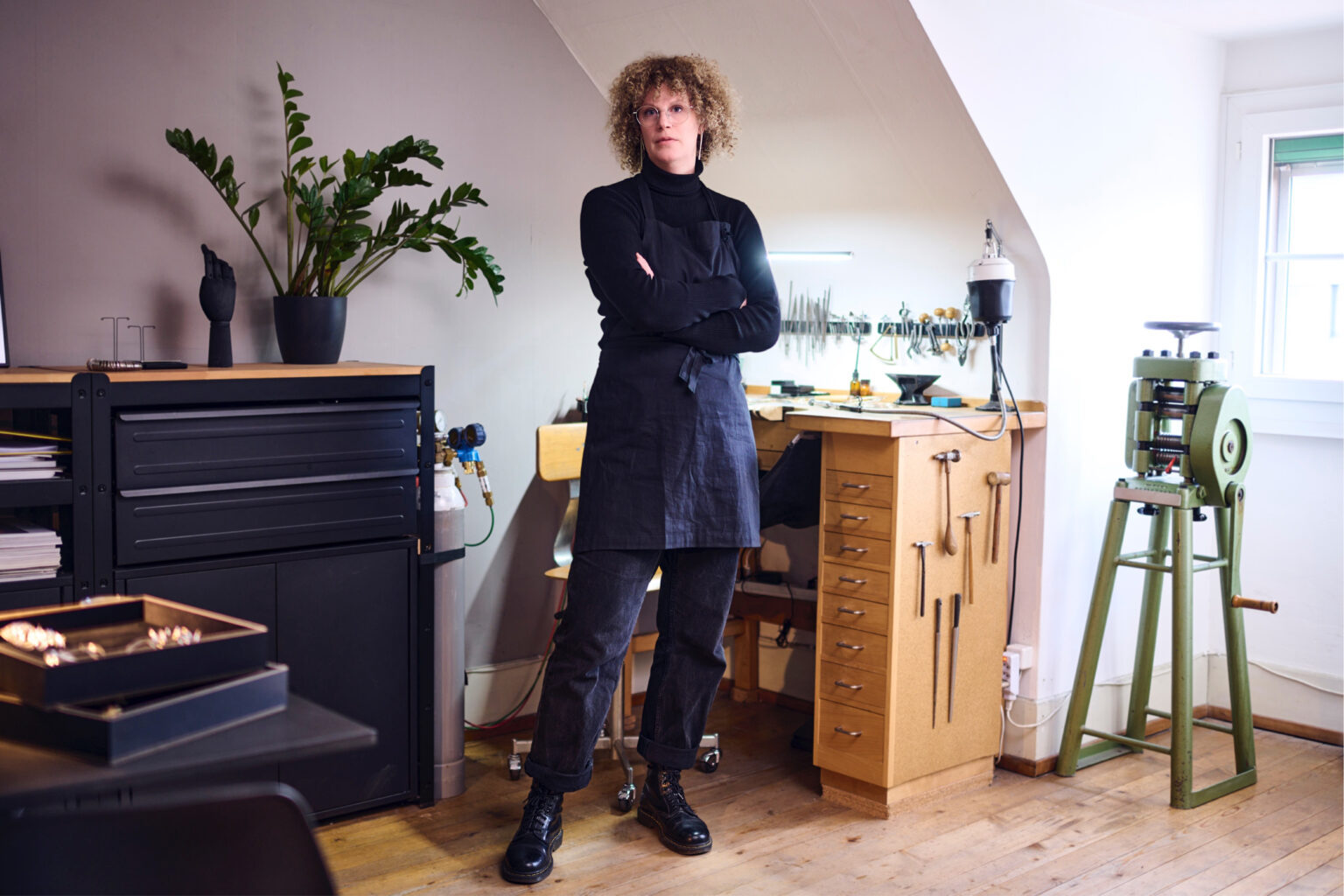
Sarah Küffer shapes gold and silver as if they were soft, responsive matter, bending and guiding them into fluid, sculptural lines. Each piece feels caught in transition—a quiet tension between movement and stillness, where strength unfolds into something more. Her forms echo the gestures of nature and logic of architecture. Working in small series with recycled precious metals, she lets each piece emerge through the act of making.

© Courtesy of the artist
Which place do you currently call home and where do you work on your projects?
I live in a charming old townhouse dating back to the 19th century, located in the lively Länggasse district of Bern. Each district in Bern has its own unique character, and the Länggasse is often referred to as the “University Quarter”, as most of the institutes of the University of Bern are located here. Along the neighborhood streets, there are plenty of small shops, restaurants and cafes that invite you to linger. My goldsmith studio is located in the historic Junkerngasse in the Old Town of Bern. This alley is part of the UNESCO World Heritage Site and is considered one of the best-preserved medieval city quarters. My studio is situated directly opposite the impressive “Erlacherhof“, the seat of the Bernese government, and is set in one of the oldest sandstone buildings of the city.
In my goldsmith studio, I design and craft contemporary jewelry with a clear, distinctive formal language. By shaping, bending, and twisting gold and silver, I create sculptural pieces—bold and expressive, yet also graceful and mysterious. Creating a piece of jewelry with my own hands, shaping precious metal into its perfect form, and making a statement through it—this is what makes craftsmanship the perfect profession for me. All the pieces I design and produce in small series directly in my studio. I use only precious metals certified by the Responsible Jewellery Council (RJC) in London, which guarantees the use of recycled silver and gold.
Do you have a favourite place in your area where you like to relax and linger?
Everyone should experience swimming in the Aare on a warm summer day at least once. The Aare is the longest river of Switzerland and originates from two glaciers in the eastern Bernese Alps. In the summer, locals either flock to the well-known river pools (Marzili, Lorraine, Muri, Eichholz) or grab their waterproof Aare bags and drift to the next pop-up bar by the river for an “apéro” drink after work.
When I like to spend a whole day by the Aare on weekends, I often go to the Zehndermätteli restaurant, which offers long-term unemployed individuals with performance limitations a chance to reintegrate into the workforce. Near the restaurant, there is a small beach from where you can drift in the river for about 20 minutes and enjoy nature. Afterwards, you can return to the starting point through a 200-meter-long tunnel and either dry off in the sun or plunge back into the refreshing water directly.
In winter, I often take the funicular to the local mountain Gurten. From there, you have a great view over the city all the way to the Alps with the famous mountains Eiger, Mönch and Jungfrau. While the city is shrouded in fog, the Gurten often enjoys bright sunshine and overlooks a magical sea of fog below.

© Photo: Stephen H,Unsplash
Are there any urgent political issues or problems in your region?
One of the most pressing issues currently concerning the Swiss population is climate change. Most Swiss people see it as a significant problem requiring immediate action. Particularly concerning are the melting glaciers in our country. Our reliance on hydropower for generating renewable energy is increasingly jeopardized by the decline in winter snowfall.
In your opinion, what has developed well in the last 5 years—and what has not?
Bern, the most politically leftist city in Switzerland, has made significant progress in recent years. Numerous new bicycle paths have been constructed, and green spaces have been created. Thanks to these developments, Bern is often referred to as the “Bike City,” as one can effortlessly and safely traverse the entire city by bicycle and find oneself amidst greenery within minutes. An excellent way to explore Bern by bike is the “Unesco Tour,” which takes you through various Bernese neighborhoods. On the final stretch of the route, you ride through the refreshing Bremgarten Forest.
Another notable improvement concerns the water quality throughout Switzerland. There are few cities where one can swim in rivers without concern. Lake Brienz in the canton of Bern is the clearest lake in Switzerland, with water so clean that one could drink it directly from the lake.
One aspect that has not developed for the worse, but has seen insufficient progress so far, is the equality of people with disabilities. Due to its status as a UNESCO World Heritage site, characterized by medieval sandstone buildings, arcades, and long stairs, the city of Bern is subject to heritage conservation regulations. This often makes it very difficult for people with disabilities to visit. I see significant potential for improvement in this area in the coming years.

© Photo: Kevin Oetiker,Unsplash

© Photo: Lawrence Krowdeed,Unsplash
Do you know a hidden gem when it comes to local manufacturers—whether it’s arts and crafts, sustainable products or food?
Of course, as a Swiss person, I naturally love cheese. That’s why I’d like to recommend a truly exceptional Swiss cheese. “Jumi“ is a Bernese family cheese dairy that is widely known beyond the Münstergasse Market for its cheese and meat specialties. Jumi’s most renowned product is the “Belperknolle,” a fresh cheese encased in pepper, which can be shaved like a truffle and used as a topping for pasta and salad dishes.
Is there anything particularly innovative in your region? Also in comparison to other places you have already visited?
The “Reitschule”—or as many call it, the “Reithalle”—was occupied by left-wing autonomous people in October 1987 and has not been released since. Since then, the location has been a cultural and political center and a non-profit meeting place in Bern, largely run autonomously and on a grassroots democratic basis. The Reitschule premises house various facilities, including a restaurant (Sous le Pont), a bar (Rössli), a printing press, a woodworking shop, a feministic retreat, a house newspaper, a cinema, and a theater. Additionally, there are three venues: Grosse Halle, Dachstock, and Cafete, where concerts, exhibitions, and flea markets regularly take place.
Do you have a secret restaurant tip that you would like to share with us?
Apfelgold is a charming little café in the Länggass neighborhood that feels more like a cozy living room than a typical café. With its vintage furniture, wooden interior, books, and large floor-to-ceiling windows, it creates a bright, warm atmosphere and is definitely a place to linger.
I mainly come here for the incredibly delicious cakes and desserts, as well as the excellent coffee. The seasonal creations—usually around 8 to 12 different cakes—are beautifully displayed at the counter, making it almost impossible to choose just one. Still, I usually go for the apple cake—and no, this is not your ordinary apple cake; it’s pure apple heaven.
Is there a local shop whose products are only available in your region?
In Bern, there are many small shops with local production. But my favourite place to go is the “Märit” on Saturday mornings in Münstergasse in Bern, which is very close to my studio.
The stroll through the market stalls to Münsterplatz is a feast for the eyes and taste buds, complemented by a wide variety of smells and aromas. Cheese makers and butchers compete for the highest possible quality of dairy products and meat. But the most intense scent emanates from a small cart located in the lower third of the market on the left side. A divine, sweet aroma of “Nydlechueche” (cake made from yeast dough and cream) rises in hot swirls from the mobile oven. Buying a slice of this local speciality and indulging in it is a delightful experience.
My favourite clothing store in Bern is TOKU, which is also located in the old town. TOKU only sells selected Swiss labels, including my jewellery. TOKU understands fashion as pleasure and joy, play and expression, enjoyment and preciousness. That’s why the store only sells selected, locally produced, high-quality pieces that are created with time, finesse and craftsmanship.

© TOKU

© TOKU
What are your 3 favourite apps that you use every day and couldn’t live without?
For professional reasons, I primarily use Mail and Instagram.
But aside from that, I often use Ron Orp. This app shows me the gems of everyday life. Concerts, art, parties, food, drinks, shopping, media, movies, people, conversations, projects, and whatever else is happening in Bern. In the summer, I often use the Aare Guru app. Here I get information about weather and water temperature for river swimming in the Aare.
A third and my absolute favourite app is Camera+. With it, I can take wonderful macro shots of the smallest things that are otherwise overlooked in everyday life.
Do you have any favourite newspapers or online magazines? And how do you keep up to date with politics or social and cultural issues?
To stay informed about world incidents, I almost daily watch the news on Swiss television. As a very visual person, it’s important to me not only to receive information but also to see the accompanying images to get a sense of the situation.

© Norbert Aepli, Switzerland, Zentrum Paul Klee Bern 10, Adjusted colours, CC BY 2.5
Imagine you could be mayor for a year—what would you change?
As mayor, I would make Bern a car-free city and only allow cycling and public transport wherever possible. Car parks could be converted into green spaces, parks and gardens. They could not only serve as places of retreat for residents, but also help to reduce the rising temperatures in the city.
One last question: If you could choose another place to live—regardless of financial or time constrains—which one would you choose?
There is only one thing I miss here in Bern and that is the sea. When I watch the waves of the sea and hear the sound of the surf, I feel more relaxed. That’s why I would choose Copenhagen in Denmark, a city by the sea that is very similar in character and people to Bern. Since I was fortunate enough to live in Copenhagen for a year already, it has become like a second hometown to me.

© Courtesy of the artist

© Courtesy of the artist

© Courtesy of the artist


