

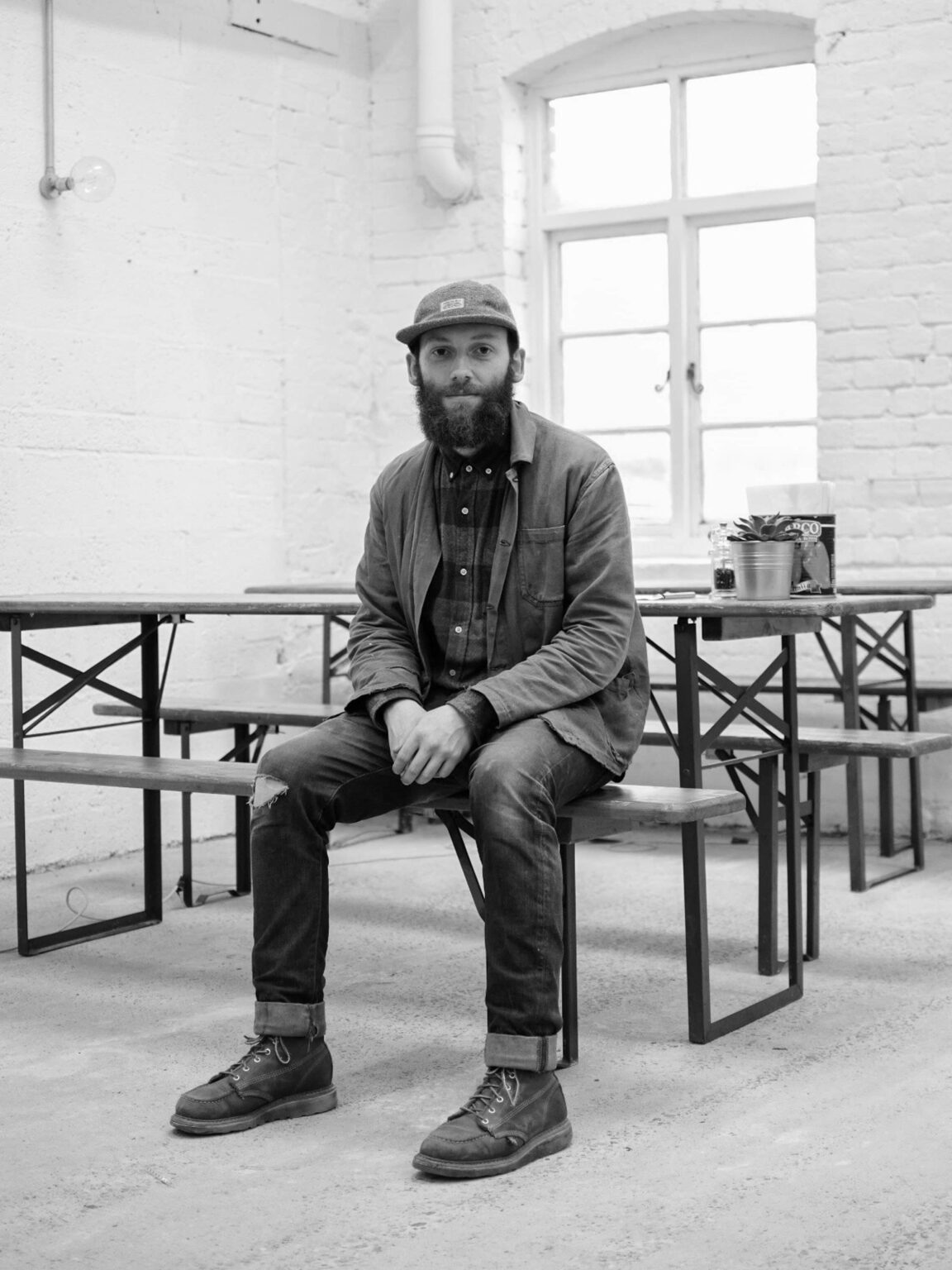
Matthew Moore doesn’t define himself by a signature aesthetic: his strength lies in designing the process that transforms an idea into reality. His approach can be described as “design as facilitation”—bringing together materials, people, and contexts to create objects that are both functional and quietly surprising. Rather than imposing a fixed style, he focuses on the conditions that allow design to emerge organically, from the dialogue between concept, craft, and use.
His projects are as diverse as they are inventive. Recent work ranges from converting a polytunnel into a pop-up classroom to designing a wall system for a local museum, alongside the production of custom desks for a creative office space. For Matthew, each new project is an opportunity to explore a completely different challenge, keeping his practice dynamic and ever-evolving.

© MJM Bespoke Fabrications
Which place do you currently call home and where do you work on your projects?
I live in Stirchley, a quiet residential area about 4 miles south of Birmingham city centre. My projects take shape in Digbeth, a neighbourhood where a creative community meshes together with the city’s industrial past and where development is rife. Property people have got their eye on it, but I don’t see the industry or the arts moving away for a long time yet.
Where is your studio located & how does it look?
My studio is located in Digbeth, an industrial suburb just outside of the city centre.
This area has been adopted by artists, craftspeople and small businesses who are starting up: it feels like a place full of experimentation and folks who are “having a go at something”, alongside people who’ve been doing that for years and run established businesses. It’s a useful area to be in for my work, because I’m not far from other fabricators so if I need a bit of metal shaping or something galvanised or some spray finishing done I can get all of that stuff within a stones throw of my studio space.
The studio itself is a small building on an industrial estate called Minerva Works, which is a site that typifies what the area is like. My neighbours include a couple of art galleries, a dance studio, a dress shop, another joinery studio, a recording studio, a personal training gym and a CEE community space. Within the studio is everything I need to make the broad range of custom furniture that my clients need. We’ve got all the typical woodworking equipment but there isn’t a production line setup because every project is different, so sometimes we start by creating a load of parts on the CNC router, and sometimes it’s solid timber getting pushed through a thickness planer.

© Courtesy of the artist
Are there any projects that are personally important to you—whether recently completed or currently in progress?
Every project we undertake is meaningful. I’m far more motivated to create things that matter than by other factors like making money—I’m a terrible businessperson because I always prioritise feeling over everything else. I romanticise the wardrobes we make because of the memories that clothes can hold, and the kitchens we’ve built because I love to cook and know how much joy those spaces contain too. But some projects hold an especially dear place in my heart.
During the Commonwealth Games we collaborated with a gallery, an artist, and a women’s group to create a refuge space and healing garden along the canalside in Digbeth. The space functions like a Scottish bothy—an open-access retreat where members of the group can rest and recharge. It’s a gorgeous, peaceful space. Last year, I also worked on a project very close to my heart: refurbishing and fitting out the Industrial Gallery at the Birmingham Museum and Art Gallery. I grew up visiting BMAG and spent countless hours running around the displays and staring into the cases as a child, so being able to help reframe and modernise that collection’s story is something I’m incredibly proud of.

© MJM Bespoke Fabrications

© MJM Bespoke Fabrications
Do you have a favorite place in your area where you like to relax and linger?
One of the things I love about South Birmingham is that there’s no shortage of green space. Despite the perception of Birmingham as a big, concrete industrial powerhouse, the city launched a tree-planting programme in the late 1800s that remains the longest-running in Europe. Birmingham actually has more green space than any other European city.
That said, I’m very much a city person, and what I like about the green space here is that it’s woven into the suburbs. My favourite area is Balsall Heath, a neighbourhood rich in migration and cultural diversity. It’s incredibly vibrant and home to some of the best food you’ll find anywhere in the city.

© Nine Elms Road and Balancing Pond, Stirchley by Paul Collins, Nine Elms Road and Balancing Pond, Stirchley – geograph.org.uk – 7839507, adjusted colours, cropped, CC BY-SA 2.0
Are there any urgent political issues or problems in your region?
Politically, Birmingham isn’t without its challenges. For a long time, it was a left-wing stronghold, but our city’s politics—like much of the country—have started to lean further right. We still have a majority left-wing council, yet in 2023 the city was declared bankrupt.
The effects of that have been deeply felt, especially by municipal workers who’ve borne the brunt of funding cuts. We’ve recently seen strikes over reductions to waste collection services, which I fully support. The root of the problem lies in long-term funding neglect from central government—and when the council’s politics sit in opposition to Westminster’s, that tension only deepens the crisis.
In your opinion, what has developed well in the last 5 years—and what has not?
I think in recent years Birmingham has done a much better job of bigging itself up. We’re a self-deprecating bunch and for a long time the city was the butt of jokes. But the success of TV shows set here, along with hosting the Commonwealth Games, has given Brummies something to feel publicly proud about—even though there have always been things to be proud of. We’re just getting better at recognising them.
So many world-changing things were invented in Birmingham: the first postage stamp, the pacemaker, Cadbury’s chocolate, Heavy Metal music, even X-rays. Mass production itself began here, at the Soho Manufactory—later the Soho Mint—where Matthew Boulton saw coinage as an opportunity to bring art to the people. He commissioned artists to design the ‘tails’ side of coins. With these being produced in immense quantity, it was an incredibly diplomatic way to disseminate something with creative beauty to people throughout the country.
We could still be better at shouting about our past—it’s so rich, layered, and fascinating—but our global soapbox is still a little short.

© Ted and Jen, Digbeth GWKWalk 1110, adjusted colours, CC BY 2.0

© Birmingham Botanical Gardens by Roger Kidd, Birmingham Botanical Gardens – geograph.org.uk – 3481150, adjusted colours, CC BY-SA 2.0
Do you know a hidden gem when it comes to local manufacturers—whether it’s arts and crafts, sustainable products or food?
There’s no shortage of amazing creative work happening in Birmingham. One of the reasons I love Digbeth is that, alongside its industrial backdrop, it’s full of creative spaces. Just a stone’s throw from my studio are two fantastic galleries, Grand Union and Eastside Projects, and within this suburb alone, four or five festivals take place each year. Highlights include the Flatpack, with its immersive cinema experiences, and Supersonic, which champions experimental and new music.

© Patrick Dandy

© Eastside Projects
Is there anything particularly innovative in your region? Also in comparison to other places you have already visited?
What I love most about Birmingham, though, is its diversity, which is one of its greatest strengths. The city has always attracted people from around the world, making it vibrant and multicultural, enriched by the many communities that call it home. Of course, this journey hasn’t been without hardship—many marginalised groups have faced, and in some cases continue to face, challenges. Yet what stands out to me are the everyday acts of solidarity and the cultural richness found in our food, music, languages, and identities. Birmingham feels special because of that remarkable diversity.
Do you have a secret restaurant tip that you would like to share with us?
My friends ridicule that I tend to gatekeep all my favourite restaurants, but I think that the best place to eat in Birmingham is Bayt Al Yemeni.
Is there a local shop whose products are only available in your region?
There’s an incredible shop called Provide, along with its sister company, Brumbox, which sell clothes, homewares, and gifts—all rooted in the city’s identity. I also love Studio Outlet, an online store showcasing the work of local artists. Both are my go-to spots for buying gifts.

© Brumbox

© Provide
What are your 3 favourite apps that you use every day and couldn’t live without?
– Spotify
– Instagram
– Substack
Do you have any favourite newspapers or online magazines? And how do you keep up to date with politics or social and cultural issues?
I actually get a lot of my politics from social media, since it feels like an accessible way to find sources that aren’t overly edited or biased. My friends are always sharing articles about what’s happening in the world.
When it comes to online magazines, I love Vittles, a food-writing platform on Substack. I appreciate their style and attitude—it’s a unique space for opinions and insights that stray from both the monocultural influencer approach and old-school journalism. Their articles always read like exercises in having your own opinion and believing in it, which has taught me a lot.

© Very Quiet, Birmingham Town Hall from Chamberlain Square, adjusted colours, CC BY-SA 2.0
Imagine you could be mayor for a year—what would you change?
I’d love to democratise and prioritise our public transport system, which currently feels disjointed and fragmented. I only learnt to drive three years ago and still don’t rely on a car—in fact, I sold mine earlier this year. Birmingham has trams, buses, and trains, but they’re run by three separate providers, each with its own fees and payment platforms.
London’s system is far more integrated, and I’d love for Birmingham to reach the same level. I don’t usually like to praise London, but in this case, it’s hard to ignore.
One last question: If you could choose another place to live—regardless of financial or time constrains—which one would you choose?
I’m fickle about this because wherever I went last is always my favourite place. That said, I spent some time around Christmas last year in Mexico City, and earlier that year a week in Marrakech. I think about both of those places at least once or twice a day now, and could see a future for myself in either—though I couldn’t choose between them.


