

“I have to say that I have never traveled to a country where the external perception and my personal experience on the ground differed as much as in Saudi Arabia.” Lutz Jäkel should know. The Islamic scholar and historian grew up in Istanbul, lived in Syria and Yemen for many years, and speaks Arabic.

© Lutz Jäkel
“A country full of mysteries”
Saudi Arabia evokes completely different associations, especially in the Western world. Quite a few of them are negative. The murder of Jamal Khashoggi is still fresh in people’s minds. Even many years after the brutal murder of the Saudi journalist the path to justice for this crime is still completely blocked. Instead, the Saudi authorities continue their relentless crackdown on people exercising their right to freedom of expression with impunity.
Amnesty International, for example, continues to call for an international, independent, and impartial investigation into Khashoggi’s murder in order to identify all those involved in the crime, regardless of their rank or status, and to ensure that those suspected of responsibility for this act are brought to justice in fair trials. However, the Saudi leadership is blocking the investigation.

© Lutz Jäkel
Many things are different in Saudi Arabia, and not all of them are developing in a positive direction (from a Western perspective). According to Amnesty International, the number of death sentences has risen in Saudi Arabia. Last year alone, more people were executed in the country than in any year in more than 30 years. According to the human rights organization Amnesty International, the number of executions in Saudi Arabia is rising at an “alarming rate.” According to a report by the organization, many of those executed in recent years were foreign nationals convicted of drug offenses. They were mainly people from Pakistan, Syria, Jordan, Yemen, Egypt, and Somalia.
“We are witnessing a truly appalling trend in which foreign nationals are being executed at an alarming rate for crimes that should never carry the death penalty,” said Kristine Beckerle, who is responsible for the region at Amnesty. Behind the “progressive image” that the country wants to project worldwide lies a “dark and deadly reality.” Well, what or who is Saudi Arabia?
“I want to show how diverse this country is.”
Saudi Arabia—a country that was virtually inaccessible for decades—has been gradually opening up to tourism and the global public since 2019. Islamic scholar and photojournalist Lutz Jäkel documents this very change with a clear eye, empathy, and journalistic precision in his moving photo reportage. Set in a region full of myths and tensions, this illustrated book tells the story of courageous women, traditional values, parties behind closed doors, and new freedoms.
When Saudi Arabia, which had been closed off until then, suddenly started issuing tourist visas in 2019, Jäkel wanted to see for himself and travel around the country. But it wasn’t until 2023 and again in 2024 that he was able to do so. Today, Saudi Arabia is more than ever a country of contrasts: on the one hand, there is Crown Prince Mohammed bin Salman’s (MbS) desire to open up the country and relax restrictive rules; on the other hand, as mentioned, there are currently more executions than ever before.

© Lutz Jäkel
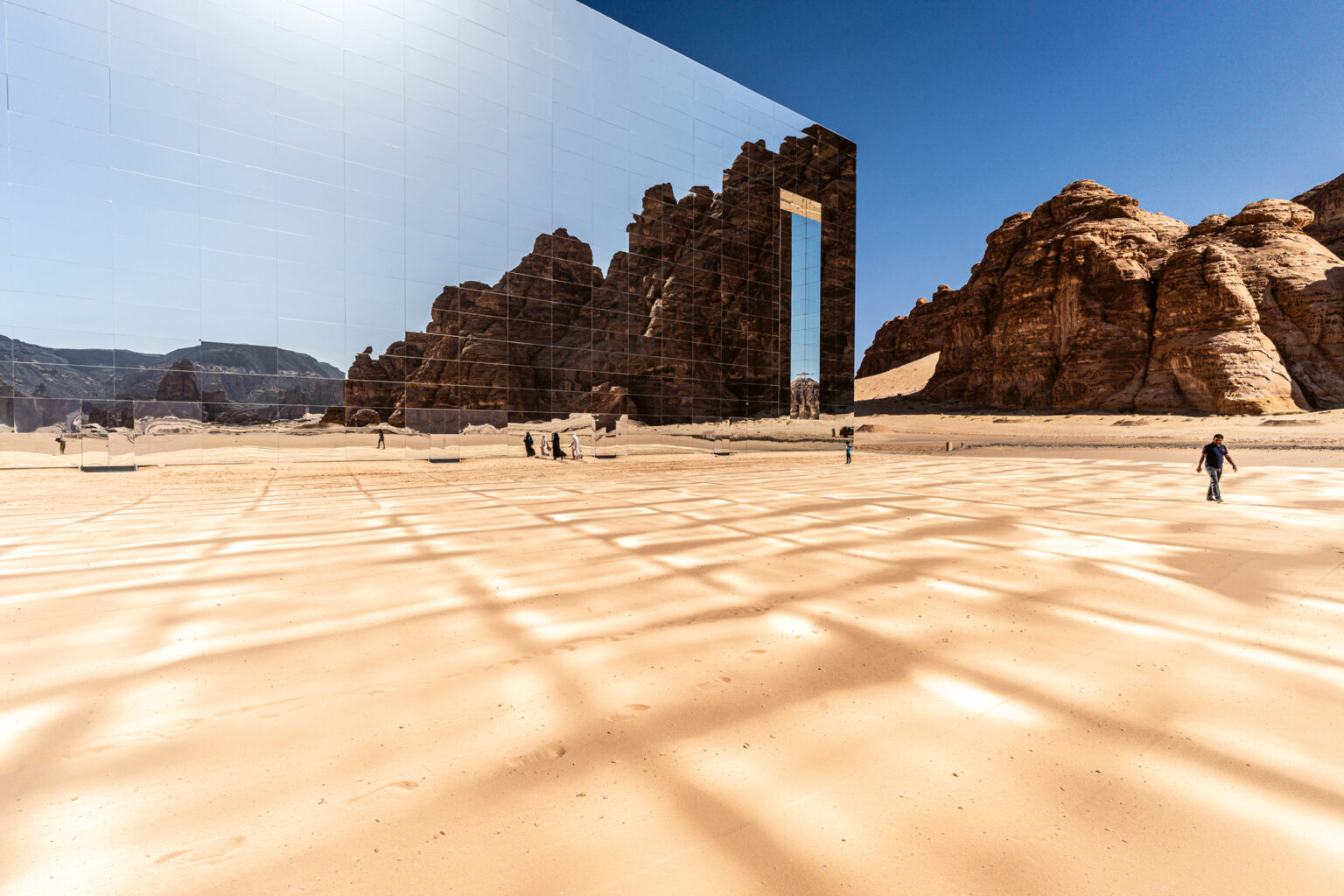
Right at the beginning, he shows the reader breathtaking images in his photo essay. From the air, we see a huge rocky plateau bathed in warm light, which suddenly ends abruptly. “Edge of the World,” as the Saudis call this place two hours’ drive north of Riyadh. Or the Maraya, a concert hall in the middle of the desert, the largest mirrored building in the world, which seems to dissolve through its reflections—built in just ten weeks.
Jäkel wants to show how diverse this country is, in a way he himself never expected, he says. Until 2019, Saudi Arabia was only open to Muslim pilgrims or businesspeople. Then came the change: when we talk about the transformation process in Saudi Arabia, we are talking about a profound social change in this country—but not about political freedoms.

© Lutz Jäkel
Lutz Jäkel travels 8,000 kilometers by car through the country, which consists largely of desert—but has so much to offer. He takes an estimated 10,000 photos, but only around 200 make it into the book. We see endless desert landscapes from a bird’s eye view taken by drone, mountain ranges mainly towards the west. But we also see many green parks and gardens, such as in Hail in the north.
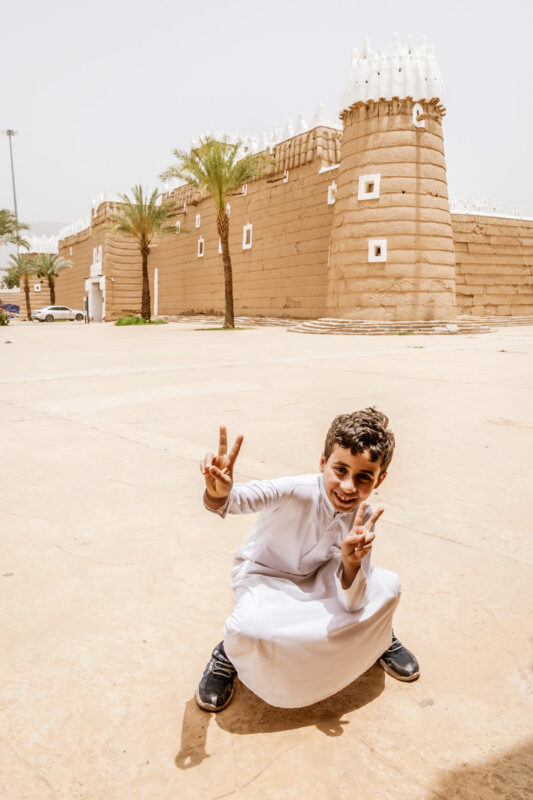
Jäkel not only takes photographs, he also listens to people. His pictures are accompanied by experiences and conversations. Jäkel gets very close to people, showing them in everyday situations: shopping, praying, celebrating, in cafés or in one of the countless squares. It is precisely these encounters on location that bring him and us, the viewers, particularly close to this undiscovered country. Like the moment when the photographer finds himself at a big techno party. Invited by DJane Cosmicat, he photographs her at an oversized mixing desk made of turntables and controls—behind her, a futuristic stage set with red neon lights and huge LED screens.
Positive developments?
In any case, Saudi Crown Prince Mohammed bin Salman has already shown himself to be fundamentally open to improving relations between his country and the Arab countries in the Middle East and Israel. During a meeting with US President Donald Trump at the White House, he held out the prospect of becoming part of the Abraham Accords for the normalization of relations. However, in this context, he insisted on a two-state solution, according to which there should be an independent Palestinian state alongside Israel. Israel rejects this, however. It is therefore unclear whether relations with Israel will actually be normalized.
Saudia Arabia also makes an impact abroad through its targeted investments in sport. Crown Prince Mohammed bin Salman’s comprehensive reform plan, “Vision 2023,” aims to free the country from its dependence on oil and strengthen new economic sectors such as tourism, technology, and culture. In recent years, Saudi Arabia has also become a hotspot for international sporting events: in addition to the highly lucrative Saudi Cup horse race, highlights have included the Diriyah Tennis Cup, the WTA Finals, Formula 1 races, martial arts events, and the new LIV Golf competition.

© Lutz Jäkel
All in all, these are obvious prestige projects, but they are also bringing about social change. Women, for example, are now granted many more rights. There is no longer gender segregation in public, and there is no longer a requirement to wear a veil.
Jäkel takes us on a journey through Saudi Arabia—from the Abhas Mountains to the oasis city of al-Ula. He meets Amina, who manages a modern café despite wearing a niqab, and cruises through Khobar with Harley riders. He meets the kingdom’s first female DJ, listens to the muezzin in Medina, travels through spectacular mountain regions, and visits historical sites. This travel report is more than a travelogue—it is an intimate narrative about a country that is reinventing itself.
About Lutz Jäkel
Photojournalist Lutz Jäkel, who also works as an author, storyteller and lecturer, studied Islamic Studies and History in Hamburg and has lived for a time in Damascus (Syria) and Sanaa (Yemen). He grew up in Istanbul, later travelled the world and captured his experiences in words and pictures. His photos and reports appear in books, magazines and newspapers such as Der Spiegel, National Geographic, GEO, Süddeutsche Zeitung and many others.

© Lutz Jäkel, Knesebeck
Saudi Arabien – In einem Land voller Kontraste
(Saudi Arabia: In a country full of contrasts. Only in German)
Pages: 192
Price: 35,00 EUR
ISBN: 978-3-95728-897-4
Publisher: KNESEBECK
Shop: KNESEBECK