

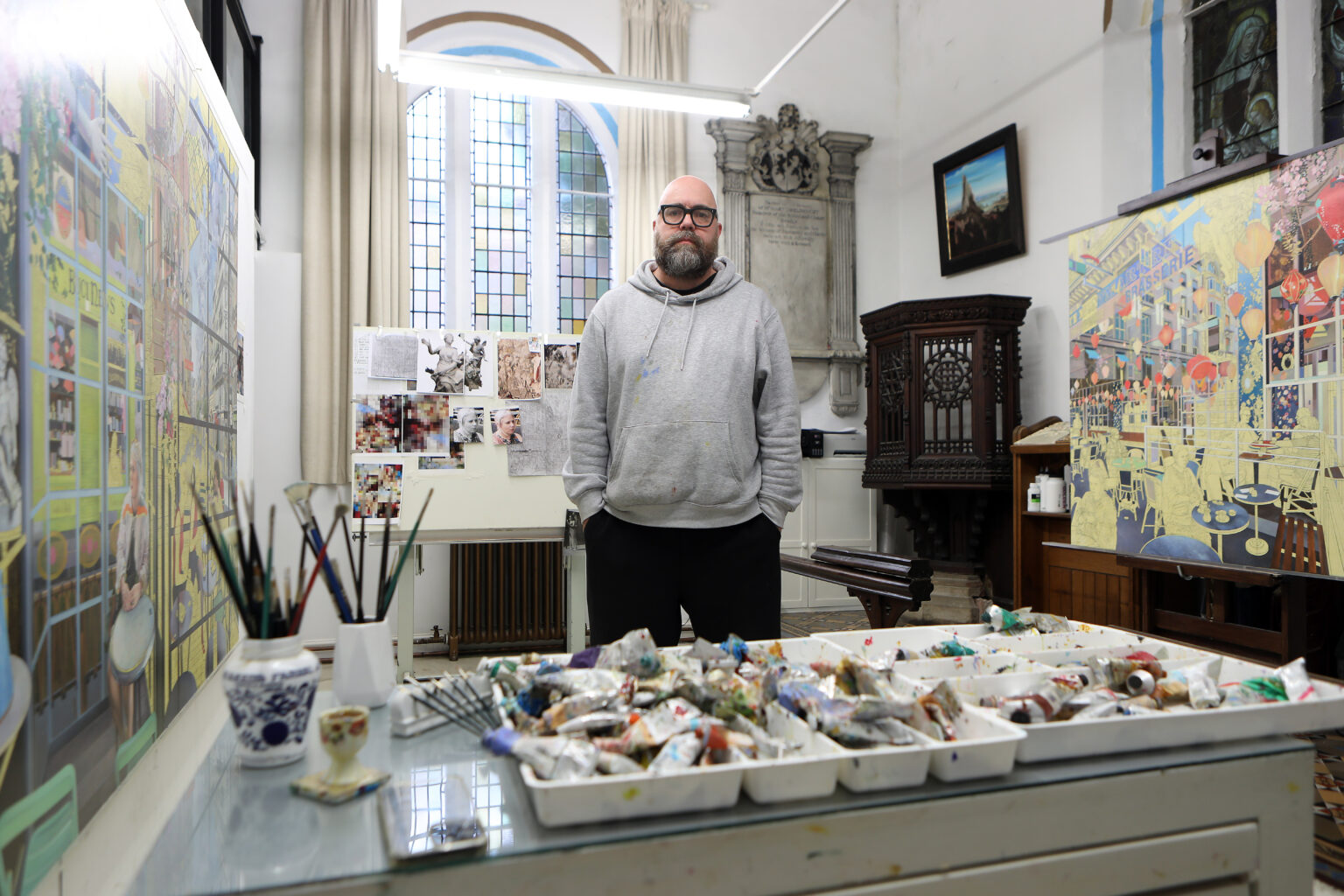
Nathan Walsh creates his paintings from hundreds of photographic studies, drawings and perspective constructions, combining them into urban scenes that are both meticulously realistic and subtly reinterpreted. The inspiration for his work stems from his studio, which is located in a converted Welsh chapel and houses a collection of numerous historical artefacts, including stained glass windows and stone tiles. By redrawing and reconstructing urban spaces, he explores the boundaries of perspective and perception, giving viewers access to a city that looks real but behaves like a parallel version of itself.

© Keith Freeburn Photography
Which place do you currently call home and where do you work on your projects?
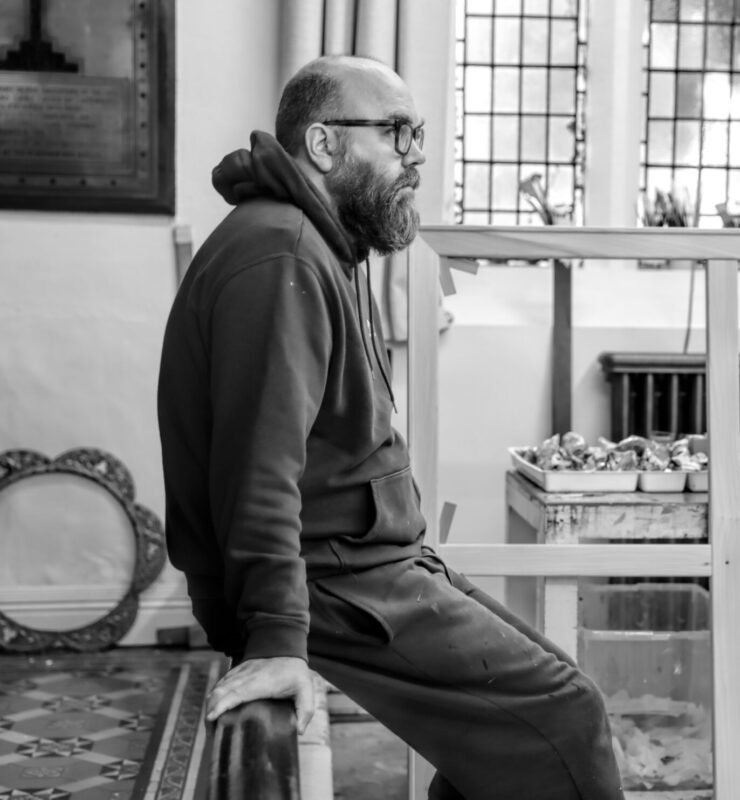
I live and work in an eighteenth-century Welsh Methodist chapel in Wrexham, North Wales. The building’s tall arched windows and soft, shifting light lend the space a contemplative atmosphere. Over time, it has become an extension of my studio and of my wider interests—from a collection of Frank Brangwyn etchings and art monographs to taxidermy and pieces of Georgian and Jacobean furniture. These surroundings feed directly into my practice, providing a physical and imaginative framework for the layered, reflective paintings I make.

© Friedrichs Pontone Gallery NYC
Where is your studio located & how does it look?
My studio occupies the main chapel hall, retaining its original pulpit, stained glass windows, and plaster ornamentation. The combination of high ceilings, pitch pine panelling, and filtered natural light allows me to work on large, complex paintings. Many of the objects within the building from carved oak chairs to a found print—contribute to an evolving conversation between history, observation and invention.
Are there any projects that are important to you personally, that you have recently completed or that you are still working on?
I think since the pandemic my work has become increasingly personal in nature. I am currently developing a series of multi-layered paintings inspired by time spent in Paris. These works are deeply personal, reflecting shared experiences of travel and everyday life with my wife. They explore how memory, observation, and imagination overlap—how a city, a moment, or a gesture can exist both as lived experience and as recollection. The paintings incorporate visual fragments from streets, interiors, and cafés, interwoven with literary and art-historical references that have long influenced my practice. Each work evolves slowly, through layering and revision, much like memory itself.
In this sense, the Paris project is as much about home as it is about travel. It connects places and relationships, grounding moments of movement and change within a larger continuum of reflection and making.
© Courtesy of the artist

© Simon Bart Gallery Italy
Do you have a favorite place in your area where you like to relax and linger?
My favourite place to relax is in the garden surrounding the chapel. It’s a quiet, enclosed space that catches the light throughout the day, and it’s shared with the four cats who live here. There’s a quiet rhythm to the place that balances the intensity of working in the studio—time spent observing, adjusting, and noticing small changes. It’s not a retreat as much as another form of looking, just with fewer expectations.
My work is by its very nature labour intensive. Sundays are therefore an important day out of the studio, and I often explore the landscapes around Wrexham. I enjoy visiting historic buildings, National Trust properties and gardens. These outings provide space to think about my work from a different perspective.

© By Phil Nash from Wikimedia Commons CC BY-SA 4.0 & GFDLViews, Liverpool Anglican Cathedral from Hope Street, adjusted colours, CC BY-SA 4.0
Are there any urgent political issues or problems in your region?
North Wales faces challenges such as housing affordability, economic development, and environmental conservation. At the same time, the region has a rich cultural and historical heritage—from Welsh language and traditions to historic towns and industrial legacies—that communities are keen to protect.
In your opinion, what has developed well in the last 5 years—and what has not?
Wrexham has changed noticeably in recent years. The rise of the football club has brought a renewed sense of optimism and visibility to the town, and with it a broader recognition of North Wales as a place with its own identity and ambition. The success of local initiatives—from community-led arts spaces to small independent businesses—has created a more confident atmosphere. There’s a genuine sense that the region is beginning to value its own cultural and creative resources rather than looking elsewhere for validation.
What hasn’t developed as well is the infrastructure to support this growth. Many of the area’s strengths—its landscape , history, and language — rely on small groups or individuals to keep them visible. That balance between energy and fragility defines much of North Wales at the moment: a place full of ideas and potential, but still needing sustained support to make them last.

© Erddig by Philip Halling, Erddig – geograph.org.uk – 4801095, Adjusting the colours and size, CC BY-SA 2.0

© Thatched Folly in the gardens at Erddig Hall by Petra, Thatched Folly in the gardens at Erddig Hall – geograph.org.uk – 7960532, adjusted colours, CC BY-SA 2.0
Do you know a hidden gem when it comes to local manufacturers—whether it’s arts and crafts, sustainable products or food?
My favourite spot is Llandysilio Island in the Menai Strait, on the shores of Anglesey, to which it is attached by a short causeway that is reachable only on foot. Its combination of an ancient church, water, woodland, and open sky offers a quiet, almost suspended quality—a place where the rhythms of the natural world feel intensified.
Is there anything particularly innovative in your region? Also in comparison to other places you have already visited?
Innovation in North Wales often takes a quieter form. It’s less about large institutions or rapid change, and more about how people adapt existing traditions to contemporary life. You see it in how craftspeople, designers, and small studios rework local materials and methods, finding new uses for old skills. There’s a kind of pragmatism to it—an ability to combine resourcefulness with aesthetic clarity.
In comparison to the cities I base paintings on innovation is less about scale and more about community-focused creativity that values material, craft, and sense of place.
Do you have a secret restaurant tip that you would like to share with us?
I’d say anywhere that serves Welsh Rarebit, which is a traditional dish of toasted bread topped with a rich, melted cheese sauce, often flavoured with mustard or ale. It’s simple, hearty, and deeply connected to the region’s culinary history.
Is there a local shop whose products are only available in your region?
Trefriw Wooden Mills is a place I often return to—a working woollen mill in the Conwy Valley that still produces traditional Welsh tapestry blankets. The machinery, much of it original from 1825 is still in use, and the rhythm of production feels largely unchanged. I’m drawn to the precision and geometry of the woven patterns—how they balance repetition and variation, order and improvisation.
There’s something very contemporary about the designs, even though they’re rooted in deep tradition. The colours and structures have the same kind of visual logic I look for in painting: formal, rhythmic, and tactile. Visiting the mill reminds me how strong the relationship between craft, design, and daily life remains in North Wales.

© Trefriw Wooden Mills

© Trefriw Wooden Mills
What are your 3 favourite apps that you use every day and couldn’t live without?
I could happily live without all of them!
Do you have any favourite newspapers or online magazines? And how do you keep up to date with politics or social and cultural issues?
World of Interiors, Archiectural Digest, Aesthetica, Anthology, and online Whitehot Magazine, Brooklyn Rail and sometimes the Art Newspaper. In terms of politics and social issues I try not to get too involved on a daily basis as it can get easily distracting.

© Mountain pool on the Fron-deg Flat by Geraint Roberts, Mountain pool on the Fron-deg Flat – geograph.org.uk – 5067959, adjusted colours, CC BY-SA 2.0
Imagine you could be mayor for a year—what would you change?
I seriously wouldn’t want that responsibilty and nor would anyone else.
One last question: If you could choose another place to live—regardless of financial or time constrains—which one would you choose?
Since the pandemic I’ve exhibited some of my work in Italy which has been a refreshing change. This has led to acquiring a property in Fiuggi about an hour from Rome. Fiuggi has a magical quality that feels very removed from contemporary life. In time I intend to develop the studio into a secondary studio or even an artists residency/writers retreat. I look forward to seeing how this project develops and spending more time in this beautiful country.


